

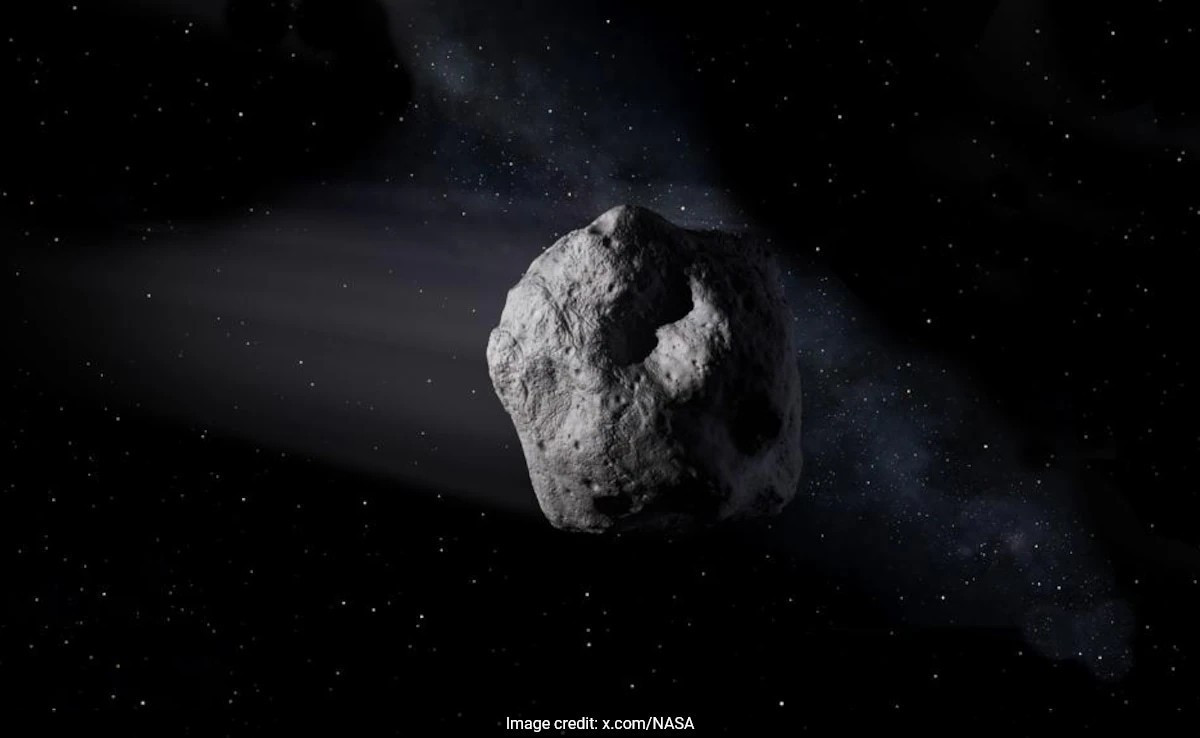
A newly published preprint study explores the risk that asteroid 2024 YR4, initially flagged for a possible Earth impact but later downgraded, still carries a roughly 4 percent chance of colliding with the Moon on December 22, 2032, potentially launching a flood of lunar ejecta into Earth’s orbit that could threaten satellites and astronauts; researchers argue that conventional deflection tactics may be impractical given uncertainties in the asteroid’s mass and the tight timeframe, and thus propose preparing for a nuclear disruption mission as a last-resort option.
Sources: Live Sceince, arXiv.org
Key Takeaways
– The chance of 2024 YR4 hitting Earth in 2032 has been revised downward dramatically—now effectively zero—but the possibility of a lunar impact remains at ~4 percent, enough to merit serious planning for mitigation.
– If the asteroid hits the Moon, researchers estimate it could free up to 10⁸ kg of lunar material, with as much as 10 percent of that reaching Earth’s environment, increasing micrometeoroid flux in orbit for days to years.
– Because of major uncertainties in the asteroid’s mass and structure, conventional deflection (kinetic impact) is judged risky; the study authors argue that a nuclear fragmentation or disruption mission may be our only viable path if the collision probability solidifies.
In-Depth
The discovery of asteroid 2024 YR4 in December 2024 immediately set off concern because early orbital fits suggested up to a 3.1 percent chance of an Earth impact in 2032. But subsequent observations trimmed that risk to virtually zero, meaning a direct strike is no longer expected. Still, the story is far from over. Recent work by Wiegert, Brown, Connors, Lopes, and others examines a “second-tier” risk: a collision with the Moon. Because the Moon lies close to Earth in gravitational influence, a lunar impact could launch dust, rocks, and debris (so-called ejecta) into cis-lunar space, potentially endangering satellites, the International Space Station, and other spacecraft. The study calculates that as much as 10⁸ kilograms of lunar material could become unbound, with up to 10 percent of it possibly reaching Earth orbits over the following days to years—raising the background micrometeoroid impact rate significantly above nominal levels.
Complicating our responses is the fact that the asteroid’s precise mass, structure, and internal density are highly uncertain—even its spectral classification is debated (R-type or Sa-type). Another paper, “The discovery and characterization of Earth-crossing asteroid 2024 YR4,” details observations using Gemini South and other telescopes to pin down its brightness, spin, and likely size (circa 30–65 meters, depending on albedo assumptions). And the “Preliminary Analysis into the Feasibility of Missions to Asteroid 2024 YR4” explores possible flybys, rendezvous, or deflection missions, emphasizing that favorable launch windows exist around 2028–2029.
Crucially, though, the Wiegert et al. study suggests that standard deflection strategies—where a spacecraft strikes the asteroid to nudge its trajectory—are too risky under current constraints. Because we don’t know its mass well, a miscalculated push could send it onto a more dangerous trajectory, possibly even toward Earth. Thus they discuss a more radical option: nuclear disruption, which means detonating an explosive device either on or near the asteroid to break it apart. While untested in practice, this method might be the only viable backstop if the probability of lunar impact becomes serious.
The researchers urge the planetary defense community not to treat this as a speculative “what-if” but as an opportunity: now is the time to design robust spacecraft architectures, simulation tools, and policy frameworks for nuclear disruption, should the risk mature. They underscore that defense planning must not be restricted to Earth-only risks but should incorporate the entire cis-lunar region. With the likely close passage in December 2032 drawing near, the astrophysics and space engineering community may soon have to make real decisions about when and how to intervene.