

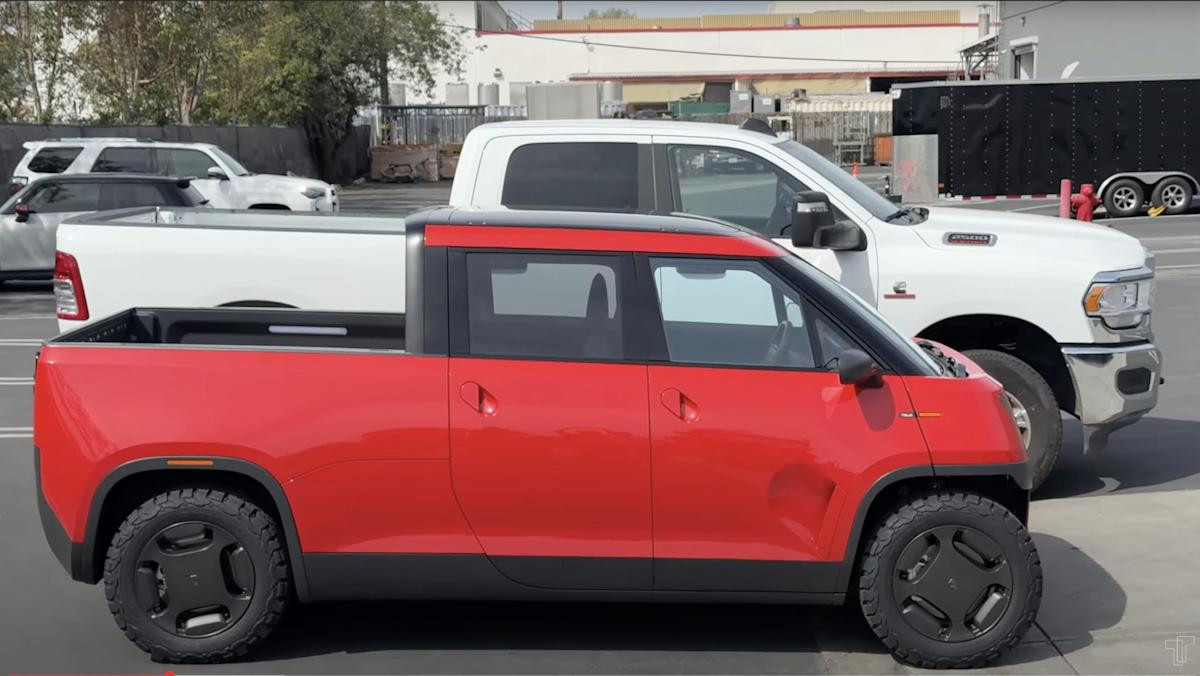
Telo, a California EV startup that wants to shrink the American obsession with large trucks, has raised $20 million in a Series A round to bring its compact electric pickup, the MT1, into production. The funding was co-led by industrial designer Yves Béhar and Tesla co-founder Marc Tarpenning, with participation from Marc Benioff, E12 Ventures, Neo, and others. Telo claims the MT1, which is about the length of a Mini Cooper yet seats five and carries a five-foot bed, is aimed at urban settings where size, efficiency, and maneuverability matter more than brute force. With more than 12,000 preorders already on the books — roughly $600 million in implied potential revenue — the company plans to build about 5,000 units per year via contract manufacturing, focusing its own team on design and safety engineering. Though the $20M war chest is modest by auto-startup standards and the road ahead is full of regulatory, manufacturing, and financial risks, Telo’s bet is that lean operations, sharp focus, and a differentiated product will let it avoid the fate of many EV challengers that burned cash chasing scale.
Sources: Reuters, Wilson Sonsini
Key Takeaways
– Niche over scale: Telo is deliberately not chasing mass-market volume; it aims for profitability with smaller output and contract manufacturing rather than building huge factories.
– Urban utility premise: The MT1’s compact footprint, five-seat layout, and real cargo bed are designed to serve urban use cases that traditional full-size EV trucks struggle with.
– High bets, high risks: While there’s strong demand on paper (12,000+ preorders), the capital challenge, crash testing, regulatory hurdles, and commercialization risks remain substantial, especially with only $20M raised so far.
In-Depth
It’s a familiar story in the EV space: big promises, ambitious goals, hat tipped to sustainability — and a mountain of risk in execution. But Telo’s pitch is a little different: instead of trying to out-monster the F-150s or Rivians, Telo wants to shrink the vision. The startup sees America’s affinity for trucks, and asks: what if that truck was compact, city-friendly, efficient, but still capable?
At the heart of the wager is the MT1 — a mini electric pickup roughly 152 inches long (similar to a Mini Cooper in length), yet engineered to seat five occupants and carry a usable five-foot bed. To hit that balance, Telo leans heavily on clever packaging, light structure, and battery design to attempt a driving range of up to 350 miles. In short, the company is selling what you might call “urban utility”: a vehicle that can live in tight spaces yet still pull its weight in cargo and passenger versatility.
On September 23, 2025, Telo announced a $20 million Series A funding round co-led by industrial designer Yves Béhar and Tesla co-founder Marc Tarpenning. Other backers include Marc Benioff, E12 Ventures, Neo, and several VC and angel investors. The company says those funds will be used to finalize the production-intent version of the MT1, homologate it to U.S. safety standards, finish crash tests, and get regulatory approval.
One striking detail: Telo isn’t planning to aim for hundreds of thousands of units in year one. Rather, it forecasts producing about 5,000 per year — at least initially — by outsourcing actual assembly to contract manufacturing partners. It keeps in-house staff lean (around 25 employees), focusing internal resources on design, battery, and safety engineering. The idea is that by staying small, agile, and capital-efficient, Telo can survive where bigger, cash-hungry EV bets have failed.
That said, the road ahead is razor-thin. $20 million is a modest sum in the capital-intensive world of auto, especially for going from prototype to certified production. Several past EV startups — like Canoo, Lordstown, Fisker, and others — raised hundreds of millions and still collapsed under scaling pressure. Crash safety is another central concern: a short front end (a necessity for compact dimensions) poses structural and pedestrian safety challenges. Critics will watch whether Telo’s crash testing and homologation are robust or corner-cut. On Reddit, skeptics are already debating whether $20M is even sufficient for full certification.
But there’s also reason for cautious optimism. The preorder demand (12,000+ units) suggests the idea resonates — at least with early adopters. The timing might work in its favor: large EV trucks have struggled in recent quarters (e.g. Cybertruck delays, F-150 Lightning sales softness), leaving room for fresh approaches. And urban mobility is under pressure from congestion, emissions rules, and infrastructure constraints, which favors compact, efficient alternatives.
In the end, Telo’s success will depend not just on clever engineering but flawless execution — from battery integration to chassis safety, from manufacturing partnerships to supply chains, and from meeting regulatory bar to managing cash burn. If they pull it off, they’ll not only prove a new form factor for American trucks — they might rewrite the rules of EV truck startups. If they fail, they’ll join the long list of promising challengers who dreamed big but faltered small.