

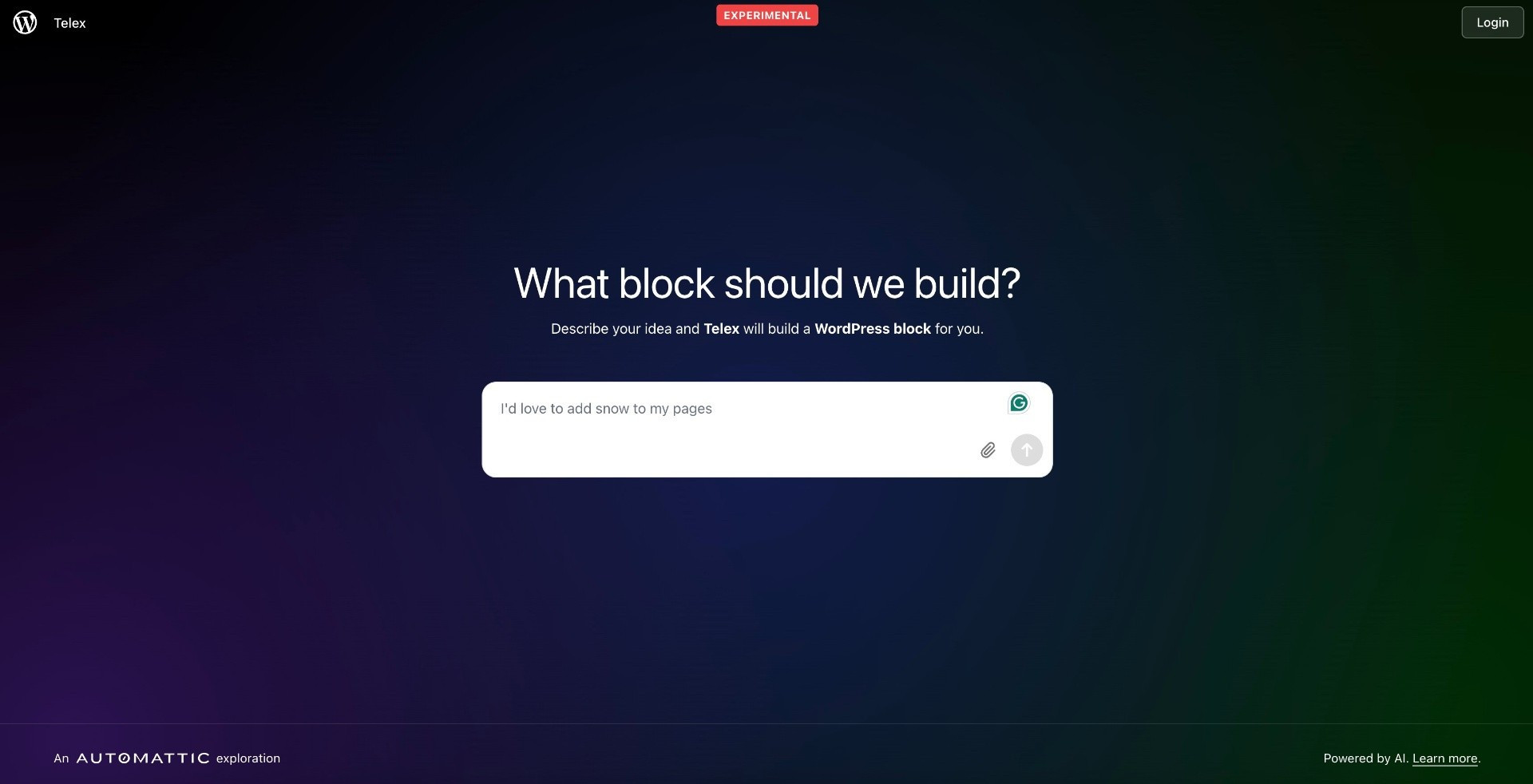
WordPress, under its parent company Automattic, introduced Telex, an experimental AI development tool unveiled by CEO Matt Mullenweg during his keynote at WordCamp US 2025 in Portland. Telex is characterized as a “V0 or Lovable” prototype—drawing inspiration from “vibe‑coding” services—that enables users to generate Gutenberg blocks (such as buttons, animations, galleries, or contact forms) simply by typing natural‑language prompts. The tool, accessible at telex.automattic.ai, returns a downloadable .zip plugin that can be installed on any WordPress site or tested inside the browser‑based WordPress Playground. While promising for easing site building and democratizing access to development, Telex remains in early testing, with some initial users reporting failures or needed adjustments when prompts didn’t quite work as intended; still, it underscores WordPress’s growing commitment to AI-guided tools.
Sources: TechCrunch, SSBCrack News, StartUp Ecosystems
Key Takeaways
– Accessible AI‑powered development – Telex simplifies web design by letting users turn simple text descriptions into functional Gutenberg blocks without manual coding.
– Still experimental – As a prototype, Telex shows promise but has technical hiccups; users are advised to expect imperfect results and potential need for post-generation tweaking.
– Strategic AI pivot – Launching Telex reflects WordPress/Automattic’s enhanced focus on AI-driven features, following earlier moves like forming a dedicated AI team and recent AI-related acquisitions.
In-Depth
WordPress has taken a bold step into the AI space with Telex, an experimental tool that promises to reshape the way site components are built. Launched at WordCamp US 2025 by CEO Matt Mullenweg, Telex taps into the emerging trend of “vibe‑coding”—where simple English prompts power software creation. The idea is straightforward: describe the block you want, and Telex packages it into a ready-to-use Gutenberg block as a downloadable plugin via a .zip file. You can install it on a live site or experiment using WordPress Playground, a browser-based sandbox, without hosting.
Telex paints an attractive picture for content creators, freelancers, and developers who want to avoid boilerplate code. Need a gallery slider? Just type it in. Want a contact form? Describe it. WordPress’s vision, echoed by Mullenweg’s comments, centers on expanding access: “democratizing publishing” by turning complex development tasks into conversational prompts.
However, Telex remains firmly experimental. Early adopters have noted instances where prompts didn’t execute cleanly, requiring manual fixes or retries. For now, it’s best treated as a creative sandbox rather than a production-ready tool.
But that’s fine—being conservative in its rollout aligns with WordPress’s long-term, open-source ethos: iterate publicly, keep ownership in user hands, and ensure flexibility without locking anyone in.
This unveiling also reinforces WordPress’s larger AI ambitions. Earlier this year, they assembled a formal AI team, and they had acquired the AI startup WPAI—whose expertise has been folded into Automattic’s broader effort. Telex acts as a proof of concept, pointing to a future where more sophisticated AI tools might become part of WordPress’s core offerings.
In short, Telex is not a final product; it’s a glimpse at where things might go—and that’s exciting. If the trajectory continues, we’ll likely see smarter, more intuitive tools that bridge the gap between idea and implementation, all within WordPress’s familiar ecosystem.