

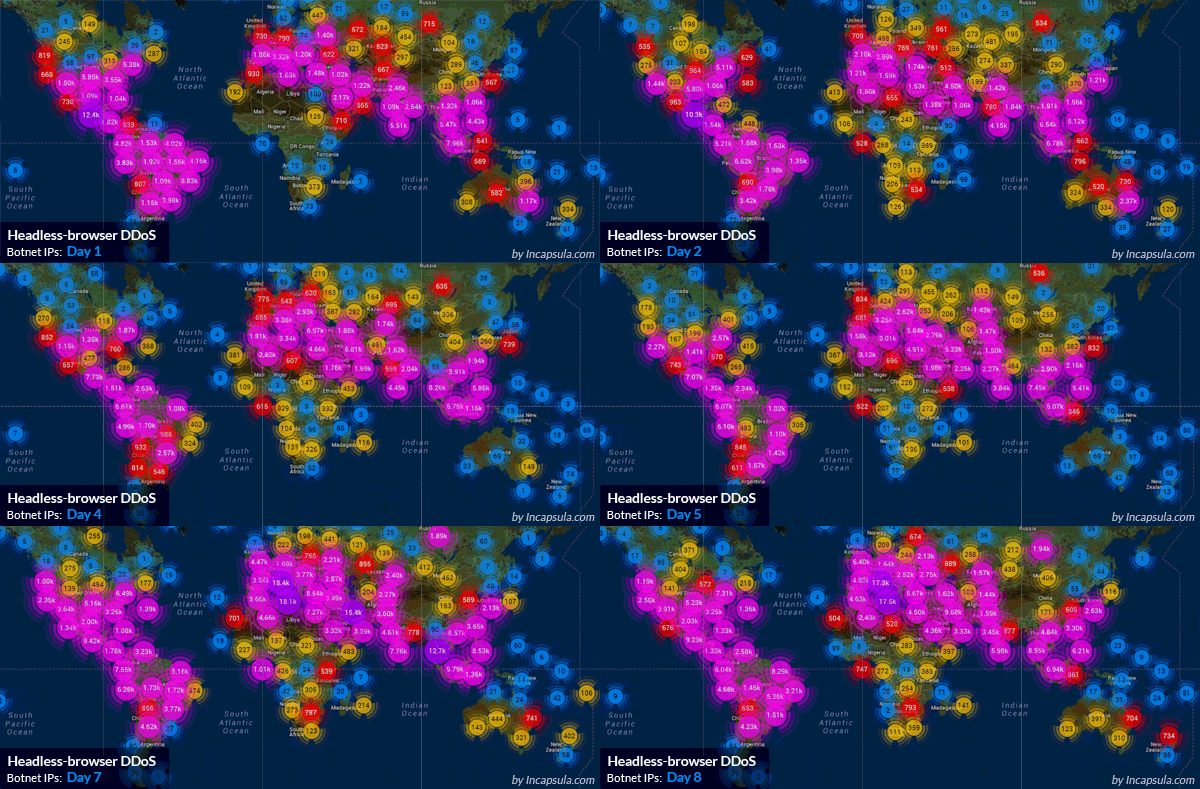
Microsoft reported that its Azure cloud network was hit by an astonishing 15.72 terabits-per-second distributed-denial-of-service (DDoS) attack launched from more than 500,000 IP addresses, traced to the Aisuru (a “Turbo Mirai”-class IoT botnet exploiting routers, cameras and DVRs). The attack, directed at a public Azure endpoint in Australia, also peaked at about 3.64 billion packets per second. Cloud-security firm Cloudflare has linked the same botnet to an earlier 22.2 Tbps attack hitting its network. The incident underscores the rising threat of massive IoT-based bot armies capable of overwhelming even the largest cloud-infrastructure providers.
Sources: Bleeping Computer, TechMeme
Key Takeaways
– Attack size: The Aisuru botnet orchestrated a UDP-flood style DDoS hitting 15.72 Tbps and 3.64 billion packets/s, launched from ~500,000 IPs.
– Botnet growth & mechanism: The botnet leverages compromised IoT devices (routers, cameras, DVRs) and expanded rapidly after breaching a firmware-update server in April 2025.
– Cloud-resilience window: While Azure mitigated this attack, the sheer scale foreshadows a new era of volumetric attacks that push the envelope—even leading cloud providers must continuously evolve their defenses.
In-Depth
In one of the most dramatic examples of cyber-threat escalation to date, Microsoft’s Azure platform successfully defended against a groundbreaking DDoS assault with a reported peak throughput of 15.72 terabits per second (Tbps) and a staggering 3.64 billion packets per second (pps), originating from more than 500,000 distinct IP addresses linked to the Aisuru botnet. This incident signals that the threat landscape is not simply expanding in volume but evolving in sophistication and sheer scale.
The Aisuru botnet, which researchers classify as a “Turbo Mirai”-style IoT botnet, harvests compromised home-network devices — routers, IP cameras, DVRs/NVRs, and certain Realtek-chip devices. According to research, Aisuru’s rapid expansion came after a mid-2025 incident in which its operators breached a firmware update server for one vendor, infecting approximately 100,000 devices in a single burst. Once established, the botnet coordinated a massive UDP-flood-style campaign, focused on a single public IP in Australia, and used minimal spoofing and random source ports to simplify trace-back and enforcement. While the destination was just one endpoint, its magnitude dwarfs most historical events.
Microsoft noted that this attack arrived after a prior 22.2 Tbps assault mitigated by Cloudflare, which likewise blamed Aisuru. The fact that multiple cloud-scale platforms are being targeted—and that bots are so easily scaled to half-a-million sources—demonstrates that the volume ceiling of DDoS has risen significantly. What was once considered “record-breaking” is now being eclipsed within months.
From a defense and policy perspective, the implications are substantial. First, the attack underscores the critical necessity of securing IoT ecosystems. Devices with weak or outdated firmware, especially those sold as ultra-low-cost consumer hardware, form the granular backbone of the botnet architecture. Second, cloud-service providers must invest not only in raw capacity but also dynamic mitigation strategies: filtering traffic by behavioral signatures, integrating upstream network defenses, and maintaining global rapid-response teams. Third, enterprises that rely on cloud services must reassess their DDoS posture. An event of this magnitude shows that even platforms designed for “infinite” scale can be pressed—and customers should demand visibility, service-level controls, and tabletop-tested incident response plans.
Politically and economically, the trend is worrying. Massive DDoS attacks act as both disruptive weapons and show-of-force tools: vulnerable endpoints can be taken offline, command structures obscured via the anonymity of IoT proxies, and ransom/extortion demands more credibly enforced. If a public-cloud provider like Azure can be targeted so directly, the broader internet — particularly smaller service providers, critical infrastructure, and siloed systems — may face even greater risk.
The silver-lining: Microsoft succeeded in mitigation and no large-scale outage or data breach was reported in this case. Such resilience demonstrates that robust architecture, scale, and layered security defenses can still hold firm under unprecedented stress. But for defenders, the warning is clear: the next “record-breaking” DDoS attack may hit higher, and likely will. Enterprises, government agencies, and cloud providers alike should treat this latest incident not as an anomaly, but as a harbinger of what normalcy may soon look like in the elevated world of cyber-threats.
As a conservative takeaway: infinite internet scale once meant boundless growth and seamless service. Now it demands boundless vigilance—and the expectation that the largest players remain targets. But with carefully layered protections, shared responsibility, and stronger regulatory incentives (especially around IoT device security), the ecosystem can respond. The next step is closing the gap before attackers make the leap from volumetric disruption to full-scale infrastructure compromise.