

Close Menu

    Subscribe to Updates

    Get the latest creative news from FooBar about art, design and business.

    What's Hot

    Airbnb Shifts One-Third Of Customer Support To AI In North America

    February 17, 2026

    Meta Plans Facial Recognition for Smart Glasses Amid Privacy Pushback

    February 17, 2026

    Spotify Developers Haven’t Written Code Since December Thanks to AI Transformation

    February 16, 2026
    Facebook X (Twitter) Instagram
    • Tech
    • AI News
    • Get In Touch
    Facebook X (Twitter) LinkedIn
    TallwireTallwire
    • Tech

      Meta Plans Facial Recognition for Smart Glasses Amid Privacy Pushback

      February 17, 2026

      Spotify Developers Haven’t Written Code Since December Thanks to AI Transformation

      February 16, 2026

      Waymo Goes Fully Autonomous in Nashville, Tennessee

      February 16, 2026

      Roku Plans Streaming Bundles Push to Boost Profitability in 2026

      February 15, 2026

      Russia Officially Blocks WhatsApp After Telegram Crackdown

      February 15, 2026
    • AI News

      Meta Plans Facial Recognition for Smart Glasses Amid Privacy Pushback

      February 17, 2026

      Airbnb Shifts One-Third Of Customer Support To AI In North America

      February 17, 2026

      Spotify Developers Haven’t Written Code Since December Thanks to AI Transformation

      February 16, 2026

      Australia Puts Roblox on Notice Amid Reports of Child Grooming and Harmful Content

      February 16, 2026

      UK Kids Turning to AI Chatbots and Acting on Advice at Alarming Rates

      February 16, 2026
    • Security

      US Lawmakers Urge Tighter Export Controls to Curb China’s Access to Chipmaking Equipment

      February 16, 2026

      Senator Raises Questions On eSafety Crackdown And Potential Strain On US-Australia Relationship

      February 16, 2026

      AI Safety Researcher Resigns, Warns ‘World Is in Peril’ Amid Broader Industry Concerns

      February 15, 2026

      Microsoft Warns Hackers Are Exploiting Critical Zero-Day Bugs Targeting Windows, Office Users

      February 15, 2026

      Microsoft Exchange Online’s Aggressive Filters Mistake Legitimate Emails for Phishing

      February 13, 2026
    • Health

      UK Kids Turning to AI Chatbots and Acting on Advice at Alarming Rates

      February 16, 2026

      Landmark California Trial Sees YouTube Defend Itself, Rejects ‘Social Media’ and Addiction Claims

      February 16, 2026

      Instagram Top Executive Says ‘Addiction’ Doesn’t Exist in Landmark Social Media Trial

      February 15, 2026

      Amazon Pharmacy Rolls Out Same-Day Prescription Delivery To 4,500 U.S. Cities

      February 14, 2026

      AI Advances Aim to Bridge Labor Gaps in Rare Disease Treatment

      February 12, 2026
    • Science

      XAI Publicly Unveils Elon Musk’s Interplanetary AI Vision In Rare All-Hands Release

      February 14, 2026

      Elon Musk Shifts SpaceX Priority From Mars Colonization to Building a Moon City

      February 14, 2026

      NASA Artemis II Spacesuit Mobility Concerns Ahead Of Historic Mission

      February 13, 2026

      AI Agents Build Their Own MMO Playground After Moltbook Ignites Agent-Only Web Communities

      February 12, 2026

      AI Advances Aim to Bridge Labor Gaps in Rare Disease Treatment

      February 12, 2026
    • People

      Google Co-Founder’s Epstein Contacts Reignite Scrutiny of Elite Tech Circles

      February 7, 2026

      Bill Gates Denies “Absolutely Absurd” Claims in Newly Released Epstein Files

      February 6, 2026

      Informant Claims Epstein Employed Personal Hacker With Zero-Day Skills

      February 5, 2026

      Starlink Becomes Critical Internet Lifeline Amid Iran Protest Crackdown

      January 25, 2026

      Musk Pledges to Open-Source X’s Recommendation Algorithm, Promising Transparency

      January 21, 2026
    TallwireTallwire
    Home»Tech»Microsoft’s Azure Targeted by 15 Tbps Botnet Flood via 500,000 Compromised Devices
    Tech

    Microsoft’s Azure Targeted by 15 Tbps Botnet Flood via 500,000 Compromised Devices

    4 Mins Read
    Facebook Twitter Pinterest LinkedIn Tumblr Email
    Microsoft’s Azure Targeted by 15 Tbps Botnet Flood via 500,000 Compromised Devices
    Microsoft’s Azure Targeted by 15 Tbps Botnet Flood via 500,000 Compromised Devices
    Share
    Facebook Twitter LinkedIn Pinterest Email

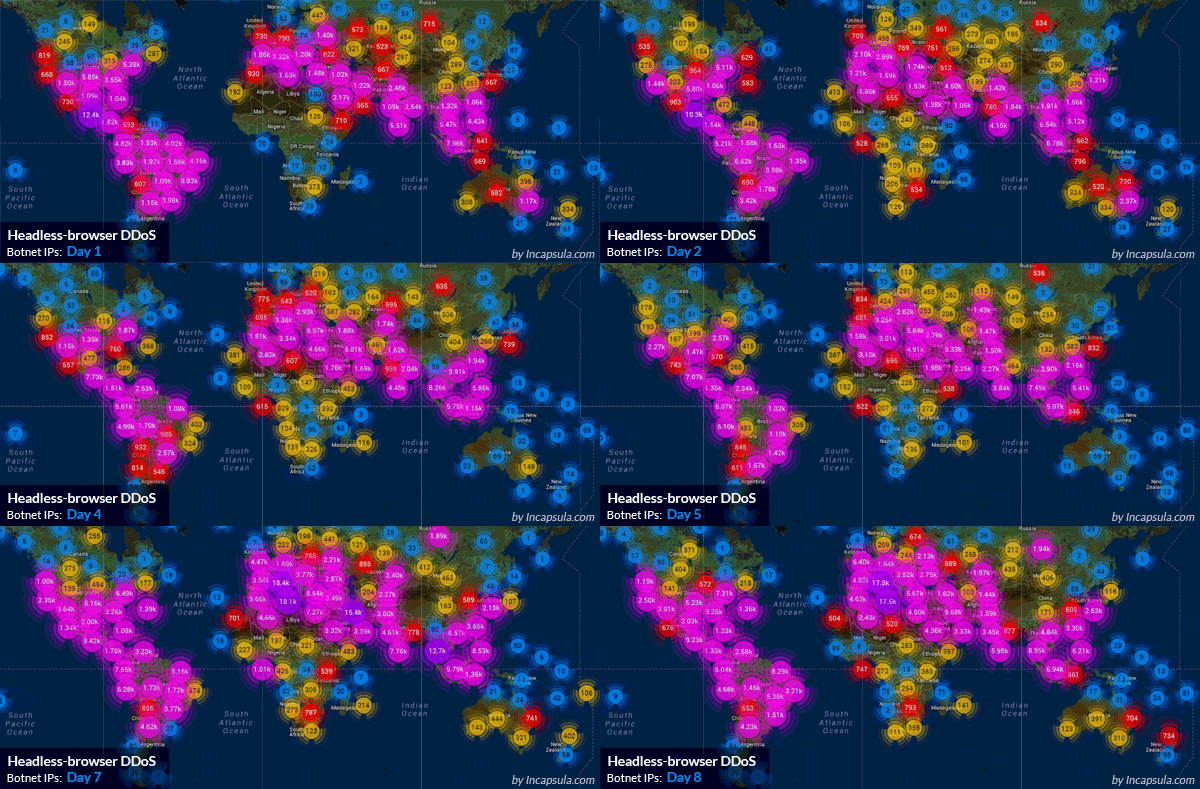
    Microsoft reported that its Azure cloud network was hit by an astonishing 15.72 terabits-per-second distributed-denial-of-service (DDoS) attack launched from more than 500,000 IP addresses, traced to the Aisuru (a “Turbo Mirai”-class IoT botnet exploiting routers, cameras and DVRs). The attack, directed at a public Azure endpoint in Australia, also peaked at about 3.64 billion packets per second. Cloud-security firm Cloudflare has linked the same botnet to an earlier 22.2 Tbps attack hitting its network. The incident underscores the rising threat of massive IoT-based bot armies capable of overwhelming even the largest cloud-infrastructure providers.

    Sources: Bleeping Computer, TechMeme

    Key Takeaways

    – Attack size: The Aisuru botnet orchestrated a UDP-flood style DDoS hitting 15.72 Tbps and 3.64 billion packets/s, launched from ~500,000 IPs.

    – Botnet growth & mechanism: The botnet leverages compromised IoT devices (routers, cameras, DVRs) and expanded rapidly after breaching a firmware-update server in April 2025.

    – Cloud-resilience window: While Azure mitigated this attack, the sheer scale foreshadows a new era of volumetric attacks that push the envelope—even leading cloud providers must continuously evolve their defenses.

    In-Depth

    In one of the most dramatic examples of cyber-threat escalation to date, Microsoft’s Azure platform successfully defended against a groundbreaking DDoS assault with a reported peak throughput of 15.72 terabits per second (Tbps) and a staggering 3.64 billion packets per second (pps), originating from more than 500,000 distinct IP addresses linked to the Aisuru botnet. This incident signals that the threat landscape is not simply expanding in volume but evolving in sophistication and sheer scale.

    The Aisuru botnet, which researchers classify as a “Turbo Mirai”-style IoT botnet, harvests compromised home-network devices — routers, IP cameras, DVRs/NVRs, and certain Realtek-chip devices. According to research, Aisuru’s rapid expansion came after a mid-2025 incident in which its operators breached a firmware update server for one vendor, infecting approximately 100,000 devices in a single burst. Once established, the botnet coordinated a massive UDP-flood-style campaign, focused on a single public IP in Australia, and used minimal spoofing and random source ports to simplify trace-back and enforcement. While the destination was just one endpoint, its magnitude dwarfs most historical events.

    Microsoft noted that this attack arrived after a prior 22.2 Tbps assault mitigated by Cloudflare, which likewise blamed Aisuru. The fact that multiple cloud-scale platforms are being targeted—and that bots are so easily scaled to half-a-million sources—demonstrates that the volume ceiling of DDoS has risen significantly. What was once considered “record-breaking” is now being eclipsed within months.

    From a defense and policy perspective, the implications are substantial. First, the attack underscores the critical necessity of securing IoT ecosystems. Devices with weak or outdated firmware, especially those sold as ultra-low-cost consumer hardware, form the granular backbone of the botnet architecture. Second, cloud-service providers must invest not only in raw capacity but also dynamic mitigation strategies: filtering traffic by behavioral signatures, integrating upstream network defenses, and maintaining global rapid-response teams. Third, enterprises that rely on cloud services must reassess their DDoS posture. An event of this magnitude shows that even platforms designed for “infinite” scale can be pressed—and customers should demand visibility, service-level controls, and tabletop-tested incident response plans.

    Politically and economically, the trend is worrying. Massive DDoS attacks act as both disruptive weapons and show-of-force tools: vulnerable endpoints can be taken offline, command structures obscured via the anonymity of IoT proxies, and ransom/extortion demands more credibly enforced. If a public-cloud provider like Azure can be targeted so directly, the broader internet — particularly smaller service providers, critical infrastructure, and siloed systems — may face even greater risk.

    The silver-lining: Microsoft succeeded in mitigation and no large-scale outage or data breach was reported in this case. Such resilience demonstrates that robust architecture, scale, and layered security defenses can still hold firm under unprecedented stress. But for defenders, the warning is clear: the next “record-breaking” DDoS attack may hit higher, and likely will. Enterprises, government agencies, and cloud providers alike should treat this latest incident not as an anomaly, but as a harbinger of what normalcy may soon look like in the elevated world of cyber-threats.

    As a conservative takeaway: infinite internet scale once meant boundless growth and seamless service. Now it demands boundless vigilance—and the expectation that the largest players remain targets. But with carefully layered protections, shared responsibility, and stronger regulatory incentives (especially around IoT device security), the ecosystem can respond. The next step is closing the gap before attackers make the leap from volumetric disruption to full-scale infrastructure ­compromise.

    Share. Facebook Twitter Pinterest LinkedIn Tumblr Email
    Previous ArticleMicrosoft’s Ambitious Rust Migration Plan Sparks Debate Over AI-Driven Rewrite Of C/C++ Codebase
    Next Article Microsoft’s Dragon Copilot Boosts Clinician Time With Patients

    Related Posts

    Meta Plans Facial Recognition for Smart Glasses Amid Privacy Pushback

    February 17, 2026

    Spotify Developers Haven’t Written Code Since December Thanks to AI Transformation

    February 16, 2026

    Waymo Goes Fully Autonomous in Nashville, Tennessee

    February 16, 2026

    Roku Plans Streaming Bundles Push to Boost Profitability in 2026

    February 15, 2026
    Add A Comment
    Leave A Reply Cancel Reply

    Editors Picks

    Meta Plans Facial Recognition for Smart Glasses Amid Privacy Pushback

    February 17, 2026

    Spotify Developers Haven’t Written Code Since December Thanks to AI Transformation

    February 16, 2026

    Waymo Goes Fully Autonomous in Nashville, Tennessee

    February 16, 2026

    Roku Plans Streaming Bundles Push to Boost Profitability in 2026

    February 15, 2026
    Top Reviews
    Tallwire
    Facebook X (Twitter) LinkedIn Threads Instagram RSS
    • Tech
    • Entertainment
    • Business
    • Government
    • Academia
    • Transportation
    • Legal
    • Press Kit
    © 2026 Tallwire. Optimized by ARMOUR Digital Marketing Agency.

    Type above and press Enter to search. Press Esc to cancel.