

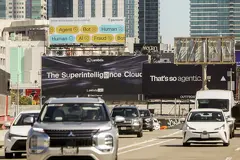
A detailed survey of San Francisco’s outdoor advertising landscape reveals a dramatic shift driven by the artificial intelligence boom, with nearly half of the city’s billboards now promoting AI-related companies, signaling both the industry’s rapid expansion and its increasingly aggressive push for visibility in the cultural and economic heart of Silicon Valley; researchers who physically canvassed hundreds of billboard locations found messaging ranging from bold, disruptive slogans to more polished corporate branding, reflecting an industry eager to normalize its presence while simultaneously shaping public perception about the role of AI in the workforce and daily life, even as critics warn that these campaigns often sidestep concerns about job displacement, safety, and long-term societal impact in favor of optimistic or provocative narratives designed to capture attention and investor interest.
Sources
https://www.sfchronicle.com/projects/2026/san-francisco-ai-billboards/
https://www.fastcompany.com/91528348/what-san-franciscos-ai-billboards-say-about-the-state-of-the-industry
https://www.kqed.org/news/12076608/what-do-san-franciscos-ai-vs-humans-billboards-say-about-our-working-futures
Key Takeaways
- Nearly half of surveyed billboards in San Francisco now advertise artificial intelligence companies, underscoring the scale and speed of the AI industry‘s growth.
- Messaging in these advertisements ranges from provocative slogans about replacing human labor to softer narratives emphasizing collaboration between humans and machines.
- Critics argue the campaigns often gloss over risks like job displacement and societal disruption, focusing instead on hype and investor appeal.
In-Depth
San Francisco has long served as a barometer for technological change, but the current wave of artificial intelligence advertising marks a particularly aggressive and visible phase in that evolution. By physically surveying hundreds of billboard locations across the city, researchers documented a landscape where AI messaging is not just present, but dominant. The sheer volume of AI-related ads—approaching half of all billboards—signals a level of market saturation that reflects both confidence and urgency within the sector.
This surge is not simply about brand awareness; it is a coordinated attempt to define the narrative surrounding artificial intelligence at a time when public skepticism remains high. Early campaigns leaned into disruption, with blunt messaging suggesting machines could replace human workers. That approach generated backlash, prompting a noticeable shift toward messaging that frames AI as a collaborative tool rather than a wholesale replacement.
Still, the tension remains evident. Many of the ads emphasize efficiency, automation, and productivity gains, while sidestepping the harder questions about workforce displacement, economic inequality, and regulatory oversight. Analysts observing the trend note that the industry’s advertising strategy appears designed to normalize AI’s rapid integration into daily life before broader societal debates can fully take shape.
From a broader perspective, the billboard takeover reflects a familiar pattern in Silicon Valley: emerging technologies aggressively shape public perception through marketing before their full implications are understood. What sets this moment apart is the scale and speed at which AI companies are attempting to embed themselves into the cultural fabric of the city. The skyline itself has effectively become a canvas for a high-stakes messaging campaign, one that seeks to persuade residents—and by extension the nation—that the future being sold is not only inevitable, but desirable.