

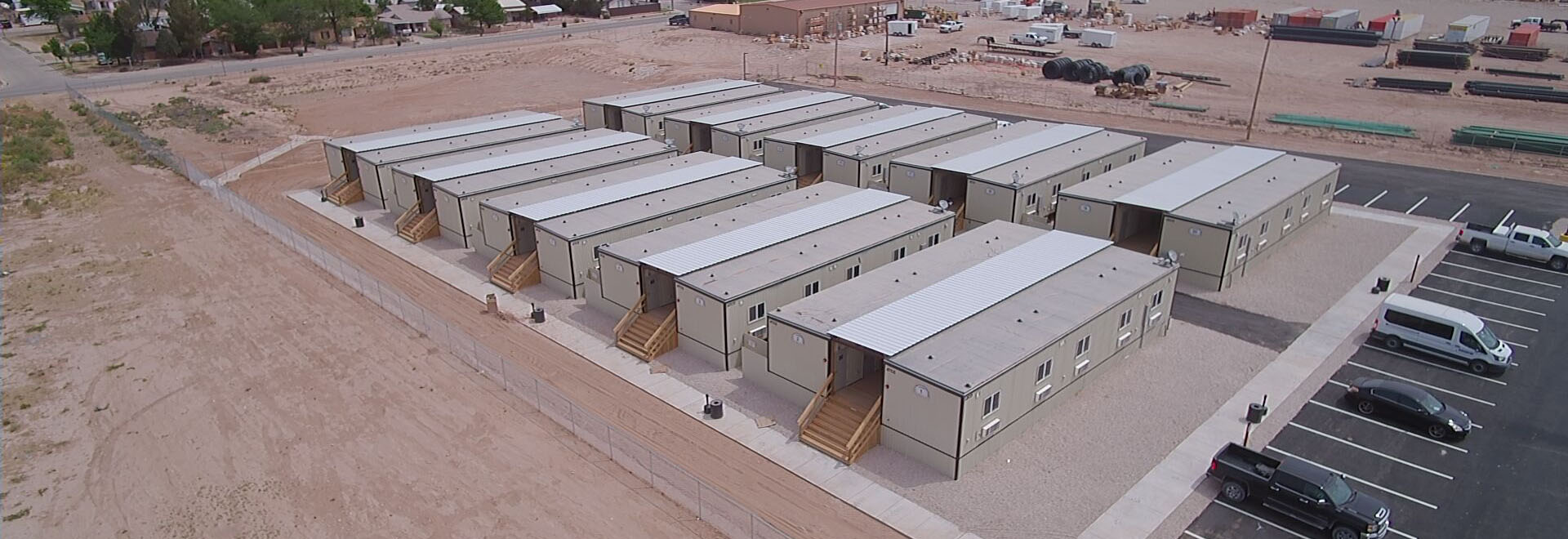
A company known for operating an immigration detention facility for federal authorities is now positioning itself to capitalize on the rapidly expanding artificial intelligence infrastructure boom by building large temporary housing camps for data-center construction workers. Target Hospitality, which runs remote worker camps and owns the Dilley Immigration Processing Center in Texas, has secured contracts worth roughly $132 million to build and operate a camp in Dickens County, Texas that could house more than 1,000 workers helping construct a massive AI-related data center. The housing model—often referred to as “man camps”—originated in remote oil and gas operations where workers required temporary lodging near isolated drilling sites, and it is now being repurposed as tech companies race to build new AI data centers in rural regions where local housing and infrastructure are scarce. Industry executives view the surge in AI data-center construction as a major growth opportunity, with some calling the pipeline of projects one of the largest they have seen, while critics have pointed to controversies tied to the company’s detention-facility operations and raised questions about conditions in some facilities connected to the broader detention-contracting industry.
Sources
https://techcrunch.com/2026/03/08/owner-of-ice-detention-facility-sees-big-opportunity-in-ai-man-camps/
https://www.bloomberg.com/news/features/2026-03-06/the-700-billion-ai-data-center-boom-is-fueling-a-boom-in-man-camp-housing
https://www.techbuzz.ai/articles/ice-detention-operator-pivots-to-ai-data-center-worker-camps
https://peopleofcolorintech.com/articles/ice-detention-facility-owner-moves-into-developing-ai-powered-man-camps/
Key Takeaways
- The massive expansion of AI data centers is driving demand for temporary housing complexes capable of accommodating hundreds or thousands of construction workers in rural areas.
- Target Hospitality, which operates immigration detention facilities, is leveraging its experience running remote worker camps to secure contracts tied to AI infrastructure development.
- The development highlights how the AI boom is reshaping industries beyond technology itself, drawing in companies from sectors such as energy-sector housing and government contracting.
In-Depth
The explosive growth of artificial intelligence is triggering an infrastructure arms race that extends far beyond silicon chips and software. Massive data centers—each packed with thousands of high-powered servers—are now being built across the United States to support the computing demands of modern AI systems. But these sprawling facilities require armies of skilled construction workers, and many of the sites chosen for new data centers sit far from major cities. That logistical challenge is giving rise to a revival of an old solution: the temporary worker settlement commonly known as the “man camp.”
The model has deep roots in America’s energy sector. During the oil booms in places like North Dakota and West Texas, companies built large temporary housing complexes near drilling sites to accommodate the influx of workers. These camps often included dormitory-style rooms along with cafeterias, gyms, recreation areas, and other amenities designed to support crews who might live on site for weeks or months at a time. Now the same concept is being repurposed for a new frontier—AI infrastructure.
Target Hospitality has emerged as a key player in this shift. The company already has extensive experience building and operating temporary housing communities in remote environments, and it is applying that expertise to the data-center construction boom. One of its latest projects involves a large camp in Dickens County, Texas, where a former bitcoin mining facility is being converted into a massive AI-focused data center. The housing complex connected to the project could eventually accommodate more than 1,000 workers.
For companies racing to construct new data centers, the appeal is straightforward. Large AI facilities require specialized electrical, mechanical, and construction crews working around the clock for months or even years. Rural project locations often lack sufficient hotels or rental housing to support that workforce. Without temporary housing, construction timelines could slow dramatically, threatening the competitive race among tech giants to deploy new AI computing capacity.
Industry executives increasingly see the scale of AI infrastructure investment as unprecedented. Billions of dollars are pouring into projects across the country as technology companies expand their computing capacity to support generative AI systems and other advanced applications. For firms like Target Hospitality, which specialize in rapid-deployment housing solutions, the surge in construction projects represents a lucrative opportunity to diversify beyond their traditional markets.
At the same time, the company’s connection to immigration detention operations has drawn attention and criticism from activists and advocacy groups. Target Hospitality owns the Dilley Immigration Processing Center in Texas, which houses migrant families detained by federal authorities. Past allegations related to detention facilities—ranging from complaints about living conditions to disputes over food quality and accommodations—have made companies operating in the detention sector controversial figures in public debates.
Those controversies add a layer of political tension to the company’s expanding role in the AI infrastructure ecosystem. Critics argue that technology companies partnering with firms tied to detention operations could face reputational scrutiny, particularly as the tech industry increasingly emphasizes corporate ethics and social responsibility. Supporters of the business model counter that the company’s expertise in operating large-scale remote housing complexes makes it uniquely suited to address the logistical challenges of data-center construction.
What is clear is that the AI boom is reshaping the economic landscape in unexpected ways. While headlines often focus on breakthroughs in algorithms or the rivalry among tech giants, the reality is that artificial intelligence requires an enormous physical backbone—power plants, fiber networks, and warehouse-sized computing facilities. Building that backbone demands not just capital and engineering expertise but also practical solutions to mundane problems like where thousands of construction workers will sleep at night.
The reemergence of man camps underscores the scale and urgency of the AI infrastructure push. For rural communities hosting these projects, the arrival of hundreds or thousands of temporary workers can transform local economies almost overnight. Restaurants, service businesses, and supply chains expand to meet new demand, while temporary housing complexes become hubs of activity during construction phases.
In that sense, the story of AI man camps illustrates a broader truth about technological revolutions: they rarely remain confined to the industries that create them. Instead, they ripple outward, reshaping labor markets, supply chains, and business models in ways that few people anticipate. The same technology driving advances in machine learning and automation is now creating opportunities for companies that once specialized in housing oil-field workers or managing remote government facilities.
Whether the trend proves temporary or becomes a permanent feature of the AI economy remains to be seen. But as long as technology firms continue pouring billions into new data centers across rural America, the demand for rapid-deployment worker housing appears poised to grow. In the age of artificial intelligence, even the humble construction camp is finding a place in the future of the digital economy.