

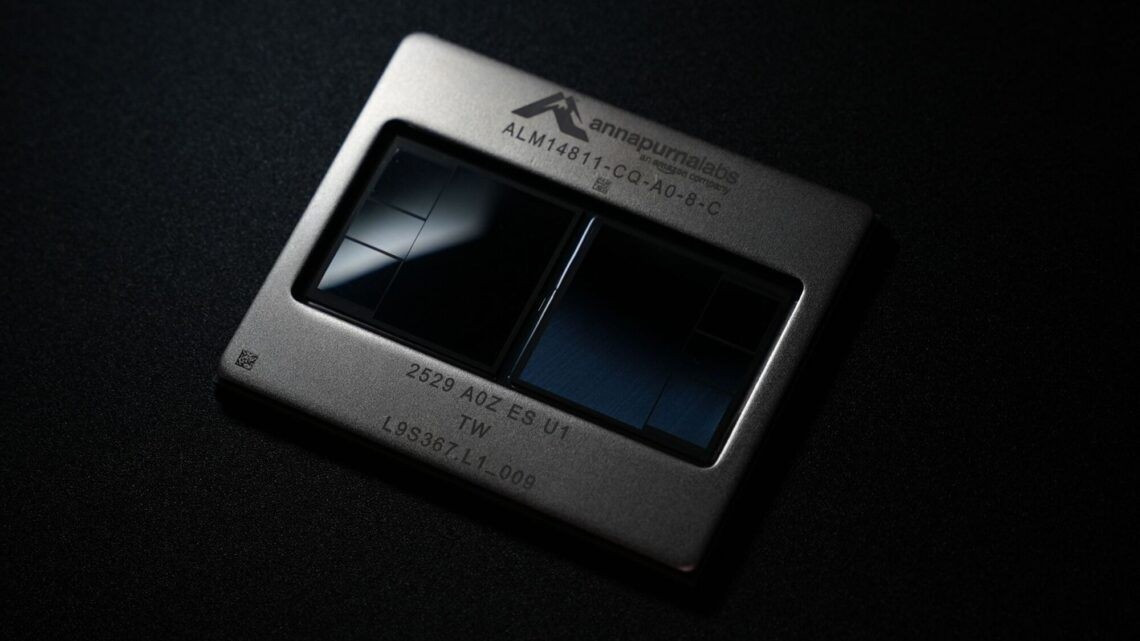
Amazon‘s cloud arm has officially launched its new AI training chip, Trainium 3, unveiling “UltraServer” hardware that delivers roughly quadruple the training and inference throughput of its predecessor, while using 40% less power. The systems can scale to massive size — thousands of UltraServers linked together for up to a million Trainium 3 chips — and boast four times the memory per server. Crucially, Amazon also disclosed that it’s already developing Trainium 4, which will support Nvidia‘s NVLink Fusion interconnect, signaling a roadmap for interoperability with the industry’s leading GPU ecosystem. The idea seems clear: offer high-performance AI infrastructure at lower cost, while opening the door for organizations already committed to Nvidia-based workflows to transition more easily to Amazon’s in-house silicon.
Sources: TechCrunch, Bloomberg
Key Takeaways
– Trainium 3 delivers major performance and efficiency gains: ~4× speed improvement over the prior generation, 4× more memory per server, and ~40% better energy efficiency — a package built to reduce both AI training latency and operating costs.
– Amazon is going all-in on infrastructure scale: UltraServers can host 144 chips each, and hundreds of such servers can be linked for extremely large-scale deployments — up to one million chips — enabling serious enterprise or cloud-scale AI workloads.
– With Trainium 4 slated to support Nvidia’s NVLink Fusion, Amazon is not turning its back on Nvidia users; instead it’s trying to merge competitive pricing and proprietary hardware with compatibility that eases vendor transition or hybrid workloads.
In-Depth
The big headline from AWS’ re:Invent 2025 conference isn’t just another incremental update — the debut of Trainium 3 marks a significant inflection point in how enterprises might approach AI infrastructure. Amazon isn’t just chasing raw compute benchmarks; it’s trying to rewrite the economics and logistics of AI deployment. With UltraServers packing up to 144 of its 3-nm Trainium 3 chips, and scalability claimed into the realm of one million chips linked across racks, the company is clearly positioning for high-end, large-scale, commercial AI workloads. Gains of “4× the performance” and “4× the memory,” alongside a 40% reduction in power use, combine to make a compelling value proposition for firms wrestling with the tradeoffs of speed, cost, and sustainability.
But the really clever move is the nod to Nvidia compatibility. The advance notice about Trainium 4 supporting NVLink Fusion makes it evident that Amazon doesn’t expect to win adoption solely on proprietary lock-in. By enabling interoperability with the industry standard Nvidia GPU ecosystem, AWS is giving existing users a bridge — a softer landing — toward its custom hardware. That’s a strategic recognition of where the AI tooling and ecosystem remain: heavily Nvidia-based, largely built around CUDA, and gravitating toward interconnect standards that make large-model training and multi-GPU scaling efficient.
From a broader market perspective, this could increase pressure on GPU makers like Nvidia and other vendors, since organizations now have a credible alternative offering comparable performance at a lower cost and possibly with greater energy efficiency over time. For companies sensitive to GPU licensing, vendor risk, or cloud cost — or those needing to deploy at massive scale — Amazon’s new offering could tilt the balance in favor of its cloud. The NVLink-ready roadmap also indicates AWS isn’t looking to lock customers into a one-vendor world, but rather to give them flexibility — a smart approach that may win more conservative enterprise and government clients.
If Amazon follows through, we may soon see more mixed hardware stacks: Nvidia GPUs for legacy workloads, Amazon Trainium chips for batch training or cost-sensitive inference, and hybrid clusters tying both together. That could widen competition, lower costs industry-wide, and ultimately accelerate adoption of generative and large-model AI in more enterprises than we’ve seen so far.