

Close Menu

    Subscribe to Updates

    Get the latest tech news from Tallwire.

      What's Hot

      Apple Music Moves To Label AI-Generated Songs With New Transparency Tags

      March 6, 2026

      Anthropic Says It Has Not Been Formally Notified Of Blacklisting By Pentagon

      March 6, 2026

      CERN Turns To Artificial Intelligence To Challenge Long-Standing Physics Theories

      March 6, 2026
      Facebook X (Twitter) Instagram
      • Tech
      • AI
      • Get In Touch
      Facebook X (Twitter) LinkedIn
      TallwireTallwire
      • Tech

        CERN Turns To Artificial Intelligence To Challenge Long-Standing Physics Theories

        March 6, 2026

        Tech Leaders Warn Washington Tax Push Could Cripple AI Innovation

        March 5, 2026

        Hackers And Internet Blackouts Rock Iran As Airstrikes Escalate

        March 5, 2026

        Discord Age Verification Push Sparks Search For Privacy-Focused Alternatives

        March 5, 2026

        Smartphone Use Creates A Daily “Vicious Cycle” Of Disconnection And Disengagement

        March 4, 2026
      • AI

        CERN Turns To Artificial Intelligence To Challenge Long-Standing Physics Theories

        March 6, 2026

        Anthropic Says It Has Not Been Formally Notified Of Blacklisting By Pentagon

        March 6, 2026

        Apple Music Moves To Label AI-Generated Songs With New Transparency Tags

        March 6, 2026

        Data Centers Become Collateral Damage in Escalating Iran War

        March 6, 2026

        Treasury Moves To End Anthropic AI Use As Federal Government Begins Phaseout

        March 6, 2026
      • Security

        Discord Age Verification Push Sparks Search For Privacy-Focused Alternatives

        March 5, 2026

        Hacktivists Claim Breach Of Homeland Security Systems, Release ICE Contractor Data

        March 5, 2026

        Apple Security Needs Your Spam Reports To Strengthen Defenses

        March 4, 2026

        Anthropic Eases AI Safety Restrictions to Avoid Slowing Development,

        March 4, 2026

        Gaming Platforms Like Roblox Used by Crime Gangs to Groom Children, Victoria Warns

        March 4, 2026
      • Health

        Courtroom Scrutiny Grows Over Claims Instagram Tracked Usage While Pursuing Teens

        March 5, 2026

        Smartphone Use Creates A Daily “Vicious Cycle” Of Disconnection And Disengagement

        March 4, 2026

        Gaming Platforms Like Roblox Used by Crime Gangs to Groom Children, Victoria Warns

        March 4, 2026

        New AI-Generated Videos Ignite Debate Over Realism and Risks

        March 4, 2026

        Landmark Trial Puts Social Media Giants on the Defensive Over Youth Addiction Claims

        March 3, 2026
      • Science

        CERN Turns To Artificial Intelligence To Challenge Long-Standing Physics Theories

        March 6, 2026

        Astronomers Confirm Discovery Of Galaxy Nearly Entirely Composed Of Dark Matter

        March 1, 2026

        Microsoft Claims 100 Percent Renewable Energy Match Across Global Electricity Use

        February 28, 2026

        Taara Beam Launch Brings 25Gbps Optical Wireless Networks to Cities

        February 27, 2026

        Large Hadron Collider Enters Third Shutdown For Major Upgrade

        February 26, 2026
      • Tech

        Sam Altman Says ‘AI Washing’ Is Being Used to Mask Corporate Layoffs

        February 28, 2026

        Zuckerberg Testifies In Landmark Trial Over Alleged Teen Social Media Harms

        February 23, 2026

        Gay Tech Networks Under Spotlight In Silicon Valley Culture Debate

        February 23, 2026

        Google Co-Founder’s Epstein Contacts Reignite Scrutiny of Elite Tech Circles

        February 7, 2026

        Bill Gates Denies “Absolutely Absurd” Claims in Newly Released Epstein Files

        February 6, 2026
      TallwireTallwire
      Home»AI»CERN Turns To Artificial Intelligence To Challenge Long-Standing Physics Theories
      AI

      CERN Turns To Artificial Intelligence To Challenge Long-Standing Physics Theories

      5 Mins Read
      Facebook Twitter Pinterest LinkedIn Tumblr Email
      Share
      Facebook Twitter LinkedIn Pinterest Email

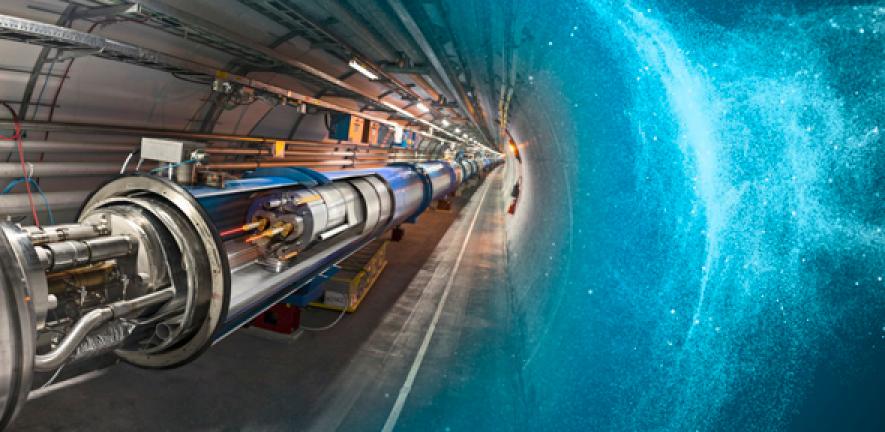
      Scientists at CERN are increasingly turning to artificial intelligence in an effort to challenge and re-evaluate the core theories that underpin modern particle physics, reflecting a growing recognition that current models, including the widely accepted Standard Model, remain incomplete despite decades of experimental validation. Researchers working with the Large Hadron Collider—where particles are smashed together at extraordinary energies—have found that the prevailing theories continue to hold up under experimental scrutiny, yet that very consistency has created a paradox: without discovering cracks in the existing framework, physicists struggle to advance toward new physics that could explain mysteries such as dark matter or the imbalance between matter and antimatter. Artificial intelligence is now being deployed not merely to analyze massive datasets generated by collider experiments but to identify patterns, anomalies, or conceptual pathways that human researchers may overlook, potentially guiding scientists toward entirely new theoretical frameworks that could redefine our understanding of the universe.

      Sources

      https://www.semafor.com/article/03/02/2026/cern-scientists-use-ai-to-reevaluate-physics-theories
      https://techstartups.com/2026/03/03/top-tech-news-today-march-3-2026-2/
      https://physicsworld.com/a/using-ai-to-find-new-particles-at-the-lhc/

      Key Takeaways

      • Artificial intelligence is being used not only to analyze particle-collision data but also to help physicists challenge the assumptions behind existing theories and potentially uncover entirely new models of physics.
      • The continued success of current theories in explaining collider results has paradoxically slowed theoretical breakthroughs, prompting researchers to use AI to search for overlooked anomalies or hidden patterns.
      • AI-driven analysis could accelerate the discovery of “new physics,” potentially helping explain unresolved cosmic puzzles such as dark matter, neutrino masses, and the imbalance between matter and antimatter.

      In-Depth

      For decades, particle physics has operated under a powerful yet incomplete framework known as the Standard Model—a set of equations and principles that explain how fundamental particles and forces interact. It has delivered remarkable predictive success, culminating in the discovery of the Higgs boson in 2012, which confirmed the mechanism by which particles acquire mass. Yet despite these achievements, the Standard Model leaves major cosmic questions unanswered. It cannot explain dark matter, the tiny but measurable masses of neutrinos, or why the universe contains more matter than antimatter.

      This is where artificial intelligence is beginning to play a transformative role. At CERN, the world’s premier particle physics laboratory, scientists are now deploying advanced machine-learning systems to sift through the enormous quantities of data generated by the Large Hadron Collider. Each collision inside the LHC produces a cascade of subatomic debris, and the collider generates millions of such events every second. Human researchers have long relied on statistical tools and theoretical predictions to analyze this data, but AI systems can examine patterns across enormous datasets at a scale and speed that far exceeds traditional methods.

      The shift toward AI represents more than just a technological upgrade; it reflects a philosophical change in how physicists approach discovery. Historically, scientific progress in particle physics has depended on formulating theories first and then designing experiments to test them. Today, however, AI systems are increasingly capable of identifying correlations and anomalies without prior assumptions about what scientists expect to see. In practical terms, this means machine-learning models could potentially reveal patterns in collider data that suggest new physical laws—patterns that human researchers might miss because they are constrained by existing theoretical frameworks.

      This approach has gained momentum partly because the Large Hadron Collider has produced a puzzling result: the existing theories work too well. The collider’s experiments have repeatedly confirmed the predictions of the Standard Model, leaving physicists without the clear discrepancies that historically triggered major theoretical breakthroughs. The discovery of the Higgs boson, while groundbreaking, effectively completed the Standard Model rather than overturning it. As a result, researchers now find themselves in an unusual position—searching for evidence that their own theories might be incomplete or flawed.

      Artificial intelligence offers a new strategy for that search. Machine-learning algorithms can evaluate competing theoretical possibilities, simulate potential particle interactions, and flag unexpected deviations in experimental results. In some cases, these systems can even reconstruct particle collisions with greater precision than traditional analytical techniques, helping scientists extract more information from each experimental event.

      The long-term implications could be profound. If AI systems help uncover subtle inconsistencies in existing models, they may point physicists toward entirely new theories that expand or replace the Standard Model. Such breakthroughs could illuminate the nature of dark matter, reveal previously unknown particles, or even reshape our understanding of the universe’s earliest moments.

      From a broader perspective, the growing partnership between human scientists and artificial intelligence represents a natural evolution in scientific discovery. Throughout history, new instruments—from telescopes to particle accelerators—have expanded humanity’s ability to observe the universe. Today, AI may be emerging as the next essential tool in that lineage, enabling researchers to navigate the increasingly complex frontier of modern physics. In an era when the biggest discoveries may lie hidden within mountains of data, the ability of machines to detect the unexpected could prove indispensable in pushing science beyond its current limits.

      Intel Startup
      Share. Facebook Twitter Pinterest LinkedIn Tumblr Email
      Previous ArticleData Centers Become Collateral Damage in Escalating Iran War
      Next Article Anthropic Says It Has Not Been Formally Notified Of Blacklisting By Pentagon

      Related Posts

      Anthropic Says It Has Not Been Formally Notified Of Blacklisting By Pentagon

      March 6, 2026

      Apple Music Moves To Label AI-Generated Songs With New Transparency Tags

      March 6, 2026

      Treasury Moves To End Anthropic AI Use As Federal Government Begins Phaseout

      March 6, 2026

      Data Centers Become Collateral Damage in Escalating Iran War

      March 6, 2026
      Add A Comment
      Leave A Reply Cancel Reply

      Editors Picks

      CERN Turns To Artificial Intelligence To Challenge Long-Standing Physics Theories

      March 6, 2026

      Tech Leaders Warn Washington Tax Push Could Cripple AI Innovation

      March 5, 2026

      Hackers And Internet Blackouts Rock Iran As Airstrikes Escalate

      March 5, 2026

      Discord Age Verification Push Sparks Search For Privacy-Focused Alternatives

      March 5, 2026
      Popular Topics
      Sundar Pichai Startup Taiwan Tech Ransomware Quantum computing Series A Qualcomm trending Tim Cook spotlight picks Tesla Cybertruck Robotics Tesla Series B SpaceX Samsung Sam Altman UAE Tech Satya Nadella
      Major Tech Companies
      • Apple News
      • Google News
      • Meta News
      • Microsoft News
      • Amazon News
      • Samsung News
      • Nvidia News
      • OpenAI News
      • Tesla News
      • AMD News
      • Anthropic News
      • Elbit News
      AI & Emerging Tech
      • AI Regulation News
      • AI Safety News
      • AI Adoption
      • Quantum Computing News
      • Robotics News
      Key People
      • Sam Altman News
      • Jensen Huang News
      • Elon Musk News
      • Mark Zuckerberg News
      • Sundar Pichai News
      • Tim Cook News
      • Satya Nadella News
      • Mustafa Suleyman News
      Global Tech & Policy
      • Israel Tech News
      • India Tech News
      • Taiwan Tech News
      • UAE Tech News
      Startups & Emerging Tech
      • Series A News
      • Series B News
      • Startup News
      Tallwire
      Facebook X (Twitter) LinkedIn Threads Instagram RSS
      • Tech
      • Entertainment
      • Business
      • Government
      • Academia
      • Transportation
      • Legal
      • Press Kit
      © 2026 Tallwire. Optimized by ARMOUR Digital Marketing Agency.

      Type above and press Enter to search. Press Esc to cancel.