

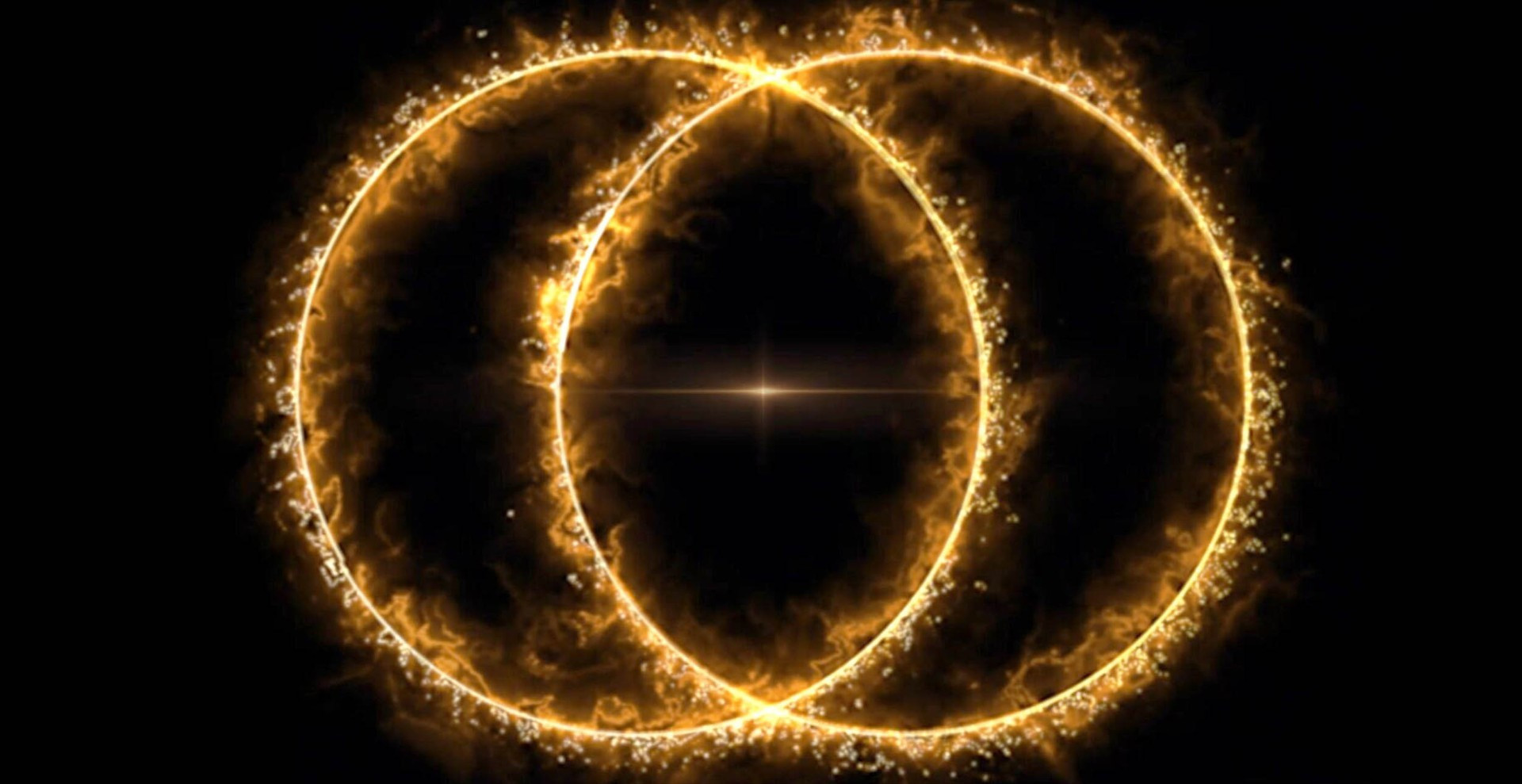
Astronomers have detected the most distant and energetic “odd radio circle” (ORC) observed to date, identifying a striking double-ring system around a galaxy billions of light-years away. The object, designated RAD J131346.9+500320, features two overlapping circles of faint radio emission—only the second known ORC with such a dual structure—and is located at an estimated redshift of ~0.94, meaning we see it as it was when the universe was roughly half its current age. The discovery was made via the LOFAR radio telescope array and aided by citizen scientists from the RAD@home Collaboratory. New hypotheses suggest that such ORCs may result from powerful “superwinds” emanating from galactic centers (rather than only from black hole mergers), reshaping long-held theories of their origin.
Sources: Science Daily, Earth.com
Key Takeaways
– This newly discovered ORC (RAD J131346.9+500320) is the most distant and energetic ever observed and uniquely shows two intersecting radio rings rather than a single loop.
– The discovery underscores the growing role of citizen science in frontier astrophysical work, as volunteers helped flag this unusual object.
– Emerging models support the idea that superwinds from active galaxies, not just black hole collisions, may drive the formation of ORCs by triggering shock waves in surrounding plasma.
In-Depth
Odd Radio Circles (ORCs) have become one of the more compelling curiosities in modern radio astronomy. Since the first confirmed detections in the last few years, they’ve challenged astronomers to explain how vast, circular shells of radio emission can form around galaxies, with no obvious counterparts at visible or X-ray wavelengths. The new discovery of RAD J131346.9+500320 marks a milestone—not just because it’s farther away and brighter than any ORC observed before, but because of its unusual double-ring structure.
Located at a redshift of ~0.94, this means the radio emissions we now detect left their source when the universe was about half its present age. The dual rings overlap like a cosmic Venn diagram, making this only the second ORC discovered with such intersecting morphology. Its detection came through the powerful LOFAR (Low Frequency Array) radio telescope, which is especially capable of surveying large swaths of sky at low radio frequencies. What makes the effort even more compelling is that citizen scientists, working through the RAD@home Collaboratory, helped flag this anomaly for closer professional scrutiny.
Until recently, many theories for ORC formation leaned toward dramatic, violent events—such as merging supermassive black holes generating shock waves outward through intergalactic medium. But this discovery is pushing alternative models to the fore. In particular, astronomers are now considering whether energetic “superwinds” expelled from active galaxies—winds driven by accretion or jets from central black holes—can carve out these giant radio shells. Those winds, interacting with surrounding plasma, might generate shock fronts that reenergize dormant electrons, making them shine in radio wavelengths as an expanding ring.
Adding context, the same study also reports two other enormous radio-ring systems. One is a galaxy with a jet that bends sharply and ends in a circular radio structure; the other is a colossal ring more than a million light-years in diameter tied to a jet structure. All three lie in galaxy cluster environments, hinting that local plasma density and cluster dynamics play a role in shaping and sustaining these patterns.
This discovery not only expands the catalog of known ORCs but also presses theoretical work to reconcile how rare, large, faint, and morphologically varied radio rings emerge. Future telescopes—like the Square Kilometre Array (SKA)—plus wide optical and spectral surveys (DESI, LSST) are expected to uncover many more ORCs, giving astronomers the statistics and multiwavelength data needed to test competing formation models and better understand how galaxies, black holes, and their environments interplay at the grandest scales.