

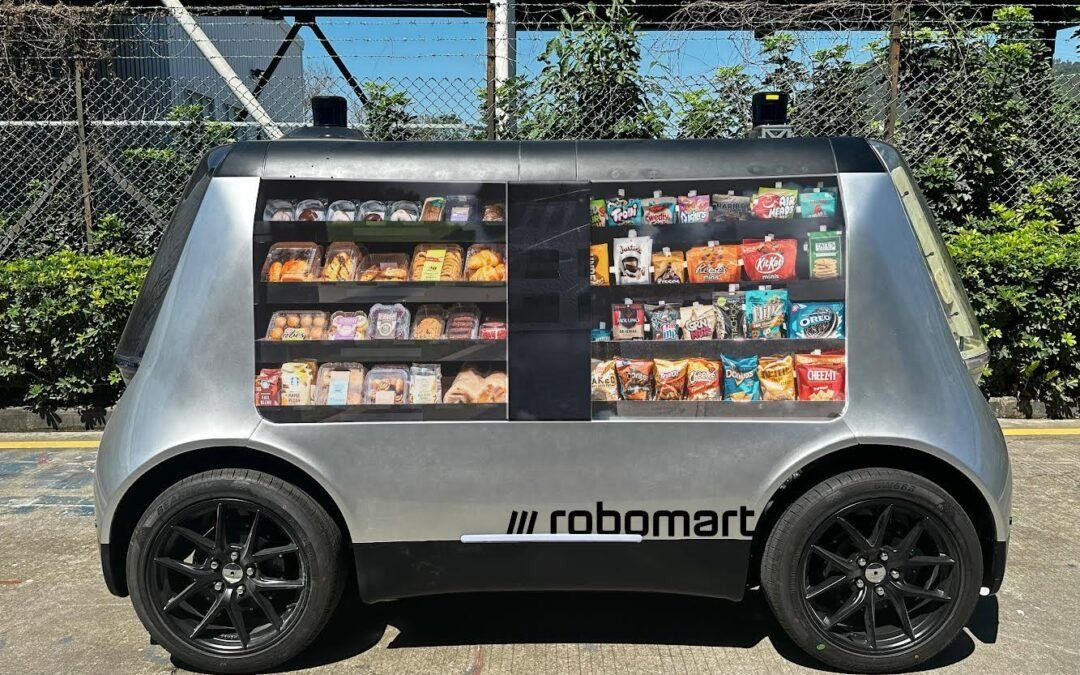
Robomart, a Los Angeles–based startup, just unveiled its RM5 — a shuttle-bus-sized, all-electric, level-4 autonomous delivery vehicle equipped with 10 climate-controlled lockers, each holding about 50 lb (total capacity ~500 lb), designed to make multi-order, last-mile delivery economically viable at just a flat $3 delivery fee, with no hidden markups, surcharges, or tips. The company claims the RM5 can drive up to 25 mph on public roads with a 112-mile range, enabling 70 percent lower fulfillment costs by consolidating delivery runs for several retailers into one efficient, app-driven autonomous marketplace. Robomart plans to launch in Austin, Texas later this year, after testing earlier mobile convenience store models and despite raising under $5 million since its 2017 founding.
Sources: The Verge, TecheBlog, TechCrunch
Key Takeaways
– High-capacity, low-cost delivery model: RM5 holds ~500 lb via 10 lockers, promising significant cost savings compared to human delivery services.
– Simplified pricing: A flat $3 fee with no extra charges makes on-demand delivery more transparent and potentially more appealing to price-conscious customers.
– Strategic rollout & background: Despite modest funding (under $5 million), Robomart is building on earlier mobile store concepts and preparing a focused launch in Austin, aiming to extend its autonomous marketplace model.
In-Depth
Robomart’s RM5 is an intriguing leap in autonomous delivery, combining high capacity with affordability.
In contrast to the usual sidewalk bots or drone experiments, the RM5 resembles a small shuttle—electric, driverless, and able to transport up to 500 pounds spread across ten climate-controlled lockers. That design allows it to batch deliveries from multiple retailers in one trip, potentially slashing fulfillment costs by a striking 70% compared to traditional human courier models.
The key to their strategy is the flat-fee model—only $3 per run, with no hidden charges for markups, service fees, or tips—offering clarity at a time when many delivery platforms layer on opaque fees. Users will interact through an app, selecting items from participating stores, similar to apps like Uber Eats or Instacart, but this time backed by an autonomous fleet.
Robomart is piloting its launch in Austin, Texas this year, hoping the fruit of years of development—from its original “store-on-wheels” concept to this more scalable autonomous marketplace—will resonate with both retailers and cost-savvy customers.
What’s notable is the lean funding: the company has scaled to five bot generations with under $5 million in backing. That restraint may mean smarter spending—and a model driven by economic practicality rather than flashy tech alone. If the RM5 lives up to its promises, it might just make living room delivery the new neighborhood convenience store.