

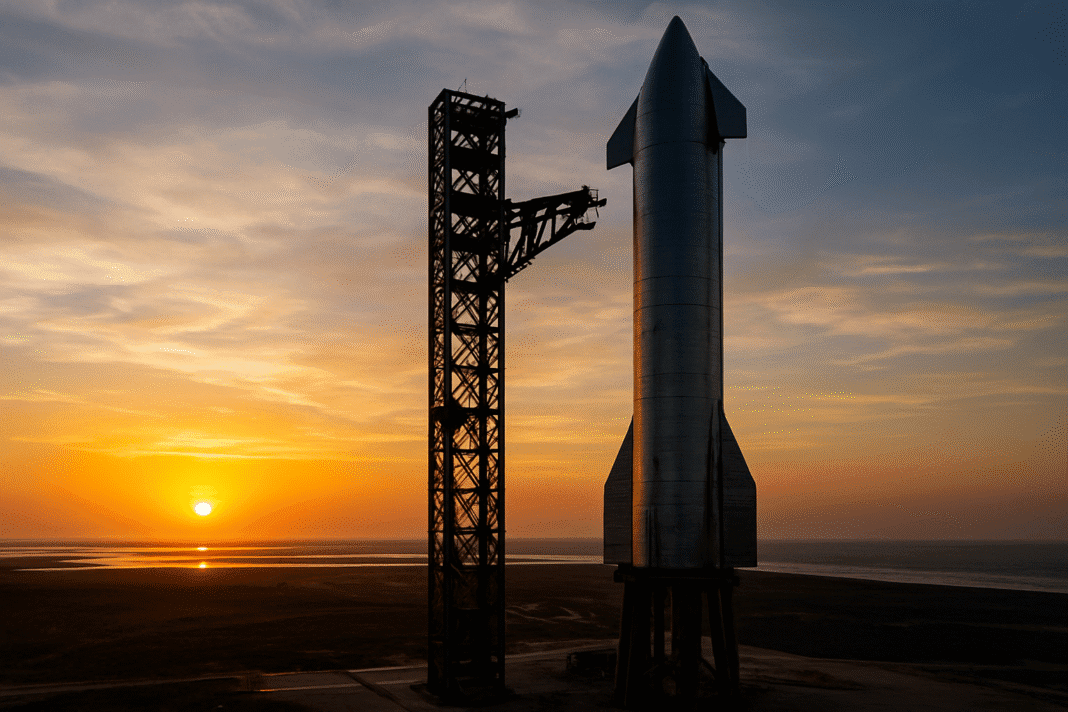
SpaceX is aiming to launch Starship Flight 11 on October 13, 2025, from its Starbase facility in Texas, marking what may be the final mission for its current “Version 2” configuration. The company recently completed static fire tests of the Super Heavy booster, deploying previously flown engines, and is preparing the upper stage for its own tests. This mission will include deployment of mock Starlink satellites and reentry experiments, while the Super Heavy booster is slated to splash down in the Gulf of Mexico. Meanwhile, the 10th flight marked a notable recovery from earlier mishaps, with Starship achieving nearly all key objectives—deploying dummy satellites and testing new heat shield tiles. The launch is a crucial stepping stone both for Elon Musk‘s Mars ambitions and NASA’s Artemis lunar plans, though challenges remain around environmental reviews, landing precision, and competition over access to future launch sites.
Key Takeaways
– The 11th Starship mission is poised to be the last in the “Version 2” era, and will test reuse and reentry systems more aggressively.
– Flight 10 was a turnaround success after prior failures, demonstrating better heat-shield performance and satellite deployment.
–
Regulatory, technical, and competitive obstacles—especially regarding Florida launch ambitions—still loom over SpaceX’s expansion plans.
In-Depth
We’ve seen SpaceX push the envelope harder with each Starship test, and Flight 11 looks like it could be a pivotal moment. The company has scheduled the launch for October 13, 2025 from Starbase, Texas, with the launch window opening at 6:15 p.m. CT. That’s based on multiple reporting outlets, and it aligns with SpaceX’s pattern of announcing major static fire tests before rollout. Space.com confirms the target date, and Teslarati adds that this will be the final “Version 2” configuration to fly. That means what happens here informs the designs to come.
In recent weeks, NASA observers and space media have highlighted SpaceX completing static fire trials of the Super Heavy booster—Booster 15-2—and preparing the upper stage, Ship 38, for its own tests. The booster test was visually dramatic, with dozens of Raptor engines burning on the pad. Digital Trends notes that this test is the last one under the current pad infrastructure, meaning future missions will likely use upgraded facilities.
Flight 10—the mission preceding this one—served as a kind of redemption. After a string of failures earlier in 2025 (including a Starship upper stage explosion during a static fire test in June), the 10th flight deployed mock Starlink satellites, tested upgraded heat shield tiles, and executed maneuvers intended to validate reentry dynamics. Reuters reports that NASA sees these movements as essential for building confidence toward lunar missions under Artemis. Space.com confirms many of the mission objectives were met, readjusting perceptions of risk in Starship’s development cycle.
However, problems remain. SpaceX has to convince regulators to permit increasingly ambitious flights, especially as they push to launch from Florida’s Space Coast. The company wants to operate at Cape Canaveral and Kennedy, but local residents and competing space firms have already raised noise, safety, and scheduling objections. The Washington Post covers how United Launch Alliance and others worry about frequent Starship launches crowding out their own operations. The environmental review process still drags, and there’s tension over whether SpaceX will dominate launch access in the eastern U.S.
In terms of mission profile, we should expect the Super Heavy booster to attempt a controlled water landing in the Gulf of Mexico (rather than returning to pad), while the upper stage will simulate its descent toward the Indian Ocean. The mock Starlink deployments, reentry maneuvering, and heat shield performance will be under close scrutiny. Success could validate design tweaks and pave the way for future crewed missions. Failure—or partial success—could set back timelines for Mars ambitions and cast doubt on the transition to “Version 3.”
All eyes will also be on whether SpaceX can maintain launch cadence and rapidly reuse hardware without catastrophic failure. This is not just a test of rocket parts—it’s a test of whether their entire development and operational philosophy can survive real-world stresses.