

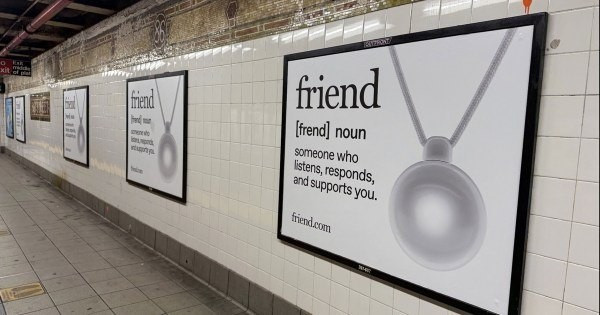
AI startup Friend poured over $1 million into a New York City subway ad blitz to push its always-listening wearable AI device, plastering more than 11,000 car cards, 1,000 platform posters, and 130 urban panels across the system. The campaign’s stark minimalist aesthetic was meant to provoke public reaction, and that’s exactly what it got: vandals scrawled “surveillance capitalism” and “get real friends” across many of the ads, while critics have decried the device’s privacy implications. Wired called the product “I Hate My Friend,” noting that the pendant’s always-on microphones and snarky commentary made users and bystanders alike uneasy. Despite the backlash, Friend CEO Avi Schiffmann says the ads were “a huge gamble” and claims this is “the world’s first major AI campaign.”
Sources: TechCrunch, AdWeek
Key Takeaways
– Friend’s subway ad blitz is an unusually bold traditional marketing play for an AI startup, aiming to create publicity via controversy rather than subtle persuasion.
– The device itself has drawn sharp criticism over privacy and social acceptability—its always-on listening and tendency toward snide commentary have alienated both testers and the public.
– Schiffmann is clearly playing high stakes: he admits his resources are nearly exhausted, and the ad design (lots of white space, provocative tone) seems to intentionally court reactions, positive or negative.
In-Depth
In a climate saturated with flashy digital marketing and influencer tie-ins, the AI startup Friend decided to go low-tech—and extremely visible. With over one million dollars committed to subway ads in New York City, the campaign stretches across all five boroughs, covering subway cars, platforms, and billboard panels. That translates into more than 11,000 car cards, a thousand or more platform posters, and 130 urban panels—some stations such as West 4th Street nearly dominated by Friend’s stark white advertisements. The messaging is intentionally spare, playing with blank space to make the viewer think. CEO Avi Schiffmann described the move as a “huge gamble” made with “not much money left,” positioning it as “the world’s first major AI campaign.”
This marketing approach is more guerilla than polished, built on provoking discussion instead of quietly persuading. The campaign is already generating chatter—but not all of it favorable. Critics and riders alike have defaced the ads with messages like “surveillance capitalism” and pleas to “get real friends,” clearly signaling public discomfort with the product’s promise of constant companionship through ambient listening.
The product itself, a pendant-style AI wearable, has come under significant fire. Wired testers subjected it to real-world trials and described their experience with irritation, embarrassment, and social friction. The device listens passively to ambient conversations and pipes commentary back to the user via a companion app. That always-on design raises questions about consent, social norms, and how much intrusion is too much. Many people around users appeared unsettled; some even accused the wearer of “wearing a wire.” The tone of the AI—often sarcastic or snide—exacerbated that discomfort. The backlash is not just theoretical: in practice, the product provoked suspicion and tension in everyday environments.
Schiffmann seems acutely aware of the stakes. He acknowledges public wariness around AI—especially in New York—and says he deliberately designed the ads to invite social commentary, rather than burying them in slick visuals. But that style comes with massive risk. The company is reportedly running low on funds, so failure would be costly. If public sentiment turns decisively negative, the campaign could become a cautionary tale rather than a breakthrough.
From a broader lens, what’s happening with Friend taps into bigger tensions over surveillance, data control, and the commercialization of intimacy. Wearables, AI companions, and ambient listening flirt dangerously with the threshold between convenience and overreach. Friend’s campaign is not just selling a gadget; it’s marketing a worldview about how much we want technology inside our private lives. Whether it succeeds or collapses under backlash, it’s pushing the boundary on how AI brands engage in the public square—and challenging us all to ask: at what cost does convenience come?