

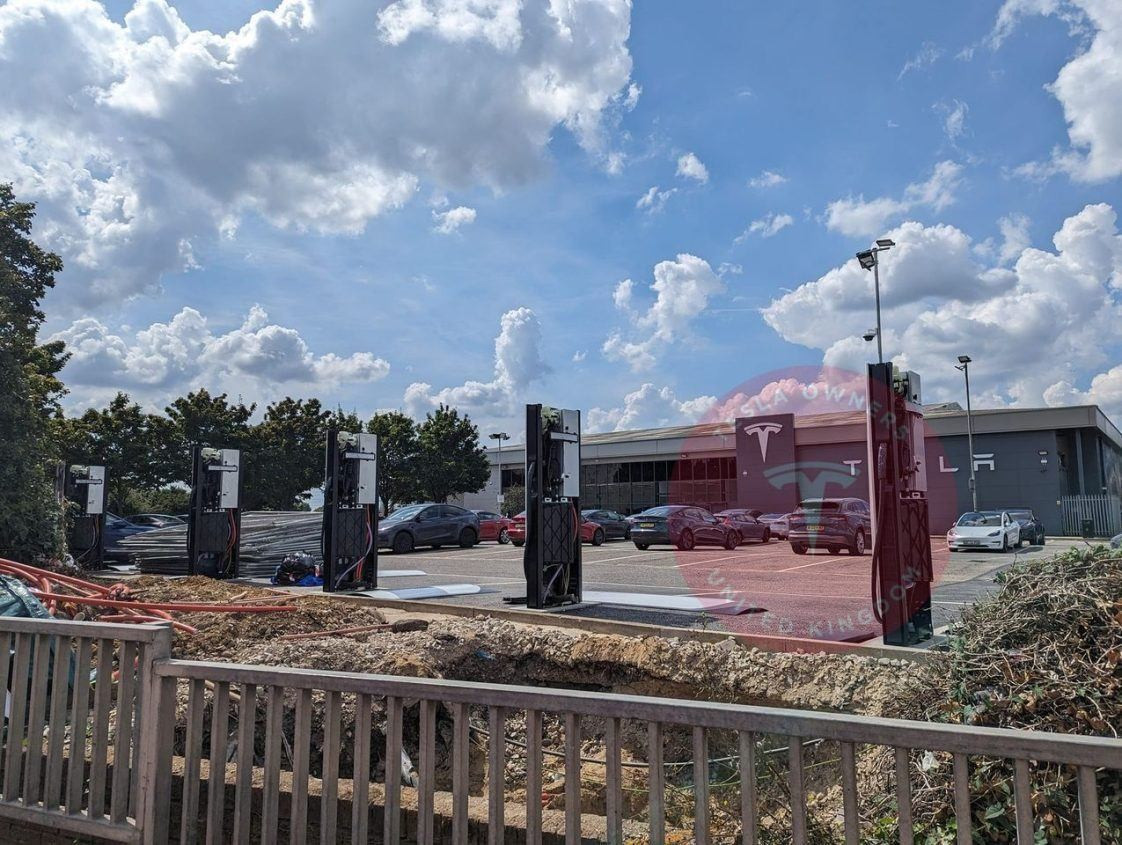
Tesla has turned its first fully realized V4 Supercharger station live in Redwood City, California, enabling charging at up to 500 kilowatts — though only its Cybertruck can fully exploit that speed for now. The station features new V4 cabinets and extended-length cables designed to better accommodate different vehicle layouts. Tesla confirms that while this site is Tesla-only at launch, support for non-Tesla vehicles is coming. The move comes amid Tesla’s global rollout of V4 assets, such as recent launches in China, and follows earlier upgrades in North America enabling 325 kW output on V4 posts tied to older V3 cabinets.
Sources: Reuters, Inside EVs
Key Takeaways
– Tesla’s first full V4 Supercharger in Redwood City reaches 500 kW, but only the Cybertruck currently can accept that peak.
– Earlier this year, Tesla enabled 325 kW charging on V4 posts linked to V3 cabinets in North America, broadening usable power before full V4 rollout.
– The rollout is part of a global push: Tesla already brought V4 stations online in China, and further deployment is planned in cities worldwide.
In-Depth
Tesla’s unveiling of its first full V4 Supercharger station in Redwood City marks a milestone in EV charging infrastructure. With the new V4 cabinet architecture driving eight charging stalls, the site can deliver up to 500 kilowatts of power under ideal conditions. That’s a meaningful jump from prior Supercharger limits and promises shorter charging times for vehicles built to handle the load. According to Tesla and third-party coverage, only the Cybertruck in its current lineup supports that full 500 kW draw, meaning other Tesla models will see less dramatic gains in charge speed at this stage.
Earlier in 2025, Tesla upgraded many V4 posts (which were still connected to V3 cabinets) to support 325 kW in North America. That interim step allowed some performance improvements for models capable of drawing more power, although it didn’t come close to the full potential of V4 cabinets. The Redwood City station represents the first deployment where the whole chain — posts and cabinet — uses the new V4 setup.
The broader rollout is already under way globally. In China, Tesla launched a batch of V4 stations across Shanghai, Chongqing, Gansu, and Zhejiang, open to non-Tesla EVs. Tesla has also signaled ambitious expansion plans — in China, they aim to scale to more stations and deeper coverage in cities like Beijing and Guangzhou. On the U.S. front, early construction of V4 sites is beginning (for example in Campbell, California), signaling that the full V4 network may roll out quickly.
From a strategic perspective, Tesla’s move helps defend its charging network advantage as other players scale up fast-charging capacity. By pushing toward 500 kW capabilities and making its network accessible to non-Tesla vehicles over time, Tesla positions itself not just as a carmaker but as a backbone of EV infrastructure. For Tesla owners, this means faster road trips; for the broader EV community, it’s a step toward more unified, high-power charging options.