

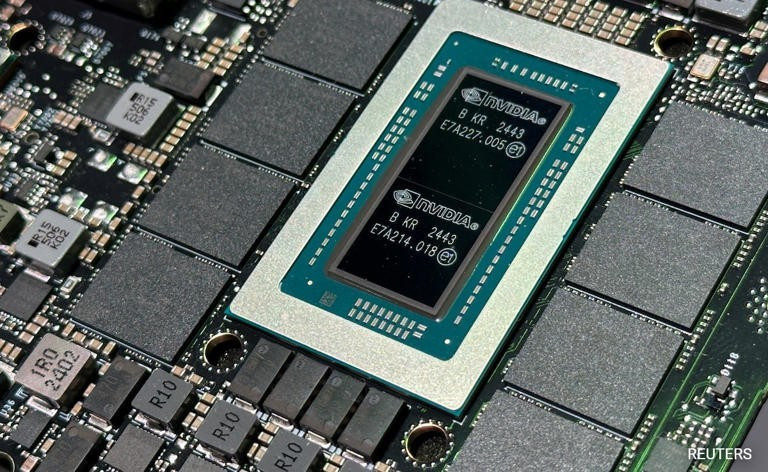
In a recent appearance on CBS’s “60 Minutes” and comments aboard Air Force One, President Donald Trump declared that the U.S. will not allow Nvidia to sell its most advanced AI processor, the “Blackwell” chip, to China or other foreign entities. He emphasized that these high-end chips will be reserved for American customers only, citing national security and U.S. technological leadership concerns. Sources report that while downgraded versions may still be considered for export, the top-tier models will remain off-limits to Beijing. The move marks a sharp turn in U.S. export-control policy as Washington seeks to contain China’s AI and semiconductor ambitions and secure the domestic edge in strategic technology.
Key Takeaways
– U.S. policy under Trump is explicitly restricting the export of the most advanced Nvidia AI chips — the Blackwell series — to China and other foreign markets, citing national-security risks and tech-leadership priorities.
– While some downgraded versions of Nvidia’s chips may be eligible for export to China under controlled conditions, the top-end chips are strictly U.S.-only, signalling a tougher stance than previous administrations.
– This decision underscores the intensifying U.S.–China tech rivalry, particularly in AI and semiconductors, and signals that U.S. strategy will increasingly treat high-end export control as a tool of strategic competition.
In-Depth
President Trump’s recent remarks place the spotlight once again on the critical intersection of technology, national security, and trade policy. By declaring that Nvidia’s top-tier Blackwell AI chips will be kept exclusively for the United States, he is signaling a paradigm shift in how the U.S. approaches export controls in the semiconductor and AI sectors. Previously, broader export liberalisation efforts had been considered—but this move clearly prioritises containment of high-end tech transfer above all.
The rationale is straightforward – the U.S. wants to ensure that the most powerful AI processing capability doesn’t fall into the hands of a strategic competitor. China’s push to close the gap in AI and advanced computing has long been of concern to U.S. policymakers, and by denying access to Nvidia’s latest chips, the Trump administration is effectively erecting a technological barrier. This aligns with broader export-control frameworks the U.S. has developed in recent years which restrict Chinese access to advanced semiconductors and associated manufacturing tools.
From Nvidia’s perspective, the Blackwell chips are among the most coveted components in the AI computing world—they enable large-scale model training, advanced inference, and malleable infrastructure that can power next-generation systems. By limiting sales abroad, the U.S. is aiming to lock in a technological lead, but also forcing Nvidia to navigate a global strategy in which China remains off-limits for its most advanced products. This raises questions for global supply chains, investor strategy, and the future architecture of AI-hardware markets.
For China, the denial is significant but not necessarily terminal. Lower-end chips or “water-downed” versions may still be permissible, so Beijing may seek to upgrade its indigenous semiconductor capacity or pursue alternatives. At the same time, Chinese firms have already been pressured by regulators about purchasing foreign chips, and this move adds another layer of complexity to Beijing’s tech plans.
Politically, the decision will be welcomed by those who view China as a strategic technology rival and argue that the U.S. must maintain an unbeatable lead in AI and computing. However, critics may argue that overly rigid export controls can harm U.S. firms’ ability to scale globally, reduce market opportunities, and slow innovation. There is also the risk of retaliatory measures by China, or of emergent third-party markets filling the gap.
In essence, Trump’s announcement is more than a corporate or trade story—it is a strategic statement about the future of American tech leadership and the global balance of power in artificial intelligence. By clearly delineating that the Blackwell chips are beyond China’s reach, the U.S. sets a firm line in the sand: certain technologies are too important to global power dynamics to allow open export. Whether this approach will prove sustainable in practice—and whether it will successfully stall China’s AI ambitions—is an open question, but the message is unambiguous: the U.S. intends to keep its most advanced chips inhouse and maintain the edge that comes with them.