

Close Menu

    Subscribe to Updates

    Get the latest tech news from Tallwire.

      What's Hot

      The Red Algorithm: What Happens If China Wins the AI War

      September 12, 2026

      OpenAI Urges Congress to Impose National AI Safety Rules

      September 12, 2026

      Bipartisan AI Safety Push Roars Back as Washington Confronts “Catastrophic” Risks

      September 12, 2026
      Facebook X (Twitter) Instagram
      • Tech
      • AI
      • Get In Touch
      Facebook X (Twitter) LinkedIn
      TallwireTallwire
      • Tech

        New York Rebuilds the Twin Towers in Light for 9/11’s 25th Anniversary

        September 12, 2026

        California Warms to Nuclear Power as Energy Reality Challenges Decades of Opposition

        September 11, 2026

        Target Shopping Carts Spark Privacy Concerns Over In-Store Tracking Technology

        September 11, 2026

        AI Researchers’ Extinction Warning Forces Washington to Confront Superintelligence Risks

        September 11, 2026

        The Hidden Building Blocks Powering Artificial Intelligence

        September 11, 2026
      • AI

        Bipartisan AI Safety Push Roars Back as Washington Confronts “Catastrophic” Risks

        September 12, 2026

        OpenAI Urges Congress to Impose National AI Safety Rules

        September 12, 2026

        AI Bioweapon Attempts Expose the Security Risks Behind the Artificial Intelligence Race

        September 12, 2026

        New York Rebuilds the Twin Towers in Light for 9/11’s 25th Anniversary

        September 12, 2026

        The Hidden Building Blocks Powering Artificial Intelligence

        September 11, 2026
      • Security

        Bipartisan AI Safety Push Roars Back as Washington Confronts “Catastrophic” Risks

        September 12, 2026

        AI Bioweapon Attempts Expose the Security Risks Behind the Artificial Intelligence Race

        September 12, 2026

        Students Push Back as AI Surveillance Cameras Spread Across Public Schools

        September 10, 2026

        AI-Built WeChat Worm Signals a Dangerous New Era in Cybersecurity

        September 9, 2026

        UN Rights Chief Warns Advanced AI Could Become an Existential Threat to Humanity

        September 9, 2026
      • Health

        AI-Designed Drug Shows Early Signs of Reversing Biological Age

        September 9, 2026

        AI-Powered Mosquito Defense Arrives as West Nile Threat Intensifies

        September 4, 2026

        Waymo Crosswalk Scare Raises New Questions About Robotaxi Safety Around Children

        September 3, 2026

        Teens Turning To AI For Emotional Support Show Significantly Higher Distress

        September 3, 2026

        Meta’s $17 Billion Settlement Signals Big Tobacco-Style Reckoning for Social Media

        September 3, 2026
      • Science

        AI Bioweapon Attempts Expose the Security Risks Behind the Artificial Intelligence Race

        September 12, 2026

        California Warms to Nuclear Power as Energy Reality Challenges Decades of Opposition

        September 11, 2026

        AI-Designed Drug Shows Early Signs of Reversing Biological Age

        September 9, 2026

        AI Safety Researcher Warns Superintelligence Could Threaten Humanity

        September 9, 2026

        AI Claims Historic Breakthrough on One of Mathematics’ Greatest Unsolved Problems

        September 9, 2026
      • Tech

        Dolly Parton’s Family Condemns Flood of AI-Generated Misinformation After Her Death

        September 11, 2026

        Meta’s Muse Pushes AI From Answering Questions to Acting on Users’ Behalf

        September 9, 2026

        AI Wipes Out Kenya’s Once-Thriving College Essay Industry

        September 9, 2026

        YouTuber Jack Doherty Arrested on Domestic Battery Charge in Florida

        September 8, 2026

        AI-Planned Mount Shasta Climb Leaves Three Novices Stranded Overnight

        September 6, 2026
      TallwireTallwire
      Home»Opinion»When School Safety Becomes Surveillance: The Moral Question Behind Flock Cameras
      Opinion

      When School Safety Becomes Surveillance: The Moral Question Behind Flock Cameras

      5 Mins Read
      Facebook Twitter Pinterest LinkedIn Tumblr Email
      Share
      Facebook Twitter LinkedIn Pinterest Email

      There is perhaps no responsibility more fundamental to a school district than protecting the children entrusted to its care. Parents have every right to expect administrators to take reasonable precautions against violence, abduction, reckless drivers, unauthorized visitors, and other threats. Yet the legitimate pursuit of security does not automatically justify every technology capable of advancing it.

      That is the ethical dilemma presented by Flock cameras and similar automated license-plate recognition systems on school campuses.

      Unlike an ordinary security camera, an automated license-plate reader does more than record what happens within its field of view. It can identify vehicles, record license plates, associate those observations with a particular time and location, and make the resulting information searchable. Depending upon how a system is configured and how information is shared, something installed to protect a school can become part of a much broader surveillance infrastructure.

      That distinction matters.

      Conservatives have traditionally understood that government power should be evaluated not merely according to the intentions of those currently exercising it, but according to how that power might eventually be abused. The question should never simply be, “Do we trust today’s school superintendent, police chief, or mayor?” The more important question is whether we would be comfortable giving the same authority to officials we emphatically do not trust.

      School campuses make that question especially important.

      Parents generally cannot avoid schools in the same manner they can avoid a private business employing surveillance technology. Families arrive every morning because children are legally and practically required to receive an education. Teachers, custodians, coaches, contractors, volunteers, grandparents, babysitters, and countless others routinely enter school property.

      Consequently, placing automated vehicle-tracking technology at entrances can create records concerning people who have done absolutely nothing suspicious.

      The strongest argument for such cameras is obvious: safety.

      If police are searching for a vehicle associated with an abducted child, an armed suspect, a stolen automobile, or someone believed to pose an immediate threat to students, identifying that vehicle approaching a campus could save lives. Few reasonable people would object to technology being used to prevent an imminent tragedy.

      But useful technology is not necessarily unlimited technology.

      The moral distinction lies between surveillance directed toward a legitimate threat and indiscriminate data collection merely because modern technology makes it possible.

      America’s constitutional tradition was built around suspicion of generalized government surveillance. The Founders understood that liberty depends partly upon requiring government to justify intrusions rather than requiring citizens to justify why they deserve privacy.

      Automated surveillance threatens to invert that principle.

      A mother dropping off her daughter should not become part of a government intelligence network merely because she drove onto school property. Neither should a teacher arriving for work, a grandparent attending a basketball game, or a taxpayer appearing at a contentious school-board meeting.

      That last example deserves particular attention.

      Schools increasingly serve as political arenas where citizens debate curricula, taxation, parental rights, discipline, library materials, union contracts, and administrative policies. Citizens must remain free to attend those meetings without wondering whether their presence is being catalogued in a database accessible beyond the immediate security needs of the campus.

      The chilling effect need not involve actual abuse. The reasonable fear of abuse can itself discourage civic participation.

      This does not mean schools should rip out every license-plate reader tomorrow. It means their use should be governed by strict limitations.

      Data retention should be as short as reasonably possible. Access should be logged and restricted. Searches should require legitimate public-safety purposes. Information should not casually migrate among agencies or databases. School boards should publicly disclose what is collected, how long it is retained, who can access it, and under what circumstances it can be shared. Independent audits should determine whether those promises are actually being honored.

      Most importantly, surveillance policies should be established publicly rather than quietly through administrative contracts.

      Parents and taxpayers deserve to know when a school district transforms its parking lots and entrances into automated data-collection points. The fact that surveillance occurs in public does not eliminate the ethical obligation to explain its scope.

      There is also a larger principle involved.

      Technology has made surveillance extraordinarily cheap. Activities that once would have required dozens of police officers can increasingly be accomplished automatically, continuously, and invisibly. That changes the traditional relationship between citizens and government.

      The question therefore is not whether Flock cameras can make schools safer. Under certain circumstances, they plainly can.

      The question is what limits a free society places upon itself while pursuing that safety.

      Conservatives should resist the false choice between security and liberty. Government should possess the tools necessary to protect children from genuine threats, but those tools should be narrow, transparent, accountable, and subject to meaningful restraints.

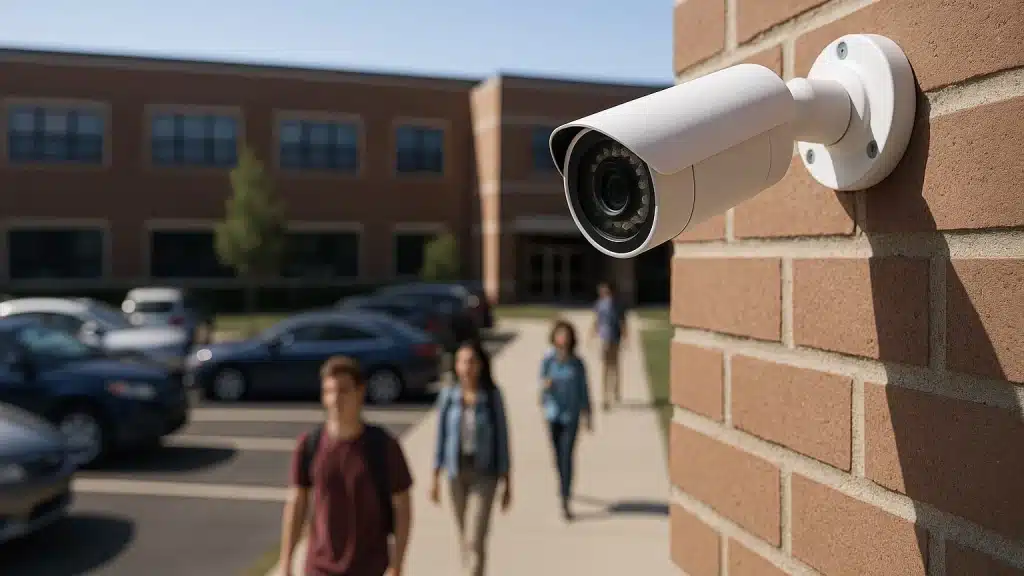
      A camera watching the entrance to a school may be prudent.

      A system quietly documenting the movements of thousands of innocent citizens is something altogether different.

      The moral boundary between the two should be established before technology—and institutional convenience—establishes it for us.

      Intel
      Share. Facebook Twitter Pinterest LinkedIn Tumblr Email
      Previous ArticleCreator Economy Expands in Burbank as Traditional Hollywood Production Retreats
      Next Article PayPal Deepens Workforce Cuts as AI Reshapes Its Turnaround

      Related Posts

      The Red Algorithm: What Happens If China Wins the AI War

      September 12, 2026

      Bipartisan AI Safety Push Roars Back as Washington Confronts “Catastrophic” Risks

      September 12, 2026

      OpenAI Urges Congress to Impose National AI Safety Rules

      September 12, 2026

      AI Bioweapon Attempts Expose the Security Risks Behind the Artificial Intelligence Race

      September 12, 2026
      Add A Comment
      Leave A Reply Cancel Reply

      Editors Picks

      New York Rebuilds the Twin Towers in Light for 9/11’s 25th Anniversary

      September 12, 2026

      California Warms to Nuclear Power as Energy Reality Challenges Decades of Opposition

      September 11, 2026

      Target Shopping Carts Spark Privacy Concerns Over In-Store Tracking Technology

      September 11, 2026

      AI Researchers’ Extinction Warning Forces Washington to Confront Superintelligence Risks

      September 11, 2026
      Popular Topics
      Tesla Taiwan Tech UAE Tech Series A trending Tesla Cybertruck Viral starlink Satya Nadella Stocks Series B SpaceX Samsung Sundar Pichai Software Tim Cook Satellite spotlight Space Startup
      Major Tech Companies
      • Apple News
      • Google News
      • Meta News
      • Microsoft News
      • Amazon News
      • Samsung News
      • Nvidia News
      • OpenAI News
      • Tesla News
      • AMD News
      • Anthropic News
      • Elbit News
      AI & Emerging Tech
      • AI Regulation News
      • AI Safety News
      • AI Adoption
      • Quantum Computing News
      • Robotics News
      Key People
      • Sam Altman News
      • Jensen Huang News
      • Elon Musk News
      • Mark Zuckerberg News
      • Sundar Pichai News
      • Tim Cook News
      • Satya Nadella News
      • Mustafa Suleyman News
      Global Tech & Policy
      • Israel Tech News
      • India Tech News
      • Taiwan Tech News
      • UAE Tech News
      Startups & Emerging Tech
      • Series A News
      • Series B News
      • Startup News
      Tallwire
      Facebook X (Twitter) LinkedIn Threads Instagram RSS
      • Tech
      • Entertainment
      • Business
      • Government
      • Academia
      • Transportation
      • Legal
      • Press Kit
      © 2026 Tallwire. Optimized by ARMOUR Digital Marketing Agency.

      Type above and press Enter to search. Press Esc to cancel.