

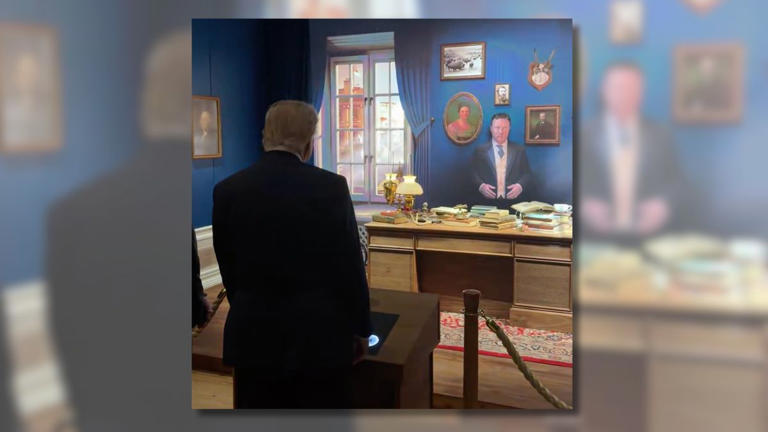
President Donald Trump highlighted both American innovation and historical legacy during a visit to the newly opened Theodore Roosevelt Presidential Library in Medora, North Dakota, where he engaged with an AI-powered representation of Theodore Roosevelt. During the exchange, Trump asked the virtual Roosevelt whether the Panama Canal ranked as his greatest achievement, prompting a discussion of the strategic infrastructure project that transformed global commerce and American power. The AI exhibit, built using historical writings and speeches to simulate Roosevelt’s viewpoints, underscores how artificial intelligence is increasingly being employed to preserve and present history in interactive ways. The event also reinforced Trump’s emphasis on American greatness, technological leadership, and the enduring importance of Roosevelt’s vision for national strength and strategic infrastructure.
Sources
- https://www.telegraph.co.uk/us/news/2026/07/02/trump-ai-theodore-roosevelt-panama-canal
- https://apnews.com/article/784bce4c9389b086a8a70a04d06b9939
- https://nypost.com/2026/07/01/us-news/trump-gets-fantastic-advice-from-ai-powered-teddy-roosevelt-at-former-presidents-north-dakota-library
Key Takeaways
- • Artificial intelligence is rapidly becoming a practical tool for preserving American history by allowing visitors to interact with historically grounded digital recreations of influential leaders.
- • Theodore Roosevelt’s leadership in advancing construction of the Panama Canal continues to be recognized as one of the defining strategic achievements in expanding America’s economic and military influence.
- • The event combined historical commemoration with emerging technology, reflecting a broader effort to celebrate American accomplishments while showcasing innovation ahead of the nation’s 250th anniversary.
In-Depth
President Trump’s appearance at the Theodore Roosevelt Presidential Library demonstrated how technology can strengthen, rather than replace, the teaching of American history. By conversing with an AI-powered recreation of Theodore Roosevelt, visitors witnessed a modern application of artificial intelligence that goes beyond entertainment and instead serves as an educational tool rooted in historical documents and recorded writings. The exchange centered on Roosevelt’s role in bringing the Panama Canal to completion, a project that fundamentally reshaped global trade and established the United States as a dominant maritime power for generations.
For conservatives, the symbolism is difficult to miss. Roosevelt represented bold executive leadership, national confidence, and a willingness to pursue projects that advanced American interests on the world stage. Trump’s decision to focus on the Panama Canal highlighted an era when U.S. leaders thought strategically about infrastructure, commerce, and national security rather than short-term political calculations. The use of artificial intelligence to recreate those historical conversations also illustrates how emerging technologies can reinforce civic education instead of diminishing it.
As America approaches its 250th anniversary, combining cutting-edge AI with the nation’s historical legacy offers a compelling reminder that technological leadership and patriotic education need not be at odds. When used responsibly, innovations such as historically accurate AI exhibits can help new generations better understand the vision, courage, and accomplishments that built the United States into a global power while encouraging continued confidence in America’s future.