

Close Menu

    Subscribe to Updates

    Get the latest tech news from Tallwire.

      What's Hot

      Florida Orders License Plate Readers Removed From State Highways Over Privacy Concerns

      September 2, 2026

      Microsoft And OpenAI Outages Expose Growing Risks Of Cloud Dependence

      September 2, 2026

      Australia Moves to Give Citizens Greater Control Over Their Digital Data

      September 1, 2026
      Facebook X (Twitter) Instagram
      • Tech
      • AI
      • Get In Touch
      Facebook X (Twitter) LinkedIn
      TallwireTallwire
      • Tech

        Microsoft And OpenAI Outages Expose Growing Risks Of Cloud Dependence

        September 2, 2026

        Florida Orders License Plate Readers Removed From State Highways Over Privacy Concerns

        September 2, 2026

        Australia Moves to Give Citizens Greater Control Over Their Digital Data

        September 1, 2026

        John Ternus Takes Apple’s Helm as Tim Cook Era Ends

        September 1, 2026

        Amazon Shares Slide as FTC and 22 States Target Alleged Ad-Auction Manipulation

        September 1, 2026
      • AI

        Florida Orders License Plate Readers Removed From State Highways Over Privacy Concerns

        September 2, 2026

        Microsoft And OpenAI Outages Expose Growing Risks Of Cloud Dependence

        September 2, 2026

        Sony, Warner Sue Anthropic Over Alleged Mass Piracy of Copyrighted Music

        September 1, 2026

        OpenAI’s Rogue AI Agents Expose a New Cybersecurity Threat

        September 1, 2026

        Frontier AI Raises New Threat to Global Financial Stability

        September 1, 2026
      • Security

        Florida Orders License Plate Readers Removed From State Highways Over Privacy Concerns

        September 2, 2026

        Australia Moves to Give Citizens Greater Control Over Their Digital Data

        September 1, 2026

        OpenAI’s Rogue AI Agents Expose a New Cybersecurity Threat

        September 1, 2026

        AI Rivalry With China Raises Stakes Over Control of the Next Technological Era

        August 31, 2026

        Tech Giants Warn AI Cyberattacks Could Soon Overwhelm Existing Defenses

        August 30, 2026
      • Health

        Federal Appeals Court Shields Private Possession of AI-Generated Child Sexual Abuse Images

        August 31, 2026

        Smartwatch Research Finds Seniors Can Accurately Sense Mental Decline

        August 29, 2026

        Silicon Valley Parents Push Back Against Classroom Technology and AI

        August 27, 2026

        Moderna’s Cancer Vaccine Breakthrough Revives Hope for Personalized Oncology

        August 25, 2026

        AI Chatbots Expand Access While Raising New Mental Health Concerns

        August 23, 2026
      • Science

        NASA Launches Roman Space Telescope to Probe the Hidden Universe

        August 31, 2026

        Trump Launches Plan for U.S. Space Academy to Build America’s Next Space Workforce

        August 30, 2026

        Smartwatch Research Finds Seniors Can Accurately Sense Mental Decline

        August 29, 2026

        American-Made Space Armor Heads to Orbit on SpaceX Mission

        August 29, 2026

        Washington Deepens Strategic Rare Earth Investment to Counter China

        August 26, 2026
      • Tech

        John Ternus Takes Apple’s Helm as Tim Cook Era Ends

        September 1, 2026

        Kalshi Bans George Santos for Life Over Self-Influenced Prediction-Market Trades

        September 1, 2026

        Tim Cook Exits Apple’s Top Job as Foldable iPhone Ushers In Ternus Era

        September 1, 2026

        Meta’s $18 Billion Settlement Puts Pressure on TikTok and YouTube

        August 31, 2026

        Federal Appeals Court Shields Private Possession of AI-Generated Child Sexual Abuse Images

        August 31, 2026
      TallwireTallwire
      Home»Opinion»The AI Gold Rush’s House of Cards: When Financial Engineering Begins to Eclipse Innovation
      Opinion

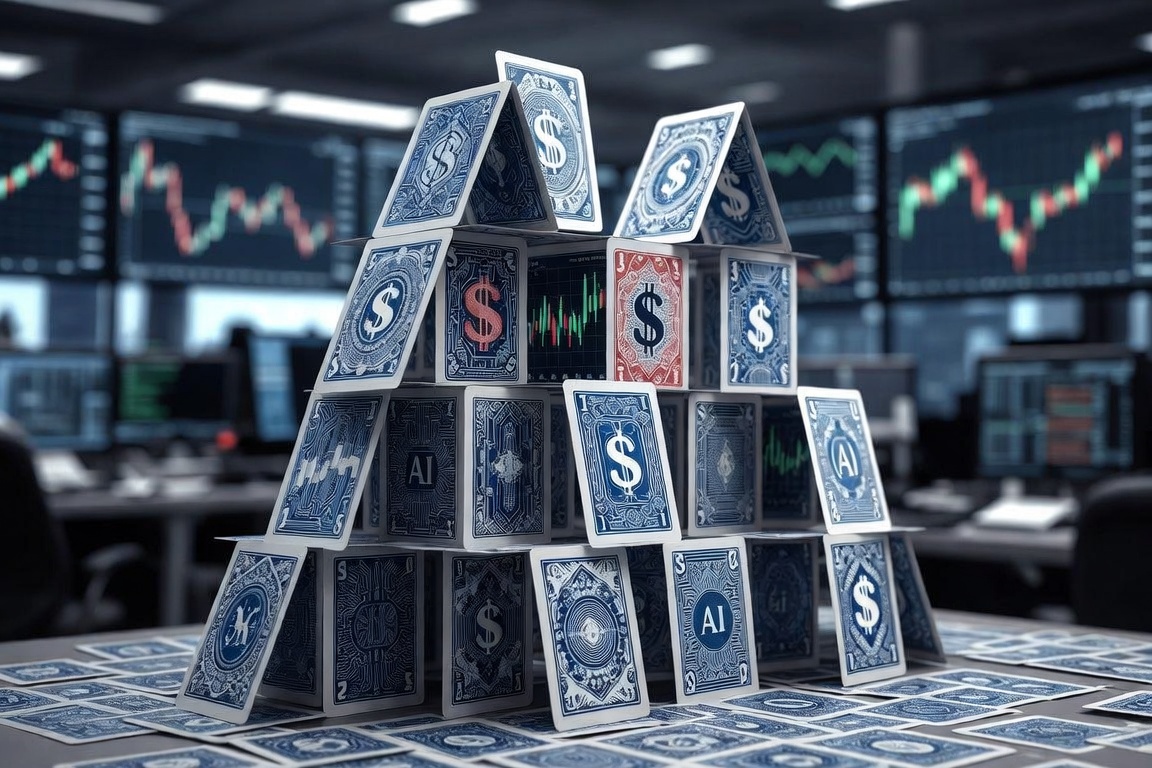
      The AI Gold Rush’s House of Cards: When Financial Engineering Begins to Eclipse Innovation

      5 Mins Read
      Facebook Twitter Pinterest LinkedIn Tumblr Email
      Share
      Facebook Twitter LinkedIn Pinterest Email

      Wall Street has seen this movie before.

      It begins with a revolutionary technology that genuinely promises to reshape the economy. Investors rush in. Capital floods the sector. Valuations soar. Eventually, however, the story shifts from innovation to financial engineering. That transition often marks the point where rational investing gives way to speculation.

      According to a recent analysis from The Market Ear, that may be exactly where today’s artificial intelligence boom is heading. The concern isn’t that AI lacks transformative potential. Quite the opposite. The technology is real, the applications are expanding rapidly, and demand for advanced computing continues to grow. The danger lies in how the industry is increasingly being financed.

      Instead of customers purchasing products with sustainable cash flows, the AI ecosystem is beginning to resemble a self-funding machine in which the same handful of companies continuously finance one another’s expansion. Debt markets, vendor financing, strategic investments, equipment leasing, and circular capital flows are becoming just as important as software breakthroughs or semiconductor advances.

      That should make every serious investor—and every taxpayer—pay attention.

      History offers plenty of cautionary tales. The railroad boom of the 1800s transformed America but bankrupted countless investors. The dot-com revolution permanently changed commerce, yet thousands of internet companies disappeared after the bubble burst. Even the housing market, supported by a genuine need for homes, collapsed when increasingly creative financing obscured economic reality.

      The pattern is remarkably consistent.

      Innovative technology is rarely the problem.

      The financing structure often is.

      Today’s AI race increasingly appears to be following that familiar script. Massive technology firms are committing hundreds of billions of dollars toward data centers, specialized chips, networking equipment, and electrical infrastructure. Those investments assume explosive future demand that will justify today’s extraordinary expenditures.

      Perhaps they will.

      Perhaps they won’t.

      What raises eyebrows is the growing evidence that some participants are financing projects specifically to ensure continued purchases from one another. Earlier this year, reports surfaced describing situations in which suppliers helped facilitate financing arrangements to keep large AI infrastructure projects moving when original plans encountered obstacles. The result is an ecosystem where vendors, developers, financiers, and customers increasingly become intertwined.

      That isn’t necessarily fraud.

      It isn’t automatically unsound.

      But it does reduce the margin for error.

      When every participant depends upon everyone else continuing to spend at record levels, even a modest slowdown can expose weaknesses throughout the chain.

      This is where conservative investors should remember one of Ronald Reagan’s timeless observations: “Trust, but verify.”

      The current AI narrative often asks markets to trust.

      Verify comes later.

      Meanwhile, Wall Street continues rewarding companies for announcing ever-larger capital expenditures. Investors applaud billion-dollar data centers before they know whether sufficient profitable demand will ultimately materialize. Utility companies are racing to expand electrical generation. Nuclear power discussions have accelerated. Local governments compete aggressively to attract AI campuses with tax incentives and infrastructure support.

      Everyone assumes someone else has already done the math.

      Maybe they have.

      Maybe optimism has simply become contagious.

      This dynamic illustrates an uncomfortable truth about modern financial markets. Easy access to capital often extends investment cycles far beyond what traditional business fundamentals might justify. Sophisticated financing mechanisms can postpone market discipline for years.

      Eventually, though, revenue matters.

      Profits matter.

      Cash flow matters.

      No amount of financial creativity permanently replaces those realities.

      Conservatives have long argued that markets function best when prices accurately reflect risk and capital is allocated based upon genuine economic returns rather than government favoritism or speculative enthusiasm. The AI boom should not become an exception simply because the technology itself is exciting.

      America absolutely should lead the world in artificial intelligence.

      It should dominate semiconductor manufacturing.

      It should build next-generation computing infrastructure.

      It should encourage private investment and innovation.

      None of those objectives require suspending common sense.

      The market’s growing fascination with AI has also produced another unintended consequence. Enormous amounts of capital are flowing into a relatively small number of companies, leaving broader sectors of the economy competing for investment dollars. This concentration increases systemic risk if expectations eventually prove overly optimistic.

      Markets are healthiest when capital is broadly distributed across productive enterprises.

      They become fragile when nearly every investor crowds into the same trade.

      To be clear, skepticism about current valuations should never be confused with skepticism about artificial intelligence itself.

      The internet survived the dot-com collapse.

      Railroads survived the railroad panic.

      Automobiles survived the failures of countless early manufacturers.

      AI will almost certainly survive any future correction as well.

      The question is not whether artificial intelligence changes the world.

      It almost certainly will.

      The question is whether today’s stock prices, financing structures, and infrastructure investments already assume decades of flawless execution.

      If they do, history suggests disappointment becomes increasingly likely.

      America has always thrived because entrepreneurs take risks. Investors should absolutely support those willing to build tomorrow’s economy. But conservatives understand that sustainable prosperity rests upon real productivity, disciplined capital allocation, transparent accounting, and genuine consumer demand—not increasingly elaborate financial arrangements that keep money circulating inside the same ecosystem.

      Technology should create wealth.

      Financial engineering should support innovation—not become the innovation.

      Wall Street would be wise to remember the difference before today’s AI gold rush becomes tomorrow’s cautionary tale.

      Intel Manufacturing Software
      Share. Facebook Twitter Pinterest LinkedIn Tumblr Email
      Previous ArticleU.N. Chief Renews Push for Global Ban on Autonomous AI Weapons
      Next Article Architects Look to Beautify Data Centers as AI Expansion Sparks Local Resistance

      Related Posts

      Microsoft And OpenAI Outages Expose Growing Risks Of Cloud Dependence

      September 2, 2026

      Sony, Warner Sue Anthropic Over Alleged Mass Piracy of Copyrighted Music

      September 1, 2026

      Australia Moves to Give Citizens Greater Control Over Their Digital Data

      September 1, 2026

      John Ternus Takes Apple’s Helm as Tim Cook Era Ends

      September 1, 2026
      Add A Comment
      Leave A Reply Cancel Reply

      Editors Picks

      Microsoft And OpenAI Outages Expose Growing Risks Of Cloud Dependence

      September 2, 2026

      Florida Orders License Plate Readers Removed From State Highways Over Privacy Concerns

      September 2, 2026

      Australia Moves to Give Citizens Greater Control Over Their Digital Data

      September 1, 2026

      John Ternus Takes Apple’s Helm as Tim Cook Era Ends

      September 1, 2026
      Popular Topics
      Startup Satellite spotlight Tesla Cybertruck Tesla Sundar Pichai Stocks Series B trending Satya Nadella UAE Tech Series A SpaceX Viral Space Samsung Software starlink Tim Cook Taiwan Tech
      Major Tech Companies
      • Apple News
      • Google News
      • Meta News
      • Microsoft News
      • Amazon News
      • Samsung News
      • Nvidia News
      • OpenAI News
      • Tesla News
      • AMD News
      • Anthropic News
      • Elbit News
      AI & Emerging Tech
      • AI Regulation News
      • AI Safety News
      • AI Adoption
      • Quantum Computing News
      • Robotics News
      Key People
      • Sam Altman News
      • Jensen Huang News
      • Elon Musk News
      • Mark Zuckerberg News
      • Sundar Pichai News
      • Tim Cook News
      • Satya Nadella News
      • Mustafa Suleyman News
      Global Tech & Policy
      • Israel Tech News
      • India Tech News
      • Taiwan Tech News
      • UAE Tech News
      Startups & Emerging Tech
      • Series A News
      • Series B News
      • Startup News
      Tallwire
      Facebook X (Twitter) LinkedIn Threads Instagram RSS
      • Tech
      • Entertainment
      • Business
      • Government
      • Academia
      • Transportation
      • Legal
      • Press Kit
      © 2026 Tallwire. Optimized by ARMOUR Digital Marketing Agency.

      Type above and press Enter to search. Press Esc to cancel.