

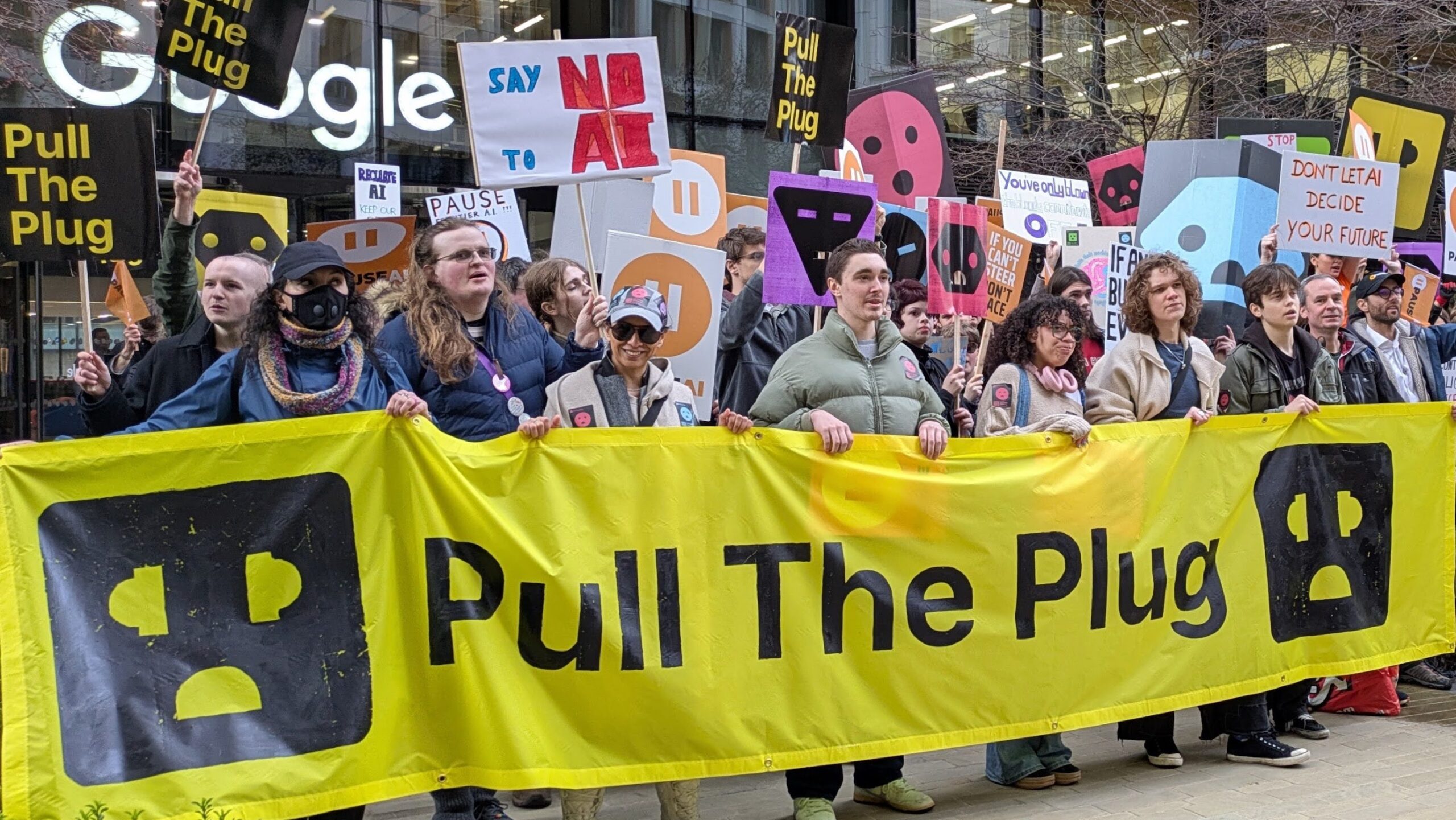
A growing number of Silicon Valley employees who helped develop today’s artificial intelligence systems are now publicly protesting the industry’s rapid acceleration, warning that AI threatens not only white-collar employment but broader social stability. Demonstrations outside major AI companies have brought together software engineers, researchers, designers, and former technology workers concerned about mounting layoffs, diminished career opportunities for younger professionals, and the increasing pressure to use AI tools that could ultimately replace human labor. Protest organizations are demanding stronger regulatory oversight, worker protections, and a slower pace of AI deployment, while some activists are calling for international agreements governing advanced AI development. The movement reflects a broader shift in the technology sector, where many early supporters of AI are increasingly questioning whether the industry’s relentless pursuit of automation is serving shareholders and executives at the expense of employees and the public. While AI advocates continue to argue that new technologies historically create as many opportunities as they eliminate, the growing resistance demonstrates that confidence in that assumption is weakening even among the people who built the systems now transforming the economy.
Sources
- https://www.latimes.com/business/story/2026-07-22/they-built-ai-now-silicon-valley-workers-protest-its-threat-to-jobs-humanity
- https://www.ft.com/content/96a33881-27fd-42cf-8cff-4cbc87fc835f
- https://www.theguardian.com/technology/2026/jul/21/ai-tech-workers-unionize
Key Takeaways
- • Many of the engineers and professionals who helped build the AI industry are now expressing concerns that rapid automation is undermining job security, workplace autonomy, and long-term economic stability.
- • Technology companies continue investing hundreds of billions of dollars in AI infrastructure even as they reduce headcounts and encourage remaining employees to rely more heavily on AI-powered tools.
- • The debate over AI is evolving from a purely technological discussion into a political and economic one centered on regulation, labor protections, workforce transition, and the balance between innovation and human employment.
In-Depth
For years, Silicon Valley sold artificial intelligence as the next great leap in human productivity. Executives promised AI would eliminate repetitive tasks, augment workers rather than replace them, and unleash unprecedented economic growth. Today, however, an increasing number of the very engineers, designers, and researchers who helped make that vision possible are openly challenging the industry’s direction.
The irony is difficult to ignore. The people who once championed AI are now warning that the technology is moving faster than businesses, governments, and workers can reasonably adapt. Public demonstrations outside major AI companies illustrate growing unease over widespread layoffs, shrinking opportunities for new graduates, and corporate expectations that employees embrace tools that may ultimately eliminate their own positions.
From a conservative perspective, these concerns should not automatically become an argument for heavy-handed government control over innovation. Free markets have consistently produced transformative technologies that initially disrupted existing industries before ultimately creating greater prosperity. The Industrial Revolution, mechanized agriculture, and the internet all displaced workers while generating entirely new sectors of employment.
Nevertheless, conservatives have long recognized that technological progress is healthiest when it develops alongside strong institutions, competitive markets, and accountable leadership. When a handful of corporations possess extraordinary influence over information, employment, and emerging AI capabilities, legitimate questions arise regarding transparency, competition, and the concentration of economic power.
The current wave of layoffs throughout the technology industry has intensified those concerns. Even as companies announce unprecedented spending on AI infrastructure and data centers, thousands of highly skilled employees have lost their jobs. Executives frequently describe these reductions as efficiency measures or organizational restructuring, but many workers increasingly believe automation is becoming a primary driver of workforce reductions.
Another significant concern involves the next generation of professionals. Entry-level software engineers, designers, writers, and analysts traditionally gained experience by performing work that AI systems can now accomplish in seconds. If those foundational opportunities disappear, companies may eventually discover they have undermined the very talent pipeline needed to produce future innovators and technical leaders.
The emerging backlash also reflects growing skepticism toward the assumption that every technological advance should be deployed immediately simply because it is technically possible. Many protesters are not demanding an end to AI development. Instead, they argue that society deserves a greater voice in determining how these systems are introduced, how displaced workers are assisted, and where reasonable safeguards should exist before increasingly capable AI becomes embedded throughout government, education, healthcare, finance, and national security.
Ultimately, the debate is no longer whether artificial intelligence will reshape society. That transformation is already underway. The more important question is whether the technology will remain a tool that enhances human capability or become a mechanism that steadily reduces the value of human labor while concentrating economic and political influence in fewer hands. The fact that many of these warnings now come from Silicon Valley’s own workforce suggests that the conversation has entered a new phase—one in which even the architects of the AI revolution are questioning whether the industry is moving too quickly to adequately protect the people whose futures are most directly affected.