

Artificial intelligence is often described as a revolution in software, but its most immediate physical consequence is decidedly old-fashioned: America needs enormous amounts of electricity, land, cooling capacity, transmission infrastructure, and industrial equipment to keep the AI economy running. As hyperscale data centers multiply, the question is no longer simply where to put them. Increasingly, it may be worth asking whether some of them should be put at sea—and whether the ocean itself could help power them.
The concept sounds futuristic, but the underlying logic is surprisingly practical. Data centers convert tremendous quantities of electricity into computation and heat. Keeping thousands of advanced processors operating within acceptable temperatures requires sophisticated cooling systems, while supplying them with dependable electricity can place extraordinary demands on regional power grids.
The ocean potentially addresses both problems.
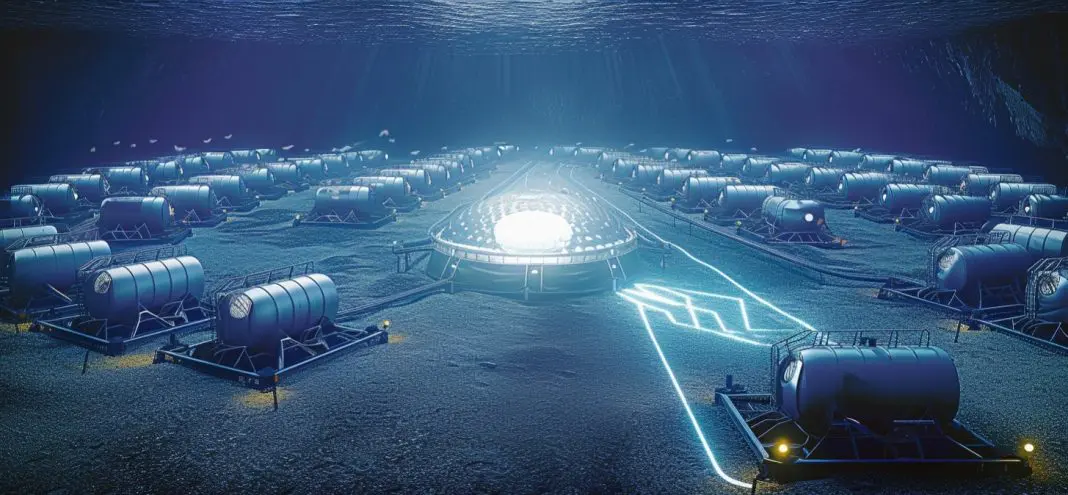
An offshore AI data center could take several forms. One possibility is a floating facility built on a ship, barge, or specially designed offshore platform. Another is a sealed subsea installation positioned on or near the ocean floor. A third—and potentially more ambitious—model would combine offshore computing infrastructure with dedicated ocean-based energy generation.
Wind power is the obvious candidate, but it is hardly the only one. Wave-energy converters can capture the continuous movement of the sea. Tidal systems can exploit predictable water movements. Floating solar installations might supplement generation in appropriate locations. Eventually, offshore platforms could combine several technologies, backed by batteries, grid connections, or other reliable generating sources.
The attraction of wave and tidal power is particularly interesting for data centers because the ocean is constantly moving. Solar power disappears every night and varies dramatically with weather. Wind is intermittent. Tides, by comparison, are extraordinarily predictable, while wave resources in certain regions can provide substantial energy over long periods.
That does not mean an ocean-powered data center could simply disconnect from civilization. AI infrastructure demands reliability. A facility containing billions of dollars of computing equipment cannot tolerate unpredictable power interruptions merely because the waves temporarily become less productive. Any commercially serious system would need redundancy, energy storage, backup generation, undersea power connections, or some combination of them.
There are nevertheless reasons to investigate the concept aggressively.
The first is land. Data centers are increasingly competing with residential, commercial, agricultural, and industrial users for suitable property. Offshore installations could relieve some of that pressure, particularly near densely populated coastal technology and financial centers.
The second is cooling. Cold seawater represents an enormous potential heat sink. Properly engineered closed-loop systems could potentially remove heat more efficiently than conventional air-conditioning arrangements while reducing dependence on freshwater resources. That matters because water consumption has become an increasingly contentious issue surrounding large data-center developments.
Third is energy independence. Instead of constructing a massive computing facility and then asking the existing electrical grid to accommodate it, developers could increasingly design generation and computing infrastructure together. An offshore AI campus might effectively become its own industrial energy ecosystem.
There is also a national-security dimension. The United States is entering an era in which computing capacity may be nearly as strategically important as petroleum refining, semiconductor fabrication, telecommunications, and electricity generation. Distributing computing infrastructure among conventional terrestrial facilities, hardened installations, and potentially offshore platforms could provide additional resilience.
But enthusiasm should not outrun engineering reality.
Saltwater is extraordinarily destructive. Corrosion, storms, hurricanes, rogue waves, marine growth, cable failures, maintenance difficulties, and physical security all complicate offshore operations. Replacing failed servers in a building outside Dallas is straightforward compared with repairing equipment hundreds of feet underwater or aboard a platform during severe weather.
Economics may prove even more challenging. Ocean energy remains considerably less mature than conventional power generation, and offshore construction is notoriously expensive. Every dollar saved on cooling or land could easily be consumed by specialized vessels, subsea cables, corrosion-resistant equipment, maintenance crews, insurance, and redundant systems.
There are environmental questions as well. Drawing heat into the surrounding ocean, installing cables across the seabed, generating underwater noise, and deploying large wave or tidal systems could affect marine ecosystems. Those consequences should be measured rather than dismissed—and weighed against the environmental footprint of enormous terrestrial data-center campuses.
Regulation presents another obstacle. Offshore AI facilities could involve federal agencies, state authorities, maritime law, environmental permitting, coastal regulations, energy regulators, and national-security considerations. If policymakers are not careful, America could invent the technology only to spend a decade waiting for permission to deploy it.
That would be a mistake.
The proper response is neither to subsidize ocean data centers indiscriminately nor to smother them with precautionary bureaucracy. Government should establish clear rules, protect navigation and marine resources, safeguard national security, and then allow private capital to determine whether the economics work.
AI’s infrastructure problem is ultimately an abundance problem. America will need more electricity, more computing capacity, more transmission, more semiconductor manufacturing, and more innovative approaches to cooling and power generation. Attempting to ration electricity among AI companies, manufacturers, homeowners, and existing businesses would turn technological progress into a political contest over scarcity.
A better strategy is to create more.
The oceans cover roughly 71 percent of Earth’s surface and contain immense quantities of kinetic and thermal energy. Humanity has barely begun exploiting that resource for computation. The engineering challenges are formidable, and ocean-powered data centers may ultimately occupy only a specialized corner of the computing industry.
But technological revolutions frequently emerge from ideas that initially seem impractical. A floating or submerged AI facility powered partly by the sea may sound exotic today. Twenty years from now, offshore computing campuses could be viewed much as offshore oil platforms are today: complicated, expensive, highly engineered—and entirely normal.
The AI race will ultimately be won not simply by whoever develops the smartest algorithms, but by whoever can build the physical infrastructure necessary to run them at enormous scale. America has always prospered when it pushed infrastructure toward new frontiers. The next one may lie just beyond the shoreline.