

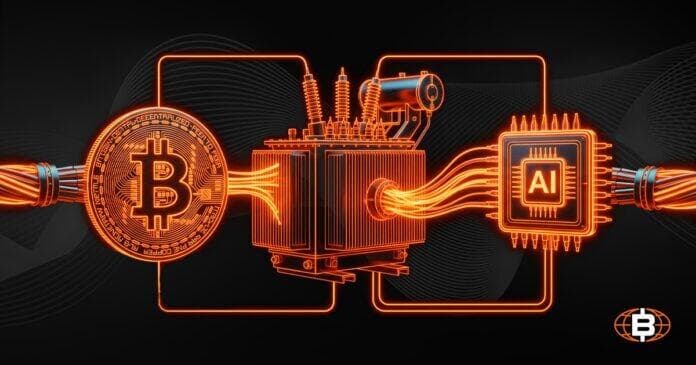
Artificial intelligence infrastructure demand is reshaping the Bitcoin mining industry as major hyperscale technology companies increasingly seek access to energized power assets rather than waiting years for new electrical grid connections. The article argues that Bitcoin miners possess a strategic advantage because they already control substations, cooling systems, transmission capacity, and long-term electricity contracts that AI operators urgently need. Rather than competing directly, many miners are repositioning themselves as infrastructure providers, converting existing mining sites into AI and high-performance computing facilities capable of generating longer-duration and potentially higher-margin revenue streams. The trend reflects a broader transition in which access to reliable electricity is becoming one of the technology sector’s most valuable assets, allowing established mining companies to diversify beyond cryptocurrency while continuing to monetize their existing infrastructure.
Key Takeaways
- Power infrastructure has become the competitive advantage. Existing grid connections, substations, and industrial-scale facilities are increasingly more difficult to obtain than computing hardware, placing Bitcoin miners in a favorable negotiating position with AI hyperscalers.
- Bitcoin miners are evolving into digital infrastructure companies. Rather than relying exclusively on cryptocurrency mining revenue, many operators are pursuing long-term AI colocation and high-performance computing contracts that may provide more stable cash flow.
- The relationship between AI and Bitcoin mining is becoming complementary rather than competitive. Mining facilities can continue supporting cryptocurrency operations while also serving as readily available platforms for expanding AI capacity, allowing operators to adapt based on market conditions and customer demand.
In-Depth
The rapid expansion of artificial intelligence has shifted the technology industry’s primary constraint from computing hardware to electrical infrastructure. While advanced processors remain essential, obtaining sufficient grid capacity has emerged as a greater challenge. New transmission connections, substations, and permitting often require years to complete, creating a significant bottleneck for hyperscale AI developers seeking to expand quickly.
Bitcoin mining companies, however, spent years building precisely the type of infrastructure AI operators now require. Their facilities already feature high-capacity power connections, industrial cooling systems, and large-scale computing environments located near relatively inexpensive electricity sources. Instead of abandoning cryptocurrency mining altogether, many firms are adapting these assets to accommodate AI training and high-performance computing workloads, creating opportunities for diversified revenue and longer-term customer contracts.
The development also reflects a broader change in how investors value mining companies. Rather than focusing solely on Bitcoin production, markets are increasingly examining ownership of energized infrastructure capable of supporting multiple computational workloads. Even so, not every mining operation is equally positioned to benefit. Successfully transitioning into AI infrastructure requires additional capital, customer relationships, technical expertise, and facility upgrades beyond traditional cryptocurrency mining. As AI demand continues to expand, companies with established electrical assets and the ability to execute these conversions are likely to remain better positioned than those possessing mining capacity alone.