

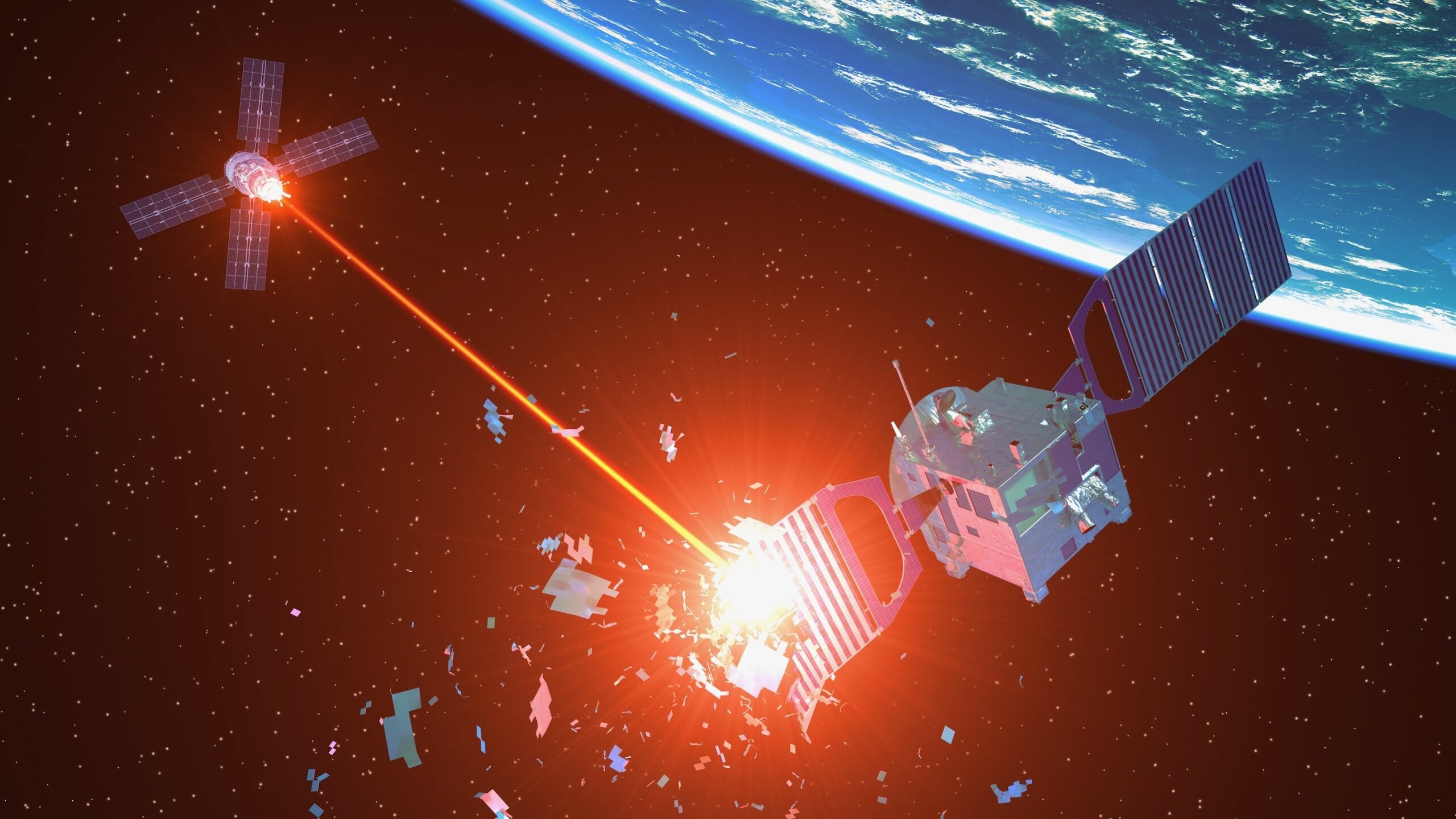
The most consequential arms race of the twenty-first century may not be taking place in the Taiwan Strait, beneath the Arctic ice, or inside the laboratories developing hypersonic missiles. It may be unfolding silently hundreds of miles above our heads, where artificial intelligence is poised to transform space from a military support system into a battlefield of its own.
America should understand what is at stake.
For decades, the United States enjoyed extraordinary advantages because of its dominance in space. Satellites provide communications, intelligence, missile warning, navigation, targeting, weather information, and the GPS signals upon which military and civilian infrastructure depend. Modern American military power is inseparable from those orbital systems.
That dependence also creates vulnerability.
China understands this. Beijing has invested heavily in counterspace capabilities intended to interfere with an adversary’s ability to operate satellites during a conflict. The Pentagon has identified Chinese development of anti-satellite missiles, electronic warfare, directed-energy capabilities, and spacecraft capable of sophisticated operations near other satellites.
Artificial intelligence could multiply the effectiveness of all of them.
The next generation of military spacecraft may not simply wait for instructions from ground controllers. AI-enabled satellites could identify threats, analyze electronic emissions, coordinate maneuvers, evade attack, select countermeasures, and communicate across enormous constellations faster than human operators could possibly manage.
That changes warfare fundamentally.
The traditional military advantage belonged to the side possessing the better weapon. The emerging advantage may belong to the side whose machines can observe, understand, decide, and respond first.
This is where America’s technological competition with China becomes particularly serious.
An authoritarian adversary may be willing to grant autonomous systems considerably more operational freedom than the United States considers acceptable. If Chinese military AI can make decisions in milliseconds while American commanders require lengthy authorization chains, Washington could confront an uncomfortable strategic dilemma: surrender decision speed or surrender human control.
Neither is attractive.
But pretending the technological race can simply be stopped is not a strategy.
The United States cannot preserve peace in space by declining to develop capabilities that potential adversaries are pursuing. History offers little reason to believe unilateral technological restraint produces reciprocal restraint from determined competitors. American deterrence therefore requires both superior technology and credible defenses capable of surviving an attack.
That means building resilient satellite constellations rather than depending excessively on small numbers of enormously expensive platforms. It means autonomous defensive maneuvering, sophisticated electronic warfare, rapid satellite replacement, artificial-intelligence-assisted threat detection, distributed communications, and systems capable of continuing to function after parts of the network have been destroyed.
America must become extraordinarily difficult to blind.
Yet there must also be a boundary.
Artificial intelligence should help commanders understand the battlefield and defend American assets, but machines should not casually inherit the authority to initiate strategically consequential attacks. In an environment where spacecraft travel thousands of miles per hour and computers communicate almost instantaneously, an algorithmic mistake could produce escalation before presidents or commanders fully understand what happened.
Imagine one autonomous satellite misidentifying another spacecraft’s maneuver as hostile.
It responds.
The opposing country’s AI interprets that response as an attack.
Its systems retaliate.
Within seconds, two nuclear powers could find themselves confronting a military crisis that neither government deliberately initiated.
This is the paradox of AI deterrence. America may need increasingly autonomous systems precisely because adversaries possess them, while simultaneously ensuring those systems never become so autonomous that human beings lose control of escalation.
That balance will require something Washington often struggles to provide: technological sophistication combined with strategic discipline.
The answer is not another bureaucracy attempting to regulate technological competition out of existence. Nor is it blindly handing lethal authority to algorithms because computers react faster than people.
The proper approach is strength under human command.
America should pursue overwhelming advantages in artificial intelligence, orbital computing, autonomous spacecraft, missile warning, electronic warfare, and resilient satellite networks while establishing unmistakable human authority over decisions that could trigger major conflict.
The objective should not be to militarize the heavens for its own sake. It should be to make attacking American space infrastructure so difficult, expensive, and strategically dangerous that an adversary concludes the attempt is not worth making.
That is deterrence.
For generations, strategists have described space as the ultimate high ground. Artificial intelligence is about to give that phrase an entirely different meaning.
The country that dominates AI-enabled space systems could possess an extraordinary advantage over everything occurring beneath them—on land, at sea, in the air, and across the electromagnetic battlefield.
America cannot assume it will automatically be that country.
The race has already begun.
And this time, losing the high ground could mean losing far more than space.