

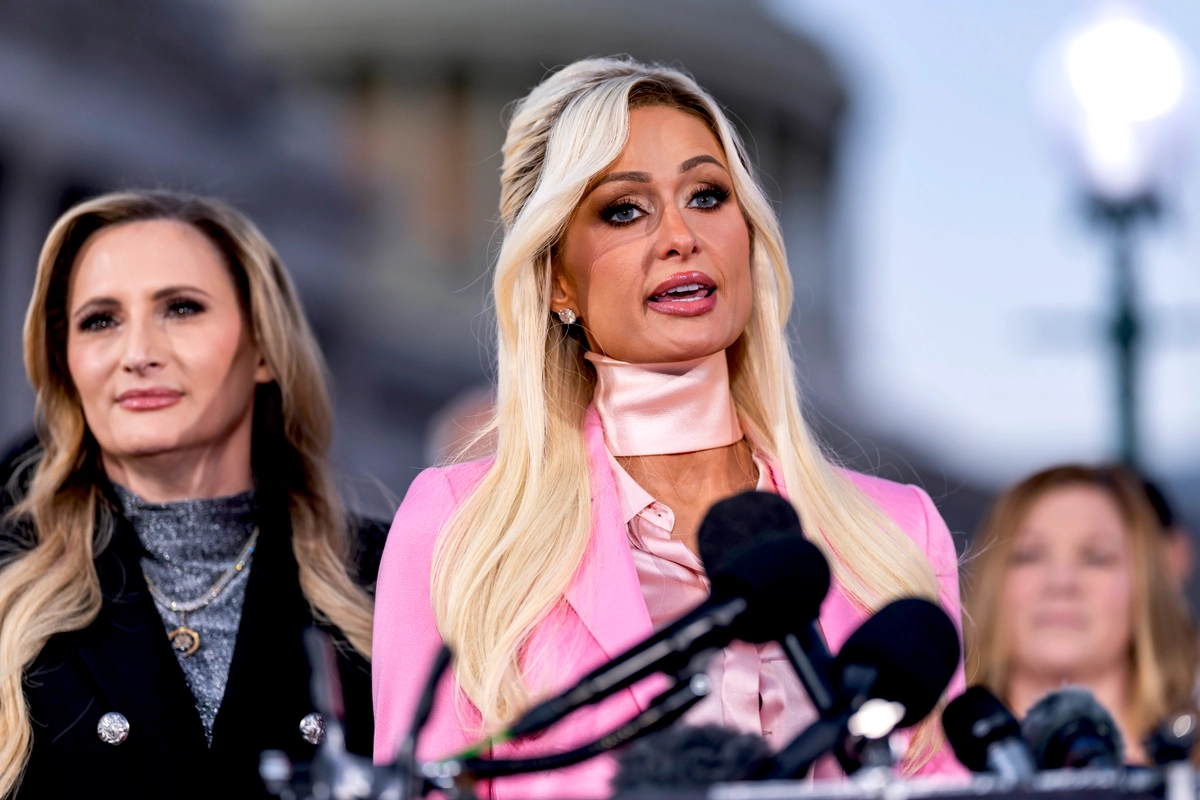
• Republican and Democratic congresswomen joined Paris Hilton in urging House passage of the DEFIANCE Act, which would allow victims of sexually explicit AI deepfakes to sue perpetrators in federal court.
• The legislation would authorize damages of $150,000, increasing to $250,000 in certain aggravated cases, while allowing courts to order the removal or destruction of explicit digital forgeries.
• The Senate unanimously passed the legislation in January, but House approval remains pending despite bipartisan support and growing concerns about AI-generated sexual exploitation.
A bipartisan group of congresswomen joined Paris Hilton at the Capitol on Tuesday to demand House passage of the DEFIANCE Act, legislation allowing victims of sexually explicit artificial intelligence deepfakes to sue perpetrators in federal court. Reps. Laurel Lee, R-Fla., Alexandria Ocasio-Cortez, D-N.Y., and Kat Cammack, R-Fla., backed the effort after the Senate unanimously approved the measure in January. Hilton, herself a victim of nonconsensual intimate imagery, urged lawmakers to act before Congress adjourns.
The bill would permit lawsuits against people who knowingly create or distribute explicit digital forgeries without consent, with additional provisions addressing solicitation and possession intended for distribution. Victims could seek statutory damages of $150,000, rising to $250,000 in certain aggravated cases, alongside court orders preventing further distribution. The proposal builds on the 2025 TAKE IT DOWN Act, which criminalized certain nonconsensual intimate imagery and imposed removal requirements on covered online platforms. House action remains pending nationwide.
Why It Matters
Artificial intelligence has made sexual exploitation easier to manufacture and harder to contain. An ordinary photograph can become convincing fabricated pornography, potentially damaging reputations, livelihoods and personal safety. Federal law already criminalizes certain distribution, but criminal prosecution alone does not necessarily compensate victims or provide meaningful control over the consequences.
The DEFIANCE Act would strengthen individual rights by allowing survivors to pursue perpetrators directly, seek damages and request orders to stop further circulation. That approach emphasizes personal accountability rather than giving government sweeping authority over lawful online expression. Lawmakers must nevertheless ensure clear definitions and safeguards against frivolous claims, particularly where satire or protected speech could be implicated. With Republicans and Democrats supporting the proposal, Congress has an opportunity to close a legal gap without treating emerging technology as justification for censorship. The central principle is straightforward: individuals should control their intimate likenesses and have recourse when others deliberately violate that boundary.
Sources
• https://www.cbsnews.com/news/paris-hilton-alexandria-ocasio-cortez-defiance-act-deepfake-bill/
• https://www.congress.gov/119/bills/s1837/BILLS-119s1837is.pdf