

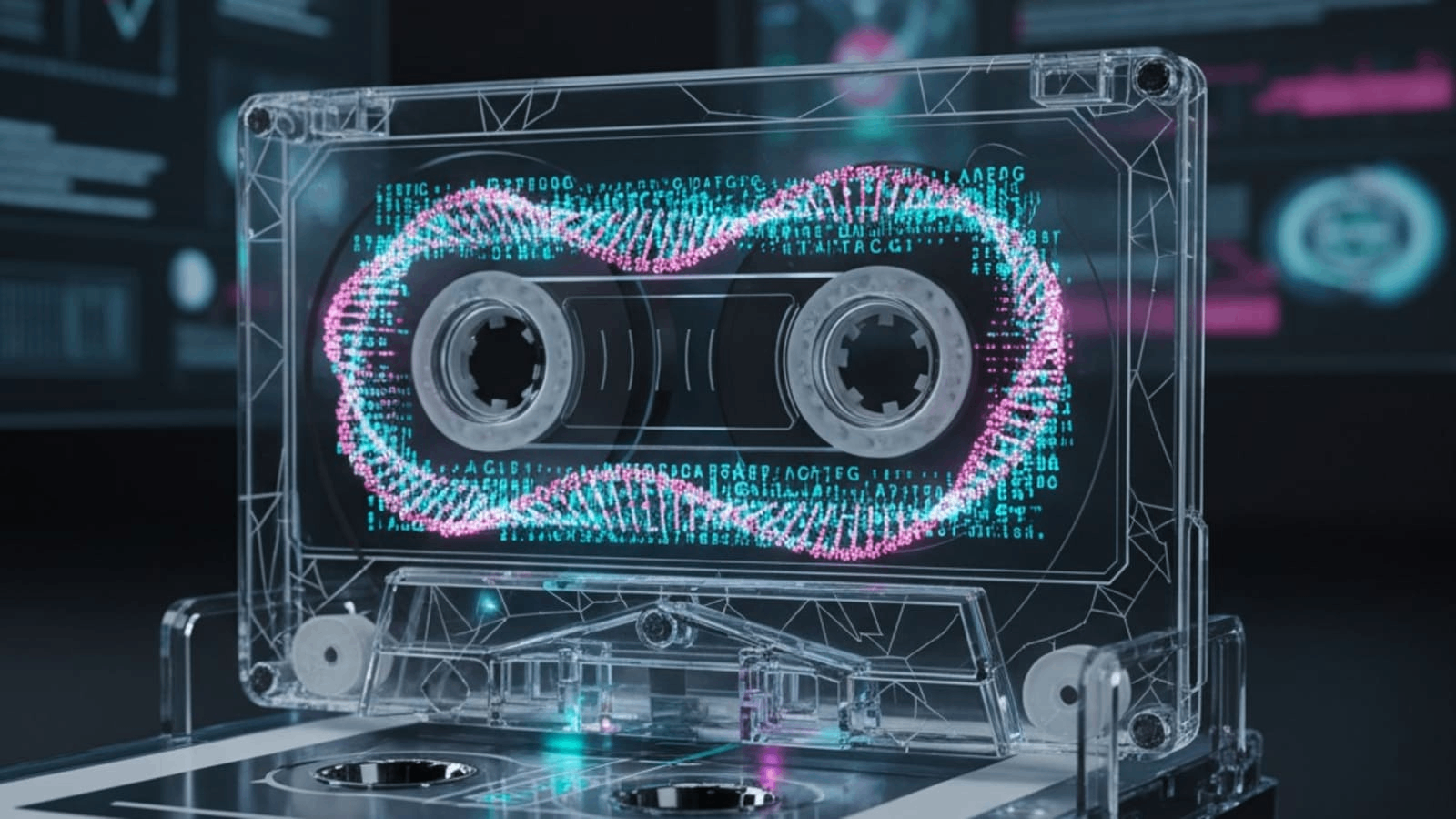
Chinese researchers led by Xingyu Jiang from the Southern University of Science and Technology have unveiled a prototype “DNA cassette tape” system that promises unbelievable storage density (theoretical limits on the order of 80 million DVDs per kilometer) and multi-century durability — but with write and read speeds so slow that filling even a small fraction of its potential would take ages. The system uses a polyester-nylon composite tape patterned with barcode “tracks” (about 5.45×10⁵ addressable partitions per 1,000 meters) for indexing, synthetic DNA strands are deposited in partitions, then sealed under a protective layer of zeolitic imidazolate framework (ZIF). In proof-of-concept, they stored and recovered a 156.6 KB image (“lantern”) through several operations including deposition, erasure, recovery, and redeposition — but current speed and cost make the system impractical for large-scale use.
Sources: The Register, Science
Key Takeaways
– Massive capacity vs. practical limits: While theoretically this DNA tape could store petabytes per meter (e.g. ~362 PB/km), current measured capacity is far lower, and the throughput (writing/reading) is extremely slow — orders of magnitude below conventional storage media.
– Longevity and stability are strong points: The protective ZIF coating and molecular design suggest retention of data for several hundred years at room temperature; longer in colder conditions. This makes it appealing for cold or archive storage.
– Engineering challenges are real: DNA synthesis and sequencing are costly, and reaction times (encapsulation, decapsulation, deposition, recovery) are slow. Scaling up to fill even a small fraction of the tape’s possible capacity would take impractical amounts of time and resources with today’s tech.
In-Depth
The new DNA cassette tape system represents a striking fusion of old and new: taking the physical format of magnetic tape — known for archival storage — and combining it with the dense information-carrying power of synthetic DNA. Researchers designed a polyester-nylon composite strip, ink-jet printed with barcodes to divide it into hundreds of thousands of partitions per kilometer (about 5.45×10⁵ per 1,000 m), each partition addressable at up to roughly 1,570 partitions per second. Into each hydrophilic partition, synthetic DNA is deposited; a protective zeolitic imidazolate framework (ZIF) is then used to encapsulate it, defending against heat, enzymes, and environmental damage.
In trials, the team successfully demonstrated data deposition and recovery: specifically, a 156.6 KB image of a lantern, stored, retrieved, erased, and redeposited through multiple cycles. However, the time required is daunting: full cycle operations (deposit, recovery, erase etc.) took on the order of tens of minutes to hours. Some steps — like three recoveries and one redeposition — took about 150 minutes, and even with optimizations the fastest possible recovery could be around 47 minutes.
Perhaps most striking is the gap between what’s possible in theory and what’s viable now. Theoretical maximum storage density sits near 362 petabytes per kilometer, equivalent to ~80 million DVDs. But current measured capacity per kilometer is much less (on the order of tens of gigabytes). For example, one experiment shows about 74.7 GB per km in its present form.
That said, the durability prospects are strong: modeling suggests retention of data around 345 years at room temperature, with extended longevity under cooler conditions. That makes the technology especially appealing for cold archive storage (data that’s written rarely and seldom read).
From a conservative, realistic standpoint, the DNA cassette tape is not something you’d deploy today for your main file server or frequent backups. Costs, speed, and scalability are all roadblocks. But in a world where data growth (in science, media, government, history) is exploding, this kind of archival medium may become indispensable. If DNA writing/synthesis and sequencing technologies improve (faster, cheaper), then what seems nearly fantastical now could become a backbone of long-term data preservation.