

Close Menu

    Subscribe to Updates

    Get the latest creative news from FooBar about art, design and business.

    What's Hot

    Airbnb Shifts One-Third Of Customer Support To AI In North America

    February 17, 2026

    Meta Plans Facial Recognition for Smart Glasses Amid Privacy Pushback

    February 17, 2026

    Spotify Developers Haven’t Written Code Since December Thanks to AI Transformation

    February 16, 2026
    Facebook X (Twitter) Instagram
    • Tech
    • AI News
    • Get In Touch
    Facebook X (Twitter) LinkedIn
    TallwireTallwire
    • Tech

      Meta Plans Facial Recognition for Smart Glasses Amid Privacy Pushback

      February 17, 2026

      Spotify Developers Haven’t Written Code Since December Thanks to AI Transformation

      February 16, 2026

      Waymo Goes Fully Autonomous in Nashville, Tennessee

      February 16, 2026

      Roku Plans Streaming Bundles Push to Boost Profitability in 2026

      February 15, 2026

      Russia Officially Blocks WhatsApp After Telegram Crackdown

      February 15, 2026
    • AI News

      Meta Plans Facial Recognition for Smart Glasses Amid Privacy Pushback

      February 17, 2026

      Airbnb Shifts One-Third Of Customer Support To AI In North America

      February 17, 2026

      Spotify Developers Haven’t Written Code Since December Thanks to AI Transformation

      February 16, 2026

      Australia Puts Roblox on Notice Amid Reports of Child Grooming and Harmful Content

      February 16, 2026

      UK Kids Turning to AI Chatbots and Acting on Advice at Alarming Rates

      February 16, 2026
    • Security

      US Lawmakers Urge Tighter Export Controls to Curb China’s Access to Chipmaking Equipment

      February 16, 2026

      Senator Raises Questions On eSafety Crackdown And Potential Strain On US-Australia Relationship

      February 16, 2026

      AI Safety Researcher Resigns, Warns ‘World Is in Peril’ Amid Broader Industry Concerns

      February 15, 2026

      Microsoft Warns Hackers Are Exploiting Critical Zero-Day Bugs Targeting Windows, Office Users

      February 15, 2026

      Microsoft Exchange Online’s Aggressive Filters Mistake Legitimate Emails for Phishing

      February 13, 2026
    • Health

      UK Kids Turning to AI Chatbots and Acting on Advice at Alarming Rates

      February 16, 2026

      Landmark California Trial Sees YouTube Defend Itself, Rejects ‘Social Media’ and Addiction Claims

      February 16, 2026

      Instagram Top Executive Says ‘Addiction’ Doesn’t Exist in Landmark Social Media Trial

      February 15, 2026

      Amazon Pharmacy Rolls Out Same-Day Prescription Delivery To 4,500 U.S. Cities

      February 14, 2026

      AI Advances Aim to Bridge Labor Gaps in Rare Disease Treatment

      February 12, 2026
    • Science

      XAI Publicly Unveils Elon Musk’s Interplanetary AI Vision In Rare All-Hands Release

      February 14, 2026

      Elon Musk Shifts SpaceX Priority From Mars Colonization to Building a Moon City

      February 14, 2026

      NASA Artemis II Spacesuit Mobility Concerns Ahead Of Historic Mission

      February 13, 2026

      AI Agents Build Their Own MMO Playground After Moltbook Ignites Agent-Only Web Communities

      February 12, 2026

      AI Advances Aim to Bridge Labor Gaps in Rare Disease Treatment

      February 12, 2026
    • People

      Google Co-Founder’s Epstein Contacts Reignite Scrutiny of Elite Tech Circles

      February 7, 2026

      Bill Gates Denies “Absolutely Absurd” Claims in Newly Released Epstein Files

      February 6, 2026

      Informant Claims Epstein Employed Personal Hacker With Zero-Day Skills

      February 5, 2026

      Starlink Becomes Critical Internet Lifeline Amid Iran Protest Crackdown

      January 25, 2026

      Musk Pledges to Open-Source X’s Recommendation Algorithm, Promising Transparency

      January 21, 2026
    TallwireTallwire
    Home»Tech»Everlasting Storage? DNA ‘Cassette Tape’ Could Hold 80 Million DVDs — If We Had the Time
    Tech

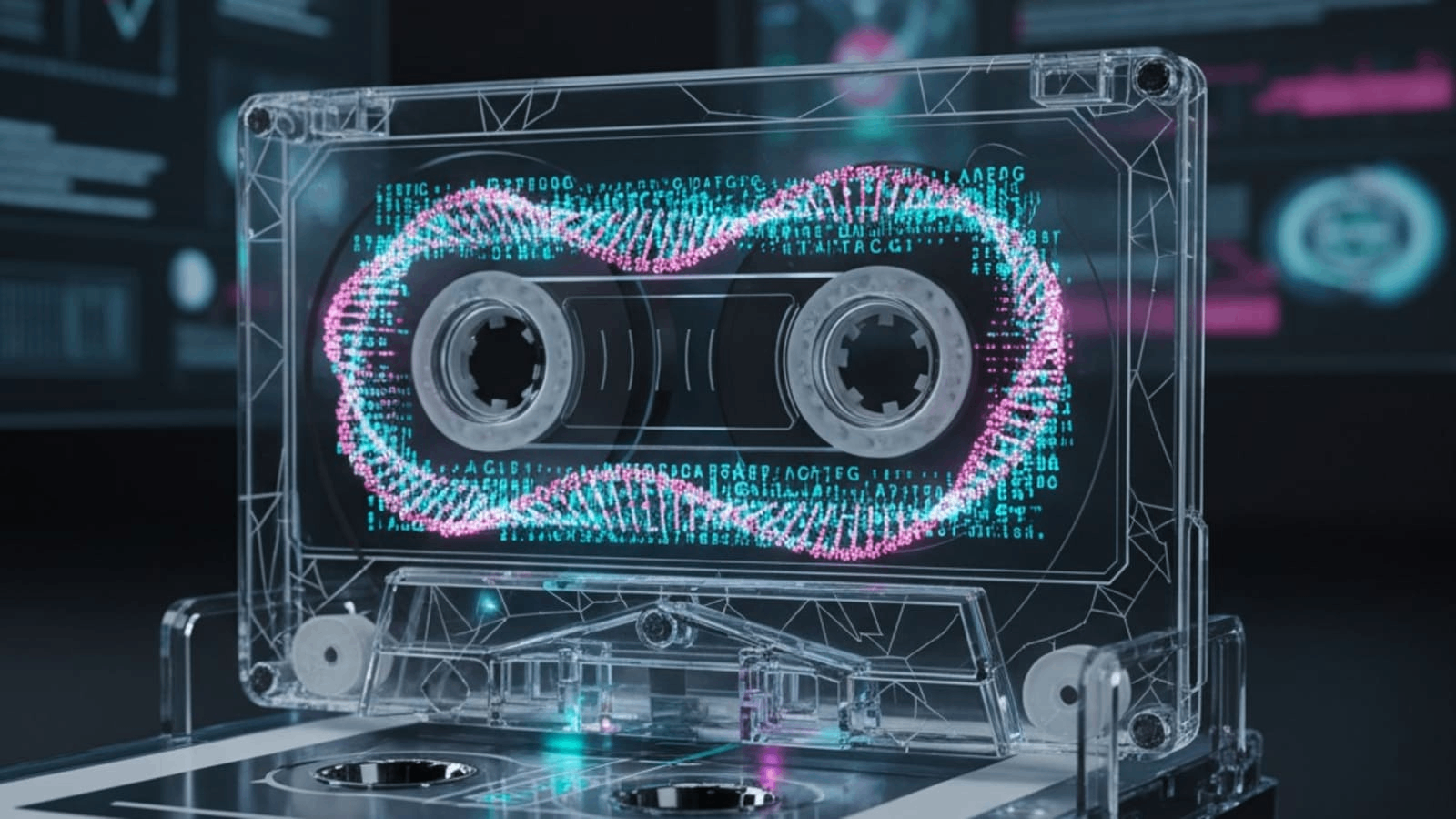
    Everlasting Storage? DNA ‘Cassette Tape’ Could Hold 80 Million DVDs — If We Had the Time

    4 Mins Read
    Facebook Twitter Pinterest LinkedIn Tumblr Email
    Everlasting Storage? DNA 'Cassette Tape' Could Hold 80 Million DVDs — If We Had the Time
    Everlasting Storage? DNA 'Cassette Tape' Could Hold 80 Million DVDs — If We Had the Time
    Share
    Facebook Twitter LinkedIn Pinterest Email

    Chinese researchers led by Xingyu Jiang from the Southern University of Science and Technology have unveiled a prototype “DNA cassette tape” system that promises unbelievable storage density (theoretical limits on the order of 80 million DVDs per kilometer) and multi-century durability — but with write and read speeds so slow that filling even a small fraction of its potential would take ages. The system uses a polyester-nylon composite tape patterned with barcode “tracks” (about 5.45×10⁵ addressable partitions per 1,000 meters) for indexing, synthetic DNA strands are deposited in partitions, then sealed under a protective layer of zeolitic imidazolate framework (ZIF). In proof-of-concept, they stored and recovered a 156.6 KB image (“lantern”) through several operations including deposition, erasure, recovery, and redeposition — but current speed and cost make the system impractical for large-scale use. 

    Sources: The Register, Science

    Key Takeaways

    – Massive capacity vs. practical limits: While theoretically this DNA tape could store petabytes per meter (e.g. ~362 PB/km), current measured capacity is far lower, and the throughput (writing/reading) is extremely slow — orders of magnitude below conventional storage media.

    – Longevity and stability are strong points: The protective ZIF coating and molecular design suggest retention of data for several hundred years at room temperature; longer in colder conditions. This makes it appealing for cold or archive storage.

    – Engineering challenges are real: DNA synthesis and sequencing are costly, and reaction times (encapsulation, decapsulation, deposition, recovery) are slow. Scaling up to fill even a small fraction of the tape’s possible capacity would take impractical amounts of time and resources with today’s tech.

    In-Depth

    The new DNA cassette tape system represents a striking fusion of old and new: taking the physical format of magnetic tape — known for archival storage — and combining it with the dense information-carrying power of synthetic DNA. Researchers designed a polyester-nylon composite strip, ink-jet printed with barcodes to divide it into hundreds of thousands of partitions per kilometer (about 5.45×10⁵ per 1,000 m), each partition addressable at up to roughly 1,570 partitions per second. Into each hydrophilic partition, synthetic DNA is deposited; a protective zeolitic imidazolate framework (ZIF) is then used to encapsulate it, defending against heat, enzymes, and environmental damage. 

    In trials, the team successfully demonstrated data deposition and recovery: specifically, a 156.6 KB image of a lantern, stored, retrieved, erased, and redeposited through multiple cycles. However, the time required is daunting: full cycle operations (deposit, recovery, erase etc.) took on the order of tens of minutes to hours. Some steps — like three recoveries and one redeposition — took about 150 minutes, and even with optimizations the fastest possible recovery could be around 47 minutes. 

    Perhaps most striking is the gap between what’s possible in theory and what’s viable now. Theoretical maximum storage density sits near 362 petabytes per kilometer, equivalent to ~80 million DVDs. But current measured capacity per kilometer is much less (on the order of tens of gigabytes). For example, one experiment shows about 74.7 GB per km in its present form. 

    That said, the durability prospects are strong: modeling suggests retention of data around 345 years at room temperature, with extended longevity under cooler conditions. That makes the technology especially appealing for cold archive storage (data that’s written rarely and seldom read). 

    From a conservative, realistic standpoint, the DNA cassette tape is not something you’d deploy today for your main file server or frequent backups. Costs, speed, and scalability are all roadblocks. But in a world where data growth (in science, media, government, history) is exploding, this kind of archival medium may become indispensable. If DNA writing/synthesis and sequencing technologies improve (faster, cheaper), then what seems nearly fantastical now could become a backbone of long-term data preservation.

    Share. Facebook Twitter Pinterest LinkedIn Tumblr Email
    Previous ArticleEvent-App Partiful Exposed Users’ Raw GPS Coordinates via Profile Photos
    Next Article Evidence Surfaces of Active Exploitation in GoAnywhere MFT’s Critical Flaw Before Patch Rollout

    Related Posts

    Meta Plans Facial Recognition for Smart Glasses Amid Privacy Pushback

    February 17, 2026

    Spotify Developers Haven’t Written Code Since December Thanks to AI Transformation

    February 16, 2026

    Waymo Goes Fully Autonomous in Nashville, Tennessee

    February 16, 2026

    Roku Plans Streaming Bundles Push to Boost Profitability in 2026

    February 15, 2026
    Add A Comment
    Leave A Reply Cancel Reply

    Editors Picks

    Meta Plans Facial Recognition for Smart Glasses Amid Privacy Pushback

    February 17, 2026

    Spotify Developers Haven’t Written Code Since December Thanks to AI Transformation

    February 16, 2026

    Waymo Goes Fully Autonomous in Nashville, Tennessee

    February 16, 2026

    Roku Plans Streaming Bundles Push to Boost Profitability in 2026

    February 15, 2026
    Top Reviews
    Tallwire
    Facebook X (Twitter) LinkedIn Threads Instagram RSS
    • Tech
    • Entertainment
    • Business
    • Government
    • Academia
    • Transportation
    • Legal
    • Press Kit
    © 2026 Tallwire. Optimized by ARMOUR Digital Marketing Agency.

    Type above and press Enter to search. Press Esc to cancel.