

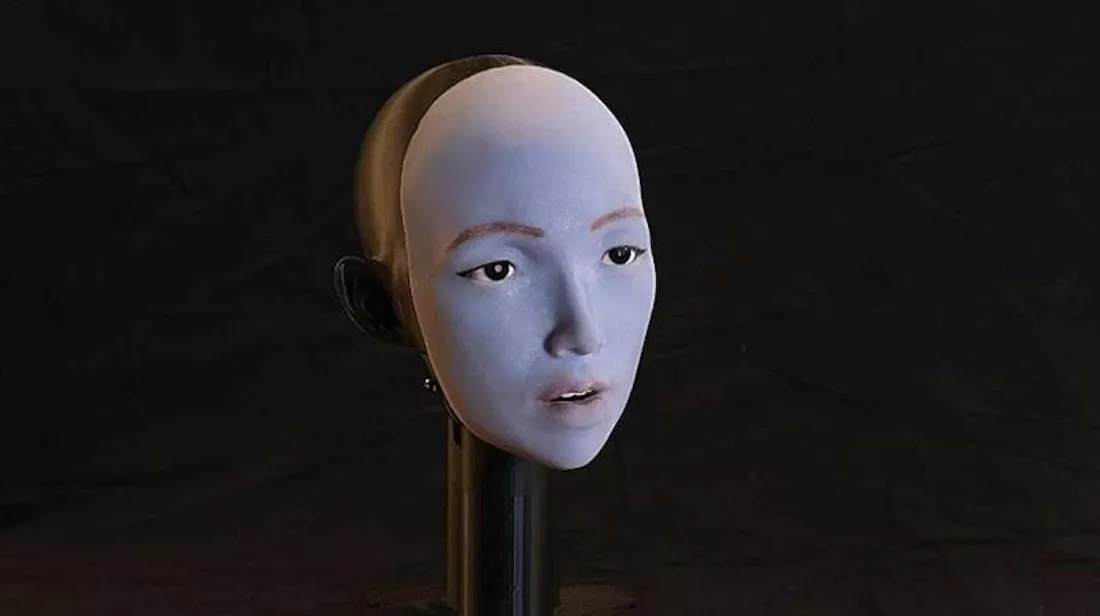
Researchers at Columbia University have trained a humanoid robot to learn lifelike lip movements by observing human speech and singing in YouTube videos, marking a major step in human-robot interaction. This robot, developed in the Creative Machines Lab, taught itself how to move 26 facial motors beneath flexible synthetic skin by first watching its own reflection in a mirror to understand facial mechanics and then studying hours of YouTube footage of people talking and singing to associate audio with corresponding lip shapes. The resulting system uses a vision-to-action learning model to convert sounds directly into synchronized lip motion without traditional hand-coded rules. While the technology still struggles with certain sounds and isn’t perfect, it significantly improves upon stiff, unnatural facial motion and aims to help robots cross the “uncanny valley,” making interactions in education, healthcare, and elder care feel more natural and emotionally resonant. As these robots integrate more conversational artificial intelligence, realistic facial expression could become a defining feature of machines designed to engage with humans.
Sources:
https://www.techspot.com/news/110967-humanoid-robot-learns-realistic-lip-movement-watching-youtube.html
https://scitechdaily.com/this-robot-learned-to-talk-by-watching-humans-on-youtube/
https://www.eweek.com/news/columbia-emo-robot-learns-lip-sync/
Key Takeaways
- Visual learning replaces rule-based programming: The robot learned lip movement by observing YouTube content rather than relying on preset phonetic rules.
- Human-like interaction focus: Realistic facial motion is crucial to making robots feel relatable and less uncanny in social settings.
- Tech far from perfect: The system still struggles with specific sounds, and ongoing improvements are needed for truly natural communication.
In-Depth
In a field where robots have long been judged harshly for rigid speech animations and robotic mouth movements that break immersion, a new development out of Columbia University is changing the game by teaching a humanoid robot how to synchronize its lip movements with human speech and song — using nothing more than hours of YouTube footage and its own physical experimentation. The breakthrough marked a departure from traditional engineering approaches in robotics, where lip movements and facial gestures are usually animated through handcrafted rules tied to specific phonemes. In contrast, the robot developed by researchers in the Creative Machines Lab taught itself how to move its lips with striking realism by first learning how its own facial structure behaved and then by associating observed human mouth shapes with corresponding audio.
The approach is centered around what’s known as a vision-to-action learning model. Instead of programmers painstakingly defining how every vowel or consonant should map to a robotic facial mechanism, the robot first explored its own facial expressions in front of a mirror, much like a child learning the mechanics of their own face. By making thousands of random expressions, it built a mapping between motor activations and visible outcomes — understanding which combination of its 26 tiny facial motors produced particular lip shapes. Only after mastering an internal model of itself did it tackle human language.
At that point, the developers loaded the system with extensive YouTube video content featuring people speaking and even singing in various languages. The robot system analyzed the audio alongside the visual speech cues, allowing it to learn the statistical correlation between sounds and lip positions. Why focus on YouTube? Because the platform provides a massive, diverse dataset of real human speech, capturing wide variations in speaking styles, accents, and emotional expressiveness — something far harder to reproduce with synthetic datasets. As a result, the robot could produce synchronized lip movements directly from sound, without explicit rules dictating which motor should fire for every phoneme.
This technique produced results that, while still imperfect, represent a huge leap forward. In tests, the robot could synchronize its lip movements across multiple languages and even perform songs drawn from an AI-generated album. However, the researchers were candid in acknowledging limitations: certain sounds requiring precise lip closure or rapid movement — such as hard consonants like “B” or rounded vowel transitions for sounds like “W” — still posed challenges. These issues serve as a reminder that despite the progress, the robot’s speech animation remains a work in progress and will require further refinement to achieve consistently natural results.
The implications of this work are significant — particularly in contexts where machines are meant to engage with people in emotionally sensitive environments like education, customer service, or elder care. There’s a psychological phenomenon known as the “uncanny valley,” where robots that appear almost human can elicit discomfort simply because slight inconsistencies in appearance and motion signal “unnaturalness” to human observers. Facial expressiveness, especially lip movements synced accurately with speech, plays a central role in how we perceive others’ emotional states and intentions. By narrowing this gap, robots become easier for humans to engage with both cognitively and emotionally.
What makes this development more compelling is its general-purpose learning paradigm. By leveraging real human behavior observed in everyday video content, the robot’s learning reflects the messy complexity of natural speech rather than sanitized, scripted datasets. This helps the robot adapt to a variety of speaking styles and social nuances that define real interactions. It also makes the technology scalable, as access to large, publicly available video datasets means future improvements won’t be limited by proprietary or artificially constrained training material.
Still, integrating this lip-sync technology with advanced conversational artificial intelligence — systems like ChatGPT or other large language models — is where its full potential lies. Facial expression paired with responsive dialogue could make robots’ conversational abilities feel more holistic and grounded. Instead of disembodied voices or stiff puppet-like animations, future robots might offer nuanced expressions that complement vocal tone and context, fostering an intuitive sense of connection.
Yet, there are ethical and psychological concerns too. As robots become more adept at mimicking human nuance, distinguishing between a genuine human and a machine partner could become harder, raising questions about consent, transparency, and how humans relate to artificial agents. Designers and policymakers will need to consider how these technologies are deployed to ensure that users understand they are interacting with machines. Nonetheless, this new approach to robot lip synchronization — rooted in observational learning through real human examples — represents a promising step towards more natural, relatable machines that can engage with humans on terms that feel familiar and comfortable.