

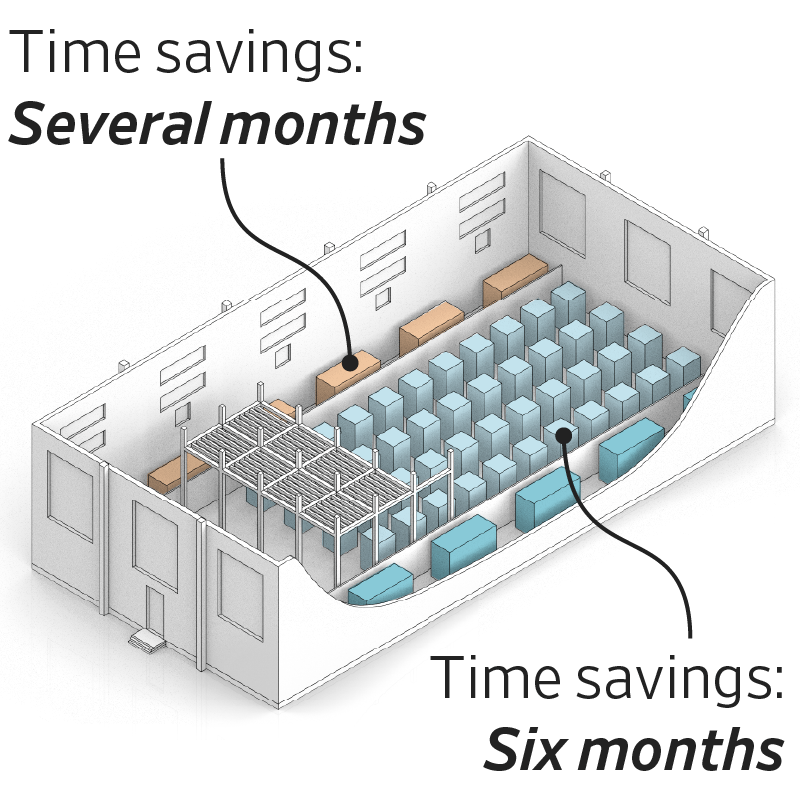
The accelerating artificial-intelligence arms race is forcing data-center developers to abandon conventional construction timelines in favor of prefabrication, modular components and factory-built systems that can bring computing capacity online far faster. Traditional projects can require two to three years, an increasingly unacceptable delay for hyperscalers spending enormous sums to secure AI capacity. Builders are responding by moving electrical systems, cooling infrastructure, power distribution and even entire computing sections into factories for assembly and testing before shipment. The shift is reducing onsite labor requirements, shortening deployment schedules and turning data-center construction into something increasingly resembling advanced manufacturing. With U.S. data-center construction spending now running above $75 billion annually and AI infrastructure demand continuing to expand, the competitive advantage may increasingly belong to companies capable of building reliably at industrial speed.
Key Takeaways
- AI demand is making traditional two- and three-year data-center construction schedules increasingly impractical, driving developers toward standardized, prefabricated and modular systems that can cut months—and potentially more than a year—from deployment schedules.
- Factory construction can reduce dependence on scarce electricians, plumbers, HVAC technicians and other skilled trades while allowing integrated power, liquid-cooling and computing systems to be assembled and tested under controlled conditions before arriving at the construction site.
- Faster construction does not eliminate engineering risk. Rapid modular deployment creates new challenges involving electrical coordination, grounding, cooling, testing and grid integration, making disciplined engineering and reliable power infrastructure essential as the AI buildout accelerates.
In-Depth
Artificial intelligence is turning data-center construction into an industrial race in which speed increasingly matters as much as scale. Hyperscalers cannot comfortably wait the two to three years traditionally required for new facilities, so builders are shifting work from construction sites into factories, where power, cooling, electrical and computing components can be prefabricated, tested and delivered as standardized modules. The approach can sharply compress schedules while reducing dependence on scarce skilled trades.
The economics explain the urgency. U.S. spending on data-center structures exceeded a $75 billion annual pace in July, nearly 60 percent above year-earlier levels. Yet the buildings themselves represent only a fraction of total investment because processors, memory, networking and power equipment account for much of the ultimate cost. Every month saved in construction therefore brings expensive computing assets online sooner and can accelerate revenue generation.
Modularization also changes the labor equation. Prefabricated systems can move complicated assembly into controlled factory environments and reduce onsite installation from months to days in some applications. Suppliers are developing integrated power and computing modules designed for increasingly dense AI workloads, with some systems claiming schedule reductions of roughly one-third or more.
But speed carries risks. Modular facilities still require careful electrical coordination, grounding, cooling integration and systemwide testing. Standards are racing to catch up with deployment. The broader lesson is straightforward: America’s AI competition increasingly depends not merely on better chips and software, but on whether private industry can build physical infrastructure faster without sacrificing reliability, engineering discipline or grid stability.
Sources
- https://www.datacenterdynamics.com/en/opinions/modular-by-necessity-why-the-ai-boom-is-making-prefabricated-data-centers-the-new-default/
- https://www.axios.com/2026/09/01/ai-data-center-constructon-spending
- https://blog.se.com/datacenter/2026/06/22/scaling-ai-faster-prefabricated-ai-pods-not-headcount/
- https://www.eaton.com/us/en-us/company/news-insights/news-releases/2026/eaton-expands-modular-data-center-offering.html