

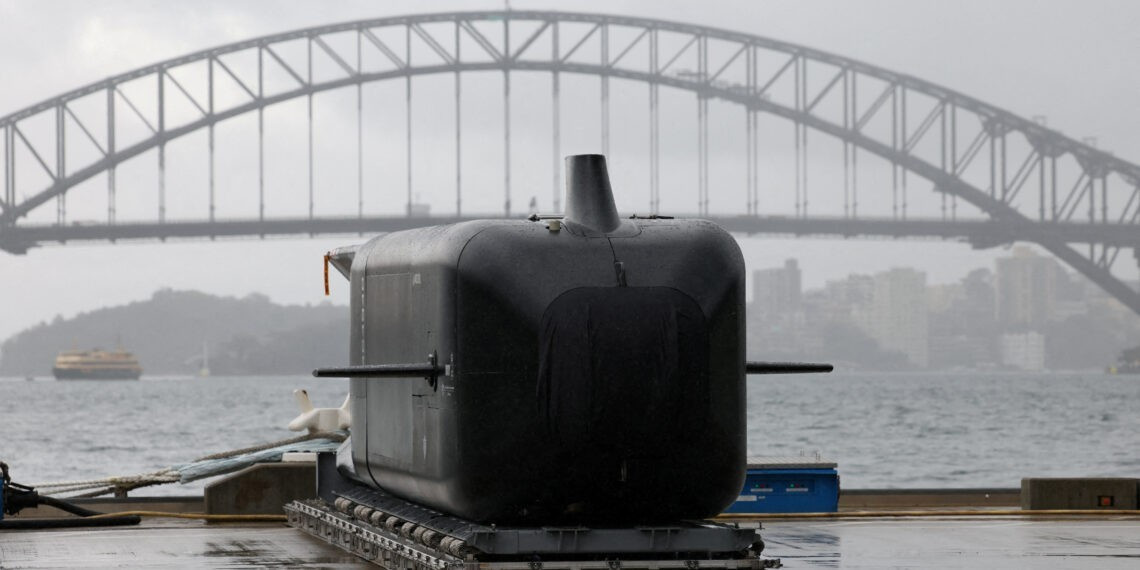
Australia has awarded Anduril a A$1.7 billion (about US$1.1–1.13 billion) contract over five years to produce, maintain, and further develop its Ghost Shark extra-large autonomous undersea vehicles (XL-AUVs), dubbed “Ghost Sharks,” for the Royal Australian Navy (RAN), with service expected to begin in early 2026. Australia and Anduril co-developed prototypes starting in 2022, each investing some AU$50 million, and delivered the first prototype ahead of schedule in April 2024. In contrast, the U.S. Navy’s Boeing-built Orca XLUUV program remains behind schedule, over budget, and has not yet fully transitioned into a program of record, despite years of development and substantial spending. The Ghost Shark system, powered all-electrically and designed for long-range, stealthy intelligence, surveillance, reconnaissance, and strike missions, can be launched from shore, from ships, and even be transported via large airlift aircraft.
Sources: Interesting Engineering, Breaking Defense, TechCrunch
Key Takeaways
– Speed and cost advantages: Australia, via Anduril, moved from prototype to contract within ~3 years and stayed on schedule and budget, unlike the U.S. Orca XLUUV project, which has faced delays and cost overruns.
– Strategic urgency in the Indo-Pacific: The Ghost Shark initiative reflects Australia’s response to growing naval pressure in the region (notably from China), enabling enhanced undersea presence and surveillance over vast maritime zones without relying solely on crewed submarines.
– Flexibility of deployment and payload modularity: Ghost Shark XL-AUVs are being designed to accept mission-specific payloads, operate stealthily (including long durations underwater without surfacing), launch from multiple platforms (shore, ships, airlift), and evolve with future national and allied needs.
In-Depth
Australia’s decision to contract Anduril for the Ghost Shark fleet marks a major leap in undersea autonomous warfare capabilities — one that underscores both the opportunities and challenges of modern defense procurement. Beginning in 2022, Australia and Anduril jointly invested approximately AU$50 million each into developing prototypes of Ghost Shark XL-AUVs. These prototypes, including the first delivered in April 2024, were delivered ahead of schedule and on budget, enabling Canberra to commit to full production by 2025 through a five-year contract worth A$1.7 billion (about US$1.1-1.12 billion).
The contract covers more than just building the vehicles. It includes sustaining them — maintenance, upgrades, and further development — as well as domestic production, job creation, and scaling the supply chain. Around 120 existing workers will be supported, more than 150 new high-skilled roles will be created at Anduril Australia, and over 40 companies in the national supply chain will participate, adding hundreds more jobs.
Technically, the vehicles are meant to offer stealthy electromagnetic signature control, long endurance — missions under water without surfacing — all-electric powertrain, and modular payloads to allow adaptation to different mission types. They’re also being built to be transportable (including airlift) and deployable from shore or sea vessels.
In contrast, the U.S. Navy’s own Orca XLUUV program hasn’t moved as quickly. The Orca effort, led by Boeing and others, has spent many years in development (since about 2017), has delivered its first prototype in late 2023, but despite substantial investment (in the hundreds of millions), it has not yet transitioned firmly into a “program of record.” Government auditors have flagged concerns about whether the current requirements can be met given budget constraints and performance.
So while both nations recognize the importance of extra-large unmanned undersea vehicles for future warfare, Australia’s Ghost Shark is moving from concept to operational deployment at a considerably faster clip.
There are broader strategic implications. The Indo-Pacific’s maritime geography — vast waters, long coastlines, complex undersea topography — creates high demand for persistent surveillance and strike deterrents. Without enough crewed submarines or surface assets, uncrewed systems like Ghost Shark offer scalable options with lower risk to personnel. Moreover, procurement models that pair government and industry early (co-development) seem to be working well in Australia, yielding faster innovation cycles, clearer accountability, and potentially lower cost overruns. Meanwhile, the U.S. program underscores how even large defense budgets struggle under bureaucratic constraints, requirement creep, and technological challenges.
If Australia meets its delivery targets beginning in early 2026, Ghost Shark could represent a model for allied nations seeking to accelerate undersea autonomous systems in response to regional threats. For the U.S., keeping pace may require revising acquisition timelines, reducing overhead, and sharpening requirement definitions. The Ghost Shark case also underscores the growing importance of autonomy, electric propulsion, and modular payloads in undersea warfare—tech trends likely to shape future naval force structure globally.