

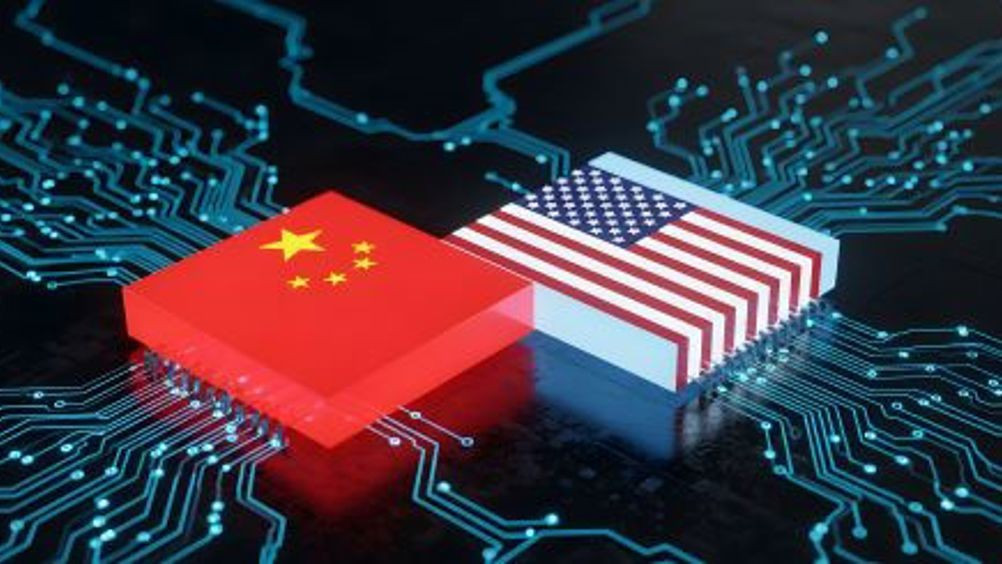
China’s recent decision to erect substantial barriers on the import of foreign semiconductor chips has drawn sharp criticism from U.S. analysts, including a Massachusetts Institute of Technology business professor who argues that the move is driven by the Chinese Communist Party’s pursuit of military power rather than purely economic strategy. According to reporting on January 23, 2026, Beijing’s ban on imports such as Nvidia‘s high-end AI chips comes amid heightened competition with the United States over technology and defense capabilities. Some analysts view the restrictions as part of a broader effort to reduce dependence on U.S. technology while aggressively building China’s own domestic semiconductor manufacturing base — a strategy closely tied to China’s long-standing “Made in China 2025” industrial policy aimed at technological self-sufficiency and strategic dominance. Critically, U.S. export controls have for years sought to limit China’s access to advanced chips and manufacturing tools to slow the potential military application of such technologies and safeguard America’s competitive edge. Observers argue that this dynamic — where China restricts imports and the U.S. restricts exports — reflects a deeper geopolitical struggle for technological primacy with implications for national security, global supply chains, and the future of AI and defense systems. This tech tug-of-war underscores how semiconductors have become central not just to commerce but to strategic military calculations on both sides.
Sources:
https://www.theepochtimes.com/china/as-china-erects-chip-import-barriers-an-mit-professor-blames-ccps-military-ambitions-5973333
https://www.congress.gov/crs-product/R48642
https://en.wikipedia.org/wiki/Made_in_China_2025
Key Takeaways
- China’s chip import restrictions are interpreted by some U.S. experts as part of the CCP’s effort to reduce foreign dependence while advancing military capabilities.
- U.S. semiconductor export controls have been tightened over recent years to hinder the PRC’s access to advanced chip technology for competitive and national-security reasons.
- China’s industrial policies, including “Made in China 2025,” underpin long-term objectives to build domestic technological capacities that challenge U.S. leadership in critical industries.
In-Depth
Semiconductors — the tiny silicon chips that power everything from smartphones to fighter jets — are at the center of an intensifying strategic competition between the United States and China. At issue is more than just trade; it’s about who will command the next generation of technological and military power. On January 23, 2026, reporting highlighted a significant move by the People’s Republic of China: erecting strict barriers on the import of foreign advanced chips, including top-tier units from American firms like Nvidia. Analysts close to U.S. policy circles argue that this isn’t merely an economic decision but a calculated strategic choice tied to the Chinese Communist Party’s drive to fortify its military and reduce reliance on adversarial technology sources.
China’s push to build a self-sufficient semiconductor sector traces back to its industrial policies such as “Made in China 2025” — a comprehensive blueprint aimed at progressing Beijing’s technological prowess in core industries, including semiconductors. Under that framework, China has invested heavily in domestic chip production and equipment manufacturing, seeking to close the gap with global leaders while insulating its economy and defense infrastructure from external pressures. Yet despite these efforts, China still lags significantly in cutting-edge chipmaking capabilities, particularly in producing the most advanced nodes and manufacturing equipment. Its dependence on foreign technology, especially for high-performance computing and artificial intelligence, has remained a strategic vulnerability that both countries are eager to address.
On the U.S. side, policymakers have steadily tightened export controls since the late 2010s, restricting shipments of advanced chips, semiconductor design tools, and specialized manufacturing gear to China. These measures are justified on grounds that unfettered access to American semiconductor technology could strengthen Chinese military systems, AI capabilities, and command-and-control infrastructure. Washington’s intent, in the eyes of defenders of the policy, is twofold: to protect U.S. technological leadership and to prevent adversarial use of components that could degrade American national security. While these restrictions have unquestionably slowed some aspects of China’s semiconductor development, they have also incentivized Beijing to double down on its own manufacturing ecosystem.
The interplay of import barriers and export controls creates a complex dynamic: China seeks self-reliance while protecting nascent domestic champions; the United States aims to contain China’s access to sensitive technologies without undermining its own industry. This back-and-forth has implications far beyond bilateral trade balances. Supply chains — already strained by pandemic disruptions and geopolitical tensions — must adapt to bifurcation that could leave global markets polarized between U.S.-aligned and China-aligned technological spheres. Advanced manufacturing hubs in South Korea, Taiwan, Japan, and Europe are forced to navigate this fragmentation, balancing commercial interests with geopolitical risks.
For Americans vested in national security and economic competitiveness, this isn’t simply a matter of economics. Semiconductors are foundational to future warfare, cybersecurity, aerospace, autonomous systems, and artificial intelligence. The U.S. approach — combining export restrictions with domestic incentives for chip manufacturing — reflects a conservative emphasis on maintaining strategic advantages while mitigating risks posed by technological rivals. Meanwhile, China’s strategies reveal a regime determined to avoid strategic dependence and fortify its defense capacities, even at the cost of greater state control over technology sectors.
Ultimately, the U.S.-China semiconductor confrontation is a defining feature of 21st-century geopolitics. It underscores a broader contest over who sets the rules for emerging technologies and whose values will shape the digital and physical battlefields of tomorrow. What plays out in boardrooms, factories, and policy chambers today could determine the balance of power for decades to come.