

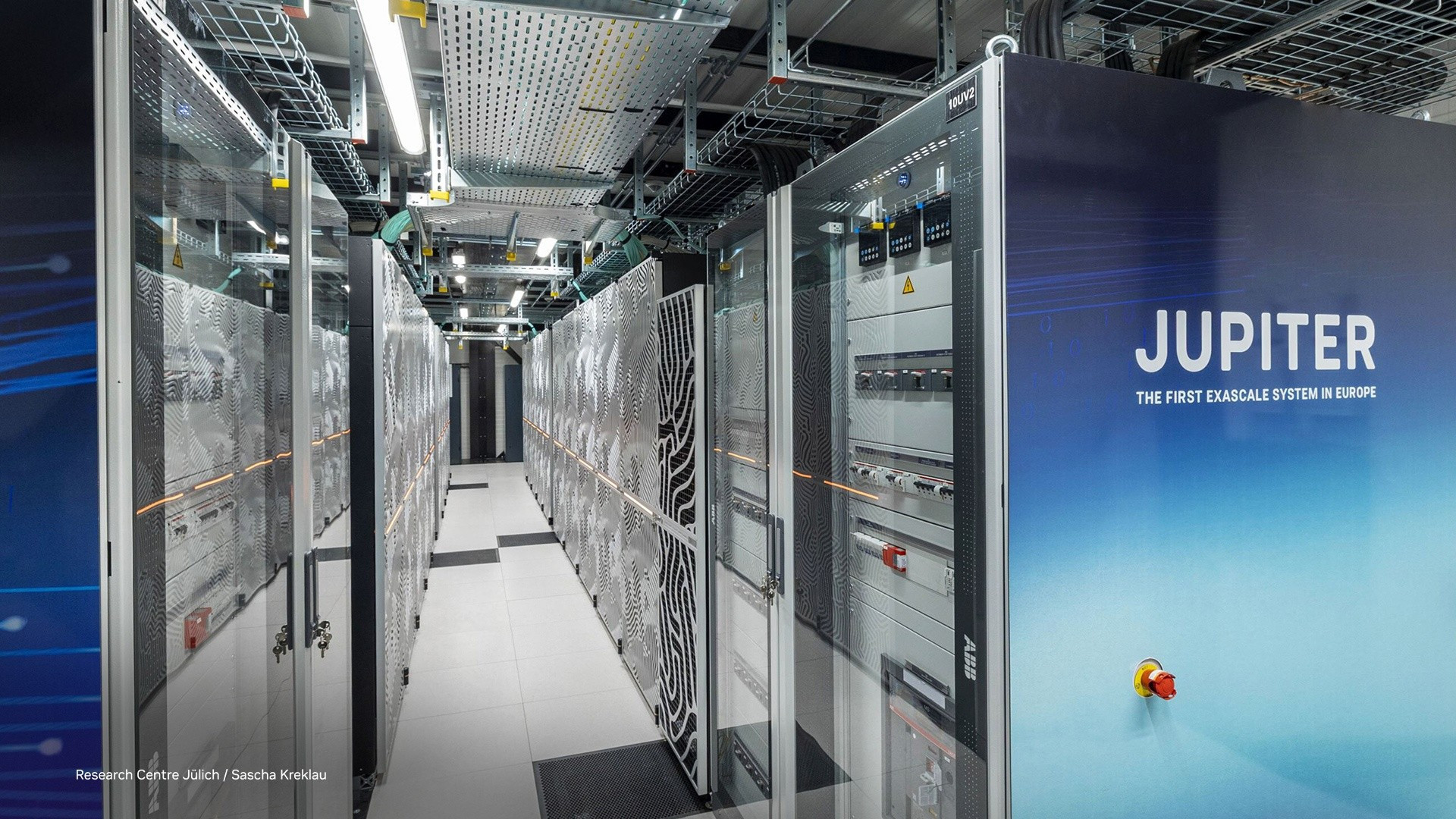
Europe has officially launched its first exascale supercomputer, Jupiter, located at the Jülich Supercomputing Centre in Germany. This powerhouse can handle more than one quintillion operations per second, making it not only the fastest supercomputer in Europe but the fourth fastest in the world. Backed by a €500 million investment from both the EU and Germany, Jupiter employs cutting-edge Nvidia Grace Hopper superchips and advanced cooling that even recycles heat for campus use. The machine is already earmarked for climate and weather modeling at unprecedented resolution, multilingual large language model development, breakthroughs in medical research like Alzheimer’s and HIV therapy, and even quantum simulation pushing beyond 50 qubits. Leaders from the European Commission welcome Jupiter as a cornerstone in boosting digital sovereignty and accelerating scientific innovation.
Sources: Reuters, Nvidia Blog, IT Pro
Key Takeaways
– Strategic Sovereignty & Capability Leap: Jupiter marks a significant step for Europe’s technological independence and global competitiveness in supercomputing.
– Wide-Ranging Scientific Impact: From granular climate modeling to AI, medical research, and quantum computing, Jupiter’s applications are broadly transformative.
– Energy Efficiency & Sustainability: Built with eco-savvy features like energy-efficient chips and heat recycling, Jupiter balances power with responsibility.
In-Depth
Europe’s technological horizon just got a massive power boost with the launch of Jupiter, its inaugural exascale supercomputer, now live at the Jülich Supercomputing Centre in Germany.
Backed by a substantial €500 million investment from both the European Union and Germany, Jupiter steps into the global limelight as the fastest supercomputer in Europe and the world’s fourth fastest. It’s built around the advanced Nvidia Grace Hopper superchips, housed in a cutting-edge liquid-cooled architecture that even harvests waste heat to warm campus facilities—a smart nod toward sustainable engineering.
Jupiter is already driving scientific frontiers. It enables researchers to run climate simulations at one-kilometer scale, unlocking unprecedented accuracy in predictions of heatwaves, storms, and floods. Meanwhile, the University of Lisbon is gearing up to train multilingual AI models that can support all European languages—a meaningful stride toward inclusive AI. On the health front, researchers anticipate breakthroughs targeting severe conditions like Alzheimer’s and HIV. And Jupiter’s capabilities even extend to the quantum realm: it’s expected to handle over 50 qubits, outpacing the previous record of 48 and opening new doors in quantum simulation.
This isn’t just about raw computing power—it’s about asserting European digital sovereignty. By stepping up with advanced infrastructure, Europe stakes its claim in the global high-performance computing space, aiming to close the gap with U.S. and Chinese AI and research capabilities. With energy-efficient performance and broad scientific utility, Jupiter is designed not only to power discoveries but to do so responsibly.