

Close Menu

    Subscribe to Updates

    Get the latest creative news from FooBar about art, design and business.

    What's Hot

    Google’s Compliance With ICE Data Request Sparks Privacy Concerns

    February 14, 2026

    XAI Publicly Unveils Elon Musk’s Interplanetary AI Vision In Rare All-Hands Release

    February 14, 2026

    Elon Musk Shifts SpaceX Priority From Mars Colonization to Building a Moon City

    February 14, 2026
    Facebook X (Twitter) Instagram
    • Tech
    • AI News
    • Get In Touch
    Facebook X (Twitter) LinkedIn
    TallwireTallwire
    • Tech

      Microsoft Exchange Online’s Aggressive Filters Mistake Legitimate Emails for Phishing

      February 13, 2026

      Hobbyist Finds $500 Worth Of RAM In Landfill As Memory Shortages Bite Hardware Market

      February 13, 2026

      Intel Quietly Pulls Plug on Controversial Pay-to-Unlock CPU Feature Model

      February 13, 2026

      Toyota Announces Open-Source “Console-Grade” Game Engine For Vehicle Systems And Beyond

      February 13, 2026

      Snapchat Rolls Out Expanded Arrival Notifications Beyond Home

      February 13, 2026
    • AI News

      XAI Publicly Unveils Elon Musk’s Interplanetary AI Vision In Rare All-Hands Release

      February 14, 2026

      OpenAI Begins Testing Ads in ChatGPT’s Free and Low-Cost Tiers as Industry Monetization Shift

      February 14, 2026

      Discord to Mandate Global Age Verification With Face Scans and IDs in March 2026

      February 13, 2026

      Hobbyist Finds $500 Worth Of RAM In Landfill As Memory Shortages Bite Hardware Market

      February 13, 2026

      Chinese Firms Expand Chip Production As Global Memory Shortage Deepens

      February 12, 2026
    • Security

      Microsoft Exchange Online’s Aggressive Filters Mistake Legitimate Emails for Phishing

      February 13, 2026

      China’s Salt Typhoon Hackers Penetrate Norwegian Networks in Espionage Push

      February 12, 2026

      Reality Losing the Deepfake War as C2PA Labels Falter

      February 11, 2026

      Global Android Security Alert: Over One Billion Devices Vulnerable to Malware and Spyware Risks

      February 11, 2026

      Small Water Systems Face Rising Cyber Threats As Experts Warn National Security Risk

      February 9, 2026
    • Health

      AI Advances Aim to Bridge Labor Gaps in Rare Disease Treatment

      February 12, 2026

      Boeing and Israel’s Technion Forge Clean Fuel Partnership to Reduce Aviation Carbon Footprints

      February 11, 2026

      OpenAI’s Drug Royalties Model Draws Skepticism as Unworkable in Biotech Reality

      February 10, 2026

      New AI Health App From Fitbit Founders Aims To Transform Family Care

      February 9, 2026

      Startups Deploy Underwater Robots to Radically Expand Ocean Tracking Capabilities

      February 9, 2026
    • Science

      XAI Publicly Unveils Elon Musk’s Interplanetary AI Vision In Rare All-Hands Release

      February 14, 2026

      Elon Musk Shifts SpaceX Priority From Mars Colonization to Building a Moon City

      February 14, 2026

      NASA Artemis II Spacesuit Mobility Concerns Ahead Of Historic Mission

      February 13, 2026

      AI Agents Build Their Own MMO Playground After Moltbook Ignites Agent-Only Web Communities

      February 12, 2026

      AI Advances Aim to Bridge Labor Gaps in Rare Disease Treatment

      February 12, 2026
    • People

      Google Co-Founder’s Epstein Contacts Reignite Scrutiny of Elite Tech Circles

      February 7, 2026

      Bill Gates Denies “Absolutely Absurd” Claims in Newly Released Epstein Files

      February 6, 2026

      Informant Claims Epstein Employed Personal Hacker With Zero-Day Skills

      February 5, 2026

      Starlink Becomes Critical Internet Lifeline Amid Iran Protest Crackdown

      January 25, 2026

      Musk Pledges to Open-Source X’s Recommendation Algorithm, Promising Transparency

      January 21, 2026
    TallwireTallwire
    Home»Tech»Europe Lights Up Its First Exascale Supercomputer “Jupiter”—A Game-Changer for Research
    Tech

    Europe Lights Up Its First Exascale Supercomputer “Jupiter”—A Game-Changer for Research

    3 Mins Read
    Facebook Twitter Pinterest LinkedIn Tumblr Email
    Europe Lights Up Its First Exascale Supercomputer “Jupiter”—A Game-Changer for Research
    Europe Lights Up Its First Exascale Supercomputer “Jupiter”—A Game-Changer for Research
    Share
    Facebook Twitter LinkedIn Pinterest Email

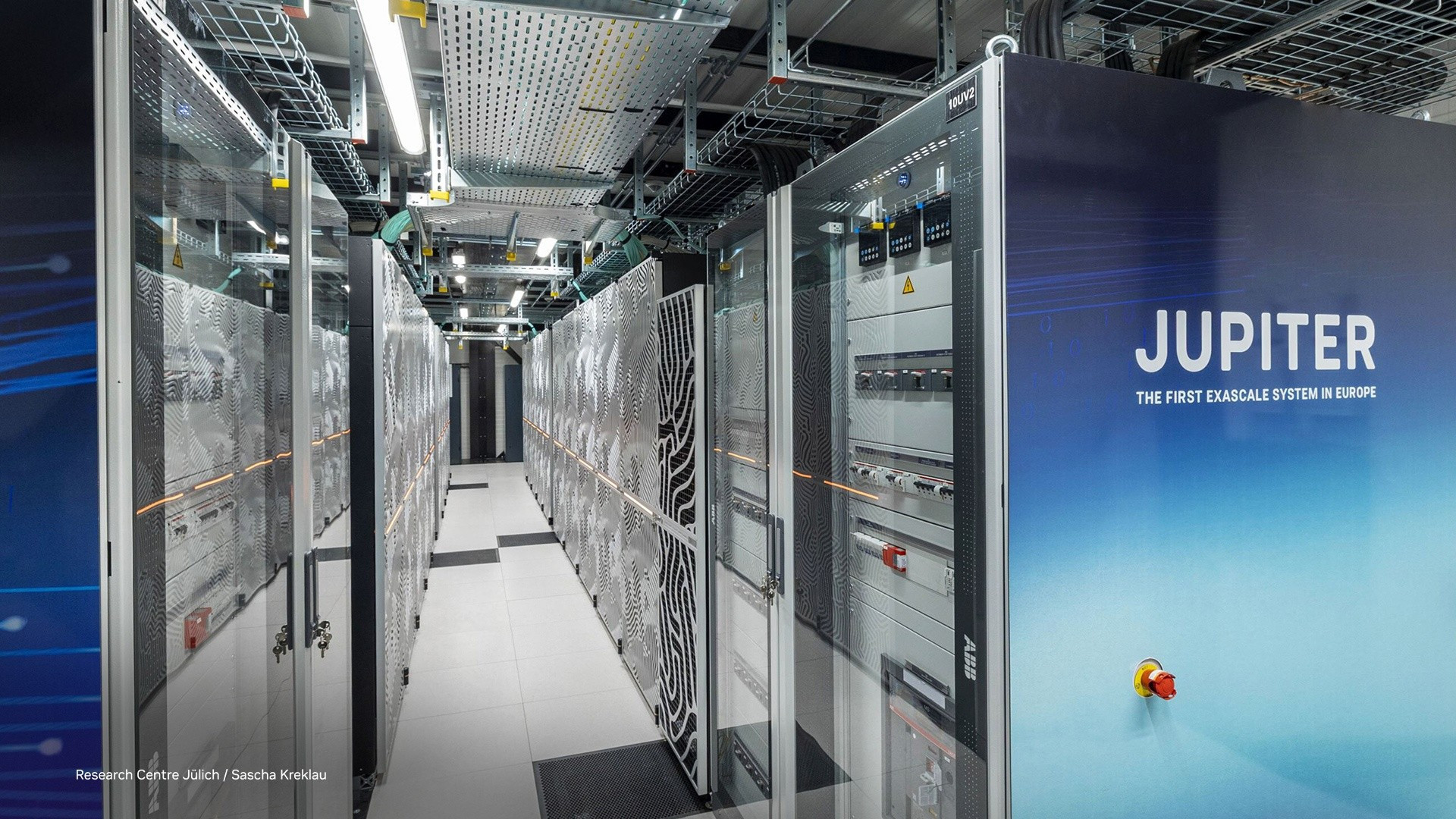
    Europe has officially launched its first exascale supercomputer, Jupiter, located at the Jülich Supercomputing Centre in Germany. This powerhouse can handle more than one quintillion operations per second, making it not only the fastest supercomputer in Europe but the fourth fastest in the world. Backed by a €500 million investment from both the EU and Germany, Jupiter employs cutting-edge Nvidia Grace Hopper superchips and advanced cooling that even recycles heat for campus use. The machine is already earmarked for climate and weather modeling at unprecedented resolution, multilingual large language model development, breakthroughs in medical research like Alzheimer’s and HIV therapy, and even quantum simulation pushing beyond 50 qubits. Leaders from the European Commission welcome Jupiter as a cornerstone in boosting digital sovereignty and accelerating scientific innovation.

    Sources: Reuters, Nvidia Blog, IT Pro

    Key Takeaways

    – Strategic Sovereignty & Capability Leap: Jupiter marks a significant step for Europe’s technological independence and global competitiveness in supercomputing.

    – Wide-Ranging Scientific Impact: From granular climate modeling to AI, medical research, and quantum computing, Jupiter’s applications are broadly transformative.

    – Energy Efficiency & Sustainability: Built with eco-savvy features like energy-efficient chips and heat recycling, Jupiter balances power with responsibility.

    In-Depth

    Europe’s technological horizon just got a massive power boost with the launch of Jupiter, its inaugural exascale supercomputer, now live at the Jülich Supercomputing Centre in Germany.

    Backed by a substantial €500 million investment from both the European Union and Germany, Jupiter steps into the global limelight as the fastest supercomputer in Europe and the world’s fourth fastest. It’s built around the advanced Nvidia Grace Hopper superchips, housed in a cutting-edge liquid-cooled architecture that even harvests waste heat to warm campus facilities—a smart nod toward sustainable engineering.

    Jupiter is already driving scientific frontiers. It enables researchers to run climate simulations at one-kilometer scale, unlocking unprecedented accuracy in predictions of heatwaves, storms, and floods. Meanwhile, the University of Lisbon is gearing up to train multilingual AI models that can support all European languages—a meaningful stride toward inclusive AI. On the health front, researchers anticipate breakthroughs targeting severe conditions like Alzheimer’s and HIV. And Jupiter’s capabilities even extend to the quantum realm: it’s expected to handle over 50 qubits, outpacing the previous record of 48 and opening new doors in quantum simulation.

    This isn’t just about raw computing power—it’s about asserting European digital sovereignty. By stepping up with advanced infrastructure, Europe stakes its claim in the global high-performance computing space, aiming to close the gap with U.S. and Chinese AI and research capabilities. With energy-efficient performance and broad scientific utility, Jupiter is designed not only to power discoveries but to do so responsibly.

    Share. Facebook Twitter Pinterest LinkedIn Tumblr Email
    Previous ArticleEU Slaps Google with €2.95 Billion Fine Over Ad-Tech Self-Preferencing
    Next Article Event-App Partiful Exposed Users’ Raw GPS Coordinates via Profile Photos

    Related Posts

    Microsoft Exchange Online’s Aggressive Filters Mistake Legitimate Emails for Phishing

    February 13, 2026

    Hobbyist Finds $500 Worth Of RAM In Landfill As Memory Shortages Bite Hardware Market

    February 13, 2026

    Intel Quietly Pulls Plug on Controversial Pay-to-Unlock CPU Feature Model

    February 13, 2026

    Snapchat Rolls Out Expanded Arrival Notifications Beyond Home

    February 13, 2026
    Add A Comment
    Leave A Reply Cancel Reply

    Editors Picks

    Microsoft Exchange Online’s Aggressive Filters Mistake Legitimate Emails for Phishing

    February 13, 2026

    Hobbyist Finds $500 Worth Of RAM In Landfill As Memory Shortages Bite Hardware Market

    February 13, 2026

    Intel Quietly Pulls Plug on Controversial Pay-to-Unlock CPU Feature Model

    February 13, 2026

    Toyota Announces Open-Source “Console-Grade” Game Engine For Vehicle Systems And Beyond

    February 13, 2026
    Top Reviews
    Tallwire
    Facebook X (Twitter) LinkedIn Threads Instagram RSS
    • Tech
    • Entertainment
    • Business
    • Government
    • Academia
    • Transportation
    • Legal
    • Press Kit
    © 2026 Tallwire. Optimized by ARMOUR Digital Marketing Agency.

    Type above and press Enter to search. Press Esc to cancel.