

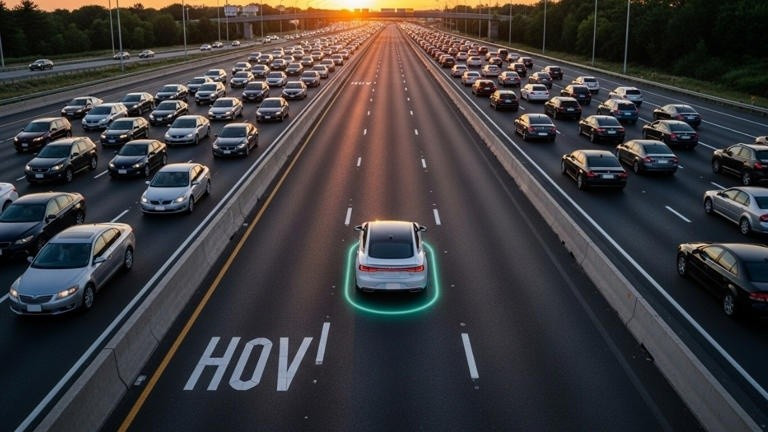
As of October 1, 2025, electric, plug-in hybrid, and hydrogen fuel cell vehicles in California will lose their ability to use carpool (HOV) lanes when driving solo, as well as associated toll discounts, due to the expiration of the Clean Air Vehicle (CAV) decal program, which the federal government failed to reauthorize. The program had issued over 1.2 million decals since its start around 1999, with about 500,000 of them still active prior to the cutoff. The driving force behind ending the program is a “sunset” provision under Section 166 of Title 23 of the U.S. Code, which required congressional/federal approval to continue, an approval that was not granted. California officials warn that the move will remove a popular incentive for clean vehicle purchases, potentially slowing EV uptake, and will force drivers to meet the usual carpool/occupancy rules or else face fines.
Sources: Reuters, KQED, California Air Resources Board
Key Takeaways
– The Clean Air Vehicle decal program, which let certain clean-fuel vehicles use carpool lanes solo and enjoy toll perks in California (and a similar provision in New York), will end on Sept 30, 2025, because federal authorization was not renewed.
– Roughly 500,000 active decaled vehicles will be affected — losing time savings, toll discounts, and a commuting incentive many cited as part of their justification for buying EVs or hybrids.
– Officials warn that ending this incentive may slow EV adoption momentum and undermine environmental goals; alternative incentives or policy mechanisms may be needed to compensate.
In-Depth
The impending end of solo carpool lane access for clean-fuel vehicles in California and New York marks a significant shift in how states reward environmentally friendly vehicle choices—and shows how dependent many incentive programs are on continued federal approval.
Since 1999, California’s Clean Air Vehicle (CAV) program has allowed qualifying electric, plug-in hybrid, and hydrogen fuel cell vehicles to use high-occupancy vehicle (HOV) or carpool lanes even when driven by a single occupant. For many EV owners and prospective buyers, this wasn’t just a convenience—it was a strong incentive to make the switch away from traditional internal combustion engine vehicles.
However, under Section 166 of Title 23 of the U.S. Code, the program’s extension required federal reauthorization. That reauthorization didn’t come, which means that on October 1, 2025, all active CAV decals will expire, and solo EV drivers will no longer be able to use carpool lanes without meeting the usual occupancy rules. There’s no grace period. California’s DMV stopped accepting new or replacement decal applications as of August 29, 2025.
What’s more, it’s not just an inconvenience. For many drivers, using the carpool lane meant drastically shorter travel times, reduced congestion, and often cheaper tolls in places where discounts applied. Removing that benefit could change commuting behavior, increase traffic congestion in general-purpose lanes, and reduce the relative appeal of buying clean vehicles. Some state officials argue the environmental return on the program is decreasing because as more clean vehicles populate the roads, the incremental benefit of giving them solo access to carpool lanes shrinks—but the incentive value to consumers remains.
States that used the program as part of broader EV adoption strategies now face a gap. With classified major incentive mechanisms—tax credits, rebates, fast-lane access—either expiring or being trimmed, EV adoption could slow unless new policies are crafted. Policymakers may need to explore refined benefits, such as limiting solo lane access to the cleanest vehicles (fully battery electric), restricting the benefit to off-peak hours, or offering other non-federal incentives to fill the void. Otherwise, what was once a free perk may turn into a sorely missed reason people chose EVs in the first place.
In the end, the change underlines how entwined environmental policy, infrastructure law, and federal-state cooperation are. Incentives are powerful—but if they depend on temporary authorizations, their loss can ripple through consumer behavior, traffic patterns, and state strategies for reducing emissions. As California, New York, and other states adjust, it’s possible we’ll see new incentives arise—but for many current clean vehicle owners, October 1 will mean losing a much-loved lane.