

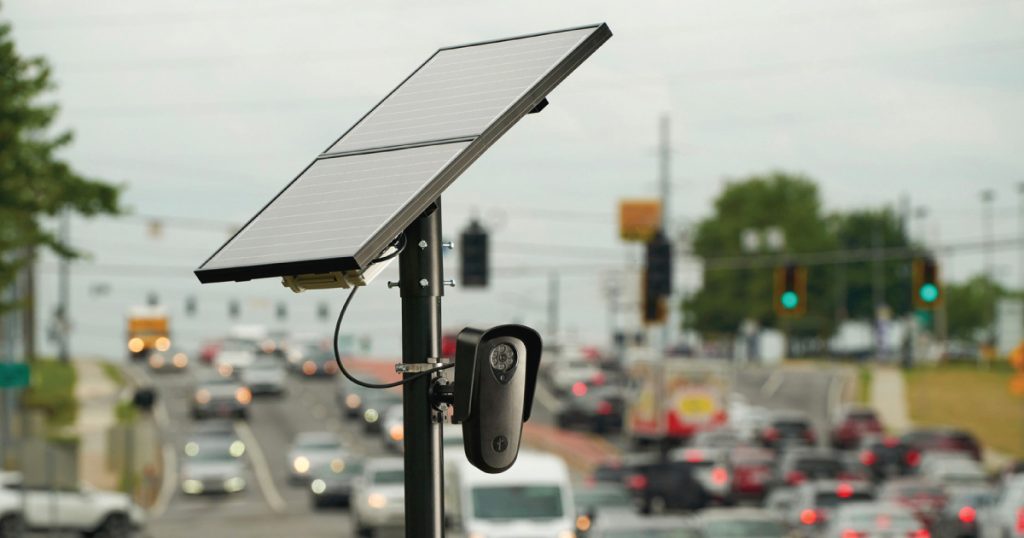
The rapid expansion of Flock Safety’s automated license plate reader network has intensified a nationwide debate over privacy, civil liberties, and public safety. The system, now consisting of more than 120,000 cameras deployed across the United States, enables law enforcement agencies to identify, locate, and reconstruct the movements of vehicles within seconds. Supporters argue the technology has become an indispensable investigative tool for locating stolen vehicles, apprehending suspects, and finding missing persons. Critics, however, contend that the sheer scale of the network has created an unprecedented system of mass surveillance capable of tracking the movements of ordinary Americans with little public awareness or meaningful oversight. Reports of officers misusing the technology for personal reasons, growing bipartisan opposition, and increasing public protests have transformed Flock cameras from a niche policing technology into a significant national political issue.
Key Takeaways
- Mass surveillance concerns have become bipartisan. Privacy advocates, conservatives, liberals, and civil liberties organizations increasingly question whether widespread automated vehicle tracking is compatible with constitutional protections against unreasonable government surveillance.
- Law enforcement cites substantial investigative value. Police agencies continue to defend the technology as an effective crime-fighting resource that has helped recover stolen vehicles, locate missing persons, and identify criminal suspects more quickly than traditional investigative methods.
- Calls for stronger oversight are growing. Allegations of misuse by individual officers, expanding artificial intelligence capabilities, and inconsistent state regulations have prompted demands for stricter auditing, shorter data-retention periods, greater transparency, and clearer legal safeguards governing access to vehicle location data.
In-Depth
The debate surrounding Flock Safety cameras illustrates the increasingly difficult balance between technological capability and constitutional liberty. Automated license plate readers are no longer limited to isolated intersections or specialized investigations. Instead, interconnected camera networks can create a detailed historical record of vehicle travel across multiple jurisdictions, allowing investigators to reconstruct movement patterns with remarkable speed. While police departments emphasize successful criminal investigations and rapid suspect identification, critics argue that the same capabilities inevitably collect information about millions of law-abiding citizens who are not suspected of wrongdoing.
Concerns have intensified following documented instances in which officers allegedly used the system to track romantic partners or acquaintances for personal reasons, reinforcing arguments that technological safeguards alone cannot prevent abuse. Simultaneously, advances in artificial intelligence have expanded searches beyond license plates to include vehicle characteristics such as color, make, model, damage, or distinguishing features, further increasing the system’s reach. These developments have prompted bipartisan legislative interest, local efforts to restrict deployments, and growing public demands for stronger oversight. The broader question extends beyond any single company: whether rapidly advancing surveillance technologies can remain consistent with longstanding expectations of privacy, accountability, and limited government authority. As camera networks continue expanding nationwide, policymakers increasingly face pressure to establish legal standards that preserve legitimate investigative capabilities while protecting civil liberties from incremental erosion.
Sources
- https://www.nytimes.com/2026/08/21/magazine/flock-cameras-surveillance-state.html
- https://www.washingtonpost.com/technology/2026/08/19/we-found-cops-who-misused-flock-their-police-departments-didnt-know/
- https://www.axios.com/2026/08/17/flock-camera-local-opposition-surveillance
- https://www.eff.org/issues/automated-license-plate-readers