

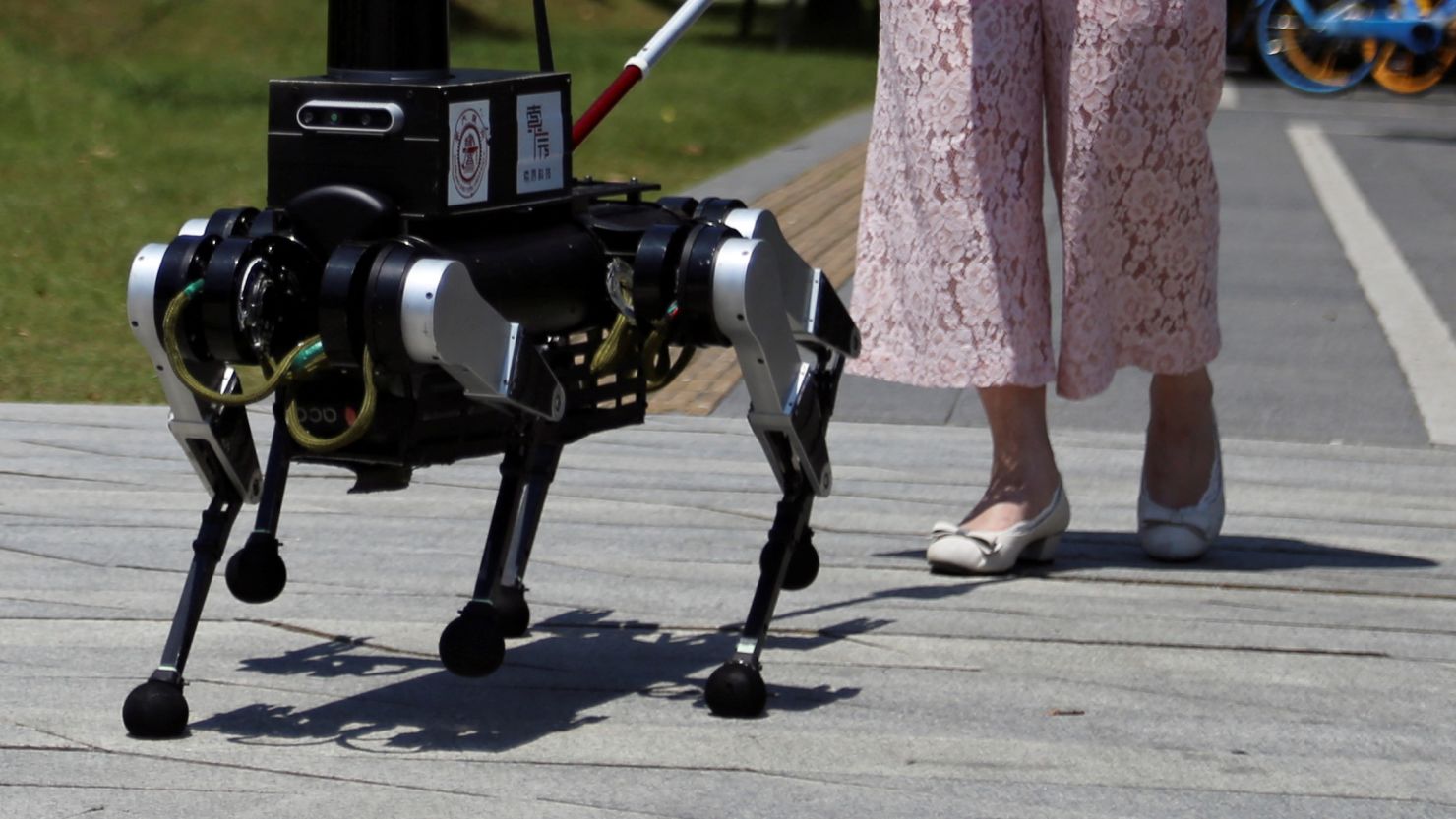
A San Francisco technology startup is paying workers $20 an hour to walk robotic dogs through city streets, highlighting the considerable distance between artificial intelligence’s promises and its practical capabilities. Dimensional, a robotics software company operating in the city’s Dogpatch neighborhood, recruited workers to guide four-legged machines for four to six hours daily, collecting information to train AI systems in real-world navigation. The robots, manufactured by China’s Unitree, cost approximately $2,000 apiece and weigh about 33 pounds. Workers must occasionally carry the machines back when they overheat or malfunction. The company hopes its technology will eventually allow robots to perform physical labor, patrol properties and operate independently in industrial settings. However, the experiment underscores an inconvenient reality: Despite substantial investment in automation, sophisticated machines still require considerable human assistance to accomplish relatively ordinary tasks.
Key Takeaways
• Humans Training Machines: Dimensional is paying workers $20 hourly to guide robotic dogs through San Francisco, generating real-world navigation data needed to improve AI autonomy.
• Automation Remains Limited: The robots require human supervision, struggle with navigation and occasionally overheat, exposing significant technological obstacles to replacing human labor.
• Economic and Safety Questions: The company’s ambitions for autonomous industrial and security robots raise questions about reliability, public safety, accountability and the practical costs of automation.
In-Depth
A San Francisco startup’s unusual employment opportunity illustrates the growing divide between Silicon Valley’s ambitious automation promises and the limitations of today’s artificial intelligence. Dimensional recently advertised positions paying $20 an hour for workers willing to walk robotic dogs through urban neighborhoods, helping machines learn tasks their developers ultimately expect them to perform independently.
The assignment involves guiding approximately 33-pound robots through city streets for four to six hours daily. Equipped with cameras and sensors, the machines collect environmental information that developers use to improve navigation software. Workers must also contend with mechanical failures, including overheating that can require physically carrying the robots back to company headquarters.
Dimensional founder Stash Pomichter envisions robots eventually handling physically demanding assignments in factories, construction sites, data centers and security operations. The company reportedly acquired more than 100 robotic dogs and 50 humanoid robots while developing software intended to make these machines increasingly autonomous.
Nevertheless, the experiment exposes persistent shortcomings in AI-driven robotics. Systems capable of sophisticated digital reasoning still struggle with unpredictable physical environments, creating substantial challenges involving safety, reliability and operational costs.
Public concerns extend beyond mechanical performance. Autonomous security patrols and camera-equipped machines operating in public spaces raise legitimate questions about surveillance, liability and appropriate oversight. The company’s activities have already generated hostile reactions from at least one individual concerned about potential weaponization.
For businesses considering automation, the lesson is straightforward: Technological investment must produce measurable improvements in productivity and safety. Until robots can consistently operate without human intervention, their economic advantages remain uncertain. The emerging industry may eventually transform physical labor, but practical engineering accomplishments, rather than promotional promises, will determine its success.
Sources
• https://www.nytimes.com/2026/10/27/technology/robot-dog-walkers.html
• https://www.chosun.com/english/world-en/2026/10/28/CD6XXLGHSVDKJPU26PJFD2GEOQ/
• https://www.gadgetreview.com/san-francisco-is-looking-for-robot-dog-walkers-for-20-an-hour