

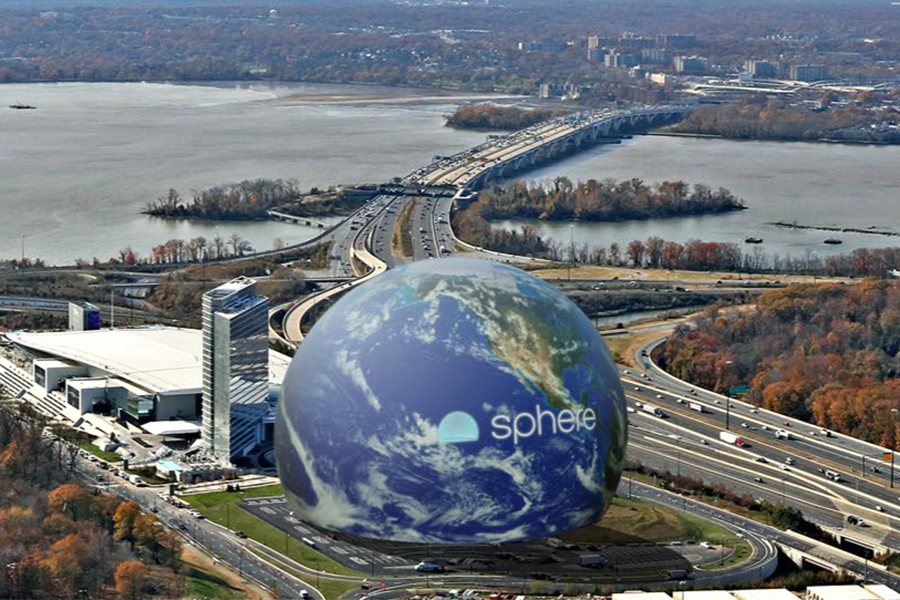
Sphere Entertainment has announced plans to build a new immersive entertainment venue at National Harbor in Maryland, marking the company’s second U.S. location following its flagship Sphere in Las Vegas. The proposed “mini-Sphere” would seat about 6,000 people and feature advanced technology including high-resolution LED screens, immersive sound systems, haptic seating, and 4D effects similar to those at the Las Vegas venue. The project is a collaboration between Sphere Entertainment, the State of Maryland, Prince George’s County, and the Peterson Companies, and is expected to generate an annual economic impact exceeding $1 billion. Funding would come from a combination of private investment and roughly $200 million in state and local incentives, though the plan still requires approvals from government bodies. Officials emphasize significant job creation during construction and operation and position the development as a major boost for tourism, entertainment, and economic growth in the region. Residents and stakeholders are already debating potential benefits and impacts as planning moves forward.
Source 1: https://www.theverge.com/tech/864192/sphere-entertainment-mini-venue-maryland-national-harbor
Source 2: https://wtop.com/maryland/2026/01/mini-sphere-planned-for-national-harbor-in-maryland/
Source 3: https://investor.sphereentertainmentco.com/press-releases/news-details/2026/Sphere-Entertainment-the-State-of-Maryland-Prince-Georges-County-and-Peterson-Companies-Announce-Intent-to-Develop-A-Sphere-At-National-Harbor/default.aspx
Key Takeaways
• Sphere Entertainment is developing a smaller-scale 6,000-seat “mini-Sphere” venue at National Harbor, Maryland, intended to replicate the immersive entertainment features of the Las Vegas Sphere.
• The project involves roughly $200 million in state, local, and private incentives and is projected to generate more than $1 billion in annual economic activity, with significant job creation during construction and operation.
• Approval from government authorities is pending, and community responses are mixed, with supporters highlighting economic growth and critics raising concerns about impacts.
In-Depth
Sphere Entertainment’s latest announcement marks a bold effort to expand its unique brand of immersive entertainment beyond the Las Vegas Strip with a proposed mini-Sphere venue at National Harbor in Maryland. Positioned just south of Washington, D.C., this development aims to bring a high-tech, experiential entertainment landmark to the East Coast, blending cutting-edge technology with regional economic development ambitions. While the flagship Las Vegas Sphere has drawn international attention for its massive LED displays and immersive experiences, this scaled-down version would adapt that model for a more moderate footprint with about 6,000 seats — still substantial enough to host large concerts, multimedia events, corporate functions, and potentially other forms of live entertainment.
The project is a partnership between Sphere Entertainment, the State of Maryland, Prince George’s County, and the Peterson Companies, as outlined in official announcements. Public and private funding commitment estimates hover around $200 million, a blend of incentives that state and local officials contend will catalyze wider economic benefits. Projections from government and business leaders suggest that once operational, the venue could contribute more than $1 billion annually in revenue, outpacing local attractions like previous theme parks and stadiums. In addition to long-term employment opportunities within the venue itself, construction is expected to support thousands of jobs, which local officials highlight as a major benefit for the region’s workforce.
From a technological standpoint, the National Harbor Sphere would preserve many of the signature features that have defined the Las Vegas location’s success, including state-of-the-art LED displays both inside and outside the structure, immersive audio systems, and sensory enhancements like haptic seating and environmental effects. These elements aim to redefine the live event experience and attract national and international audiences. Supporters of the project emphasize its potential to elevate National Harbor as a premier destination for conventions, entertainment, retail, and hospitality, leveraging its proximity to the nation’s capital and robust tourism infrastructure.
Yet the plan has not been without controversy. As with any major entertainment and economic development initiative involving public incentives, there are differing opinions among community members about the potential impacts on traffic, local infrastructure, and regional priorities. Some residents express excitement about new jobs and increased tourism, while others worry about disruptions or the allocation of public funds for a project tied closely to private enterprise. Approval from government bodies, including Prince George’s County and state legislators, remains a key next step before construction can begin, ensuring there will be ongoing public debate and political deliberation.
In summary, the proposed mini-Sphere at National Harbor represents a high-stakes gambit to replicate and regionalize a uniquely immersive entertainment model outside Nevada. With substantial projected economic benefits and a high-visibility partnership between public officials and a major entertainment company, the initiative underscores how municipalities increasingly pursue destination-level attractions to compete for tourism and business activity. Whether this vision ultimately comes to fruition will depend on regulatory approvals, community buy-in, and the ever-shifting landscape of entertainment demand — but for now, the plan signals significant momentum toward transforming National Harbor’s entertainment profile while continuing Sphere Entertainment’s broader expansion strategy.