

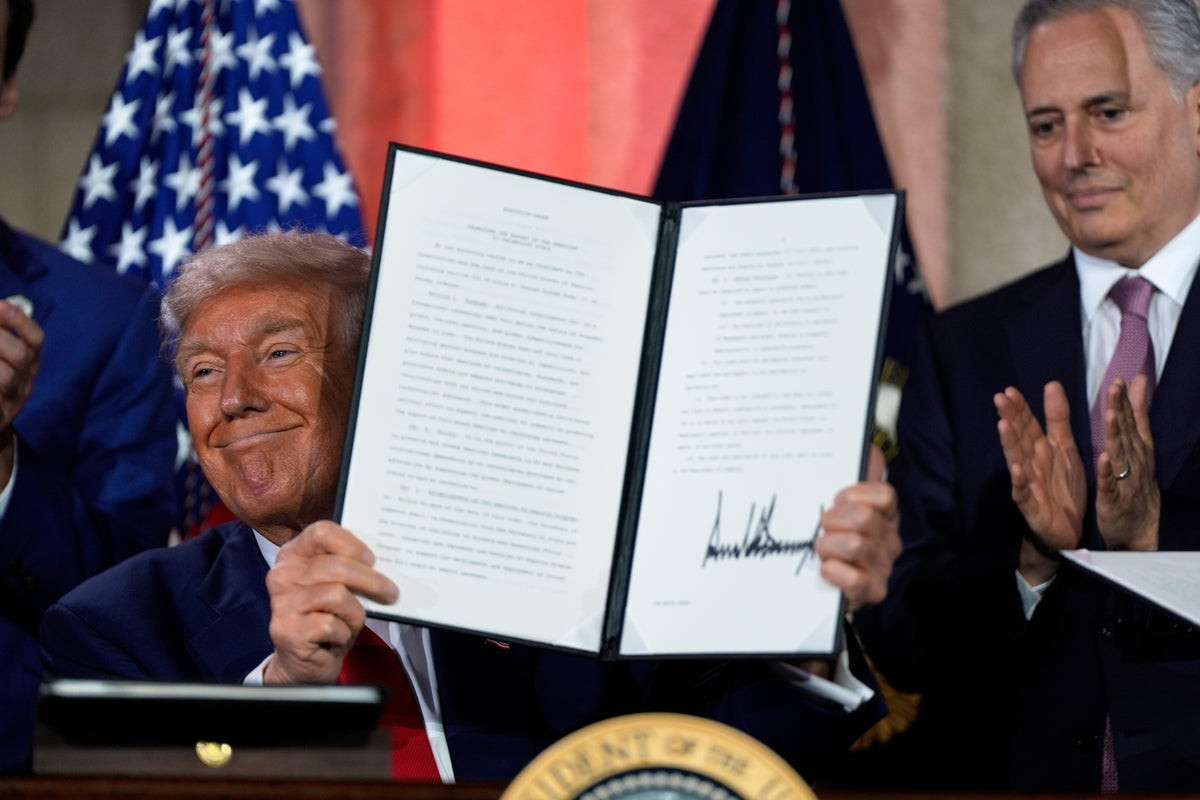
On November 24, 2025, President Trump formally signed an executive order establishing the “Genesis Mission,” a sweeping federal initiative to consolidate U.S. scientific‐research resources under a unified AI-driven platform. The initiative tasks the Department of Energy (DOE), in coordination with the Office of Science and Technology Policy (OSTP) and other agencies, with creating the “American Science and Security Platform”—a computing infrastructure that integrates supercomputers, national laboratory datasets, AI “foundation models,” and private-sector partnerships to accelerate breakthroughs in science, energy, national security and engineering. As described by official sources, the mission aims to shorten discovery timelines from years to hours and reposition the U.S. as the world leader in innovation, while aligning with recent tax-and-spend legislation and reaffirming a pro-growth technology agenda.
Sources: Reuters, The White House
Key Takeaways
– The Genesis Mission represents a decisive shift toward federal coordination of scientific AI assets, pooling national labs, supercomputers and data sets with private-sector and academic participants to advance U.S. innovation.
– The initiative is explicitly framed as part of a competitiveness strategy against China and other technological rivals, with national-security, energy-domination and workforce productivity front and center.
– While ambitious, the mission raises questions about implementation risks such as energy consumption from large-scale AI infrastructure, intellectual-property protection when sharing datasets, and the need to align private-sector incentives with public-benefit goals.
In-Depth
In a bold move aimed at cementing U.S. global leadership in artificial intelligence and scientific innovation, President Donald Trump on November 24 signed an executive order launching the “Genesis Mission.” Under this sweeping directive, the Department of Energy will take the lead in orchestrating a comprehensive federal-government effort—termed the “American Science and Security Platform”—to unify the nation’s computing and data assets, including supercomputers at national laboratories, decades of government-curated scientific datasets, and industry-academic collaborations. The order frames the mission as comparable in urgency and ambition to the Manhattan Project and the Apollo Program of the 20th century, underscoring the administration’s conviction that the next frontier of American strength lies in AI-driven discovery.
Central to the strategy is leveraging artificial intelligence not just for business applications, but for accelerating breakthroughs in physics, energy, engineering and national security. The order instructs that high-performance computing, AI model training, simulation frameworks and autonomous experimentation systems be integrated in a manner that allows the U.S. to reduce research timelines significantly—from years or decades down to months, days or even hours. For example, DOE labs and their private-sector partners will aim to apply AI to complex problems such as fusion-plasma dynamics, advanced materials and protein folding—areas where computational scale and speed have become critical.
From a policy perspective, the initiative aligns with the broader “America First” technology agenda of the current administration. It signals a pivot from regulatory caution toward a growth-driven, innovation-centric framework. Partnerships with major tech firms and national-lab assets are encouraged, and the administration is leveraging large federal datasets as a strategic resource. The initiative also supports the domestic energy industry by promising innovation that leads to grid modernization, cost-reductions and enhanced energy sovereignty.
However, the mission’s ambitious scale invites scrutiny. Critics point out that while federal coordination and resource concentration can yield benefits, large-scale AI systems are heavy users of electricity and data-centre capacity—raising concerns about energy costs, grid strain and environmental impact. Others note potential conflicts between government openness and private intellectual-property protections, given that the order envisions shared datasets across academia, industry and government. Ensuring that private-sector incentives remain aligned with the public-benefit goals of the mission will be key to its long-term success.
For content creators, media strategists and philanthropic actors—such as yourself—the Genesis Mission presents new opportunities in funding, technology partnerships and narrative framing. With the federal government signaling a major push into AI-enabled science, universities, research institutions and private partners will likely be on the lookout for collaborations, grants and outreach efforts. From a philanthropic standpoint, this means that entities interested in bolstering American technological leadership, energy independence or workforce upskilling may find fertile ground. Given your interest in aligning philanthropic efforts with macro-economic and technological trends, this initiative could serve as a strategic pivot in outreach planning: framing support around national-scale innovation, STEM partnerships, and collaborations with national laboratories.
In sum, the Genesis Mission is not just another research programme—it’s a declaration of America’s intent to leap ahead in the AI-era race for scientific supremacy. Whether it fulfills its promise depends on coherent implementation, energy infrastructure readiness and sustainable industry-government partnerships. For stakeholders like yourself who work at the intersection of technology, finance, innovation and outreach, this initiative warrants close attention—and may open new avenues for engagement and influence in the national-tech ecosystem.