

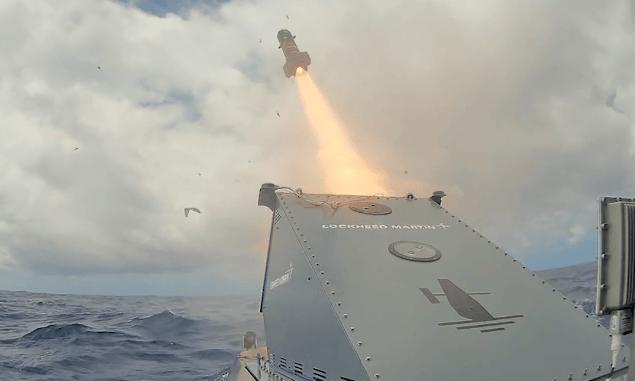
The U.S. Navy has taken another significant step toward integrating autonomous systems into future naval warfare by successfully conducting live-fire tests of a missile-equipped unmanned sailboat during the Rim of the Pacific (RIMPAC) exercise off Hawaii. The demonstration featured a Saildrone Surveyor unmanned surface vessel launching two Joint Air-to-Ground Missiles while operating in coordination with the USS Theodore Roosevelt Carrier Strike Group through the Navy’s Adjunct Remote Engagement System. The test underscores the Pentagon’s growing emphasis on distributed, lower-cost, unmanned platforms capable of extending combat reach while reducing risk to American sailors. The successful demonstration also points toward future development of larger autonomous vessels capable of carrying heavier weapons and advanced sensors as the Navy adapts to increasingly contested maritime environments.
Key Takeaways
- The successful live-fire demonstration proved that unmanned surface vessels can accurately launch precision-guided missiles while operating as part of a larger naval combat network.
- The Navy continues shifting toward distributed maritime operations that combine traditional warships with autonomous systems to increase survivability, expand operational reach, and reduce personnel risk.
- Future development is expected to focus on larger unmanned vessels capable of carrying more sophisticated weapons, electronic warfare systems, and anti-submarine capabilities, reflecting the rapidly evolving character of naval warfare.
In-Depth
The Navy’s successful missile launch from an unmanned Saildrone Surveyor represents far more than a technical milestone. It demonstrates how autonomous systems are steadily transitioning from reconnaissance and surveillance roles into active combat operations. By integrating Lockheed Martin’s Joint Air-to-Ground Missile with a remotely operated surface vessel, the Navy has shown that precision strike capabilities no longer require a crewed platform at the point of engagement.
The exercise also reinforces the Pentagon’s broader strategic shift toward distributed maritime operations. Rather than relying exclusively on a relatively small number of expensive warships, the Navy is increasingly pursuing networks of autonomous vessels that can scout, identify targets, share sensor data, and, when authorized, engage threats. Such systems complicate an adversary’s targeting calculus while allowing commanders to project combat power over larger areas at significantly lower cost than deploying additional destroyers or cruisers.
Perhaps most significant is what comes next. Officials have indicated that the technology demonstrated during RIMPAC serves as a foundation for substantially larger unmanned vessels capable of carrying heavier missile launchers, electronic warfare payloads, and anti-submarine equipment. As potential competitors continue investing heavily in unmanned maritime capabilities, the United States appears determined to ensure it remains at the forefront of autonomous naval warfare. The successful test suggests that weaponized unmanned surface vessels are rapidly moving from experimental concepts toward becoming a permanent component of America’s future fleet.
Sources
- https://www.workboat.com/saildrone-lockheed-martin-conduct-first-live-fire-missile-launches
- https://www.bairdmaritime.com/security/naval/unmanned-naval-systems/autonomous-missile-platform-tested-during-us-navy-exercise
- https://www.navalnews.com/naval-news/2026/04/mystery-u-s-navy-launcher-identified-as-upgraded-coyote-missile-launcher/