

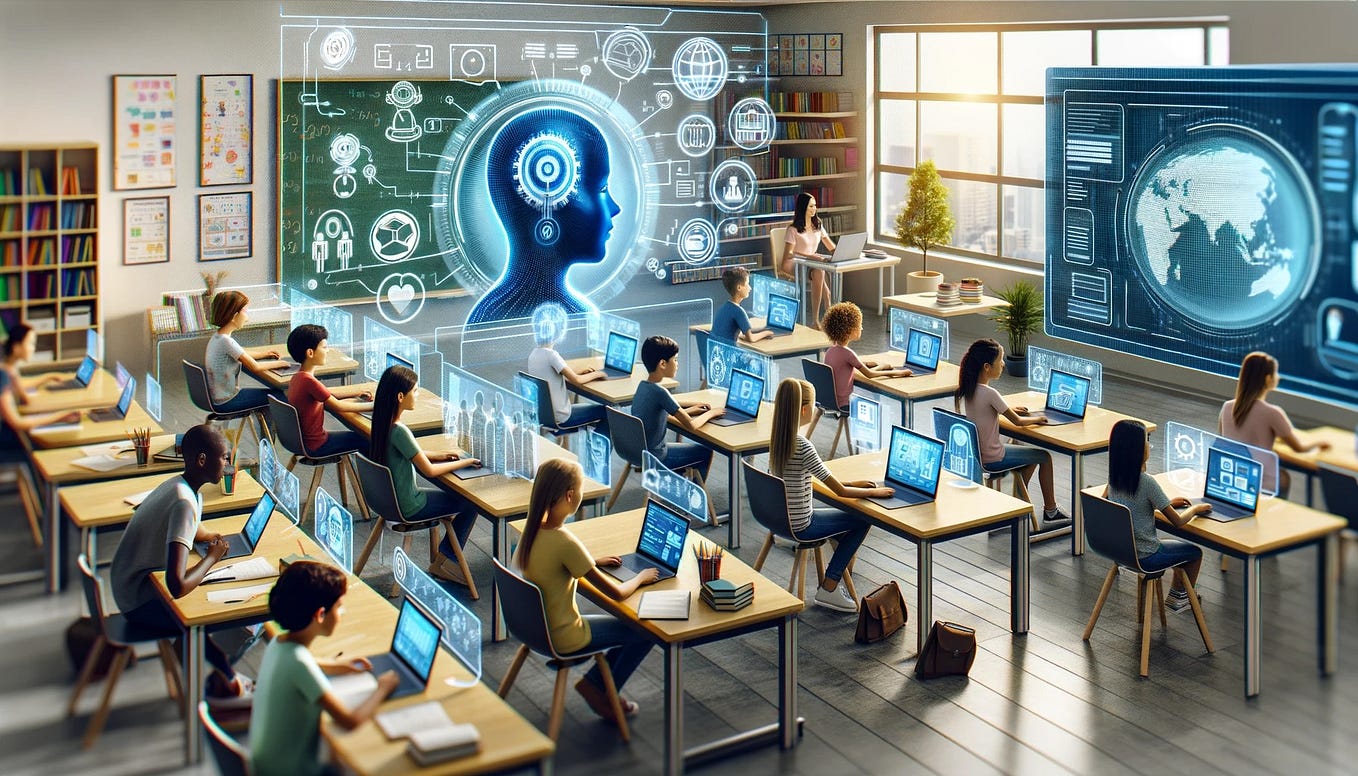
Artificial intelligence is rapidly moving from the margins of education into the classroom itself. Used properly, it may become one of the most powerful educational tools developed since the printing press. An AI tutor can patiently explain algebra for the tenth time, adapt a reading lesson to a child’s ability, translate material instantly, and provide individualized instruction that even the best teacher cannot simultaneously provide to thirty students.
But there is an enormous difference between AI-assisted education and AI-only education. The first could revolutionize learning. The second could fundamentally alter childhood—and not necessarily for the better.
The temptation will be considerable.
School districts perpetually struggle with budgets, teacher shortages, classroom sizes, disciplinary problems, and widely varying student abilities. An artificial-intelligence system does not call in sick, demand higher wages, require health insurance, retire with a pension, or become overwhelmed by an unruly classroom. Once developed and deployed at scale, an AI educational platform could potentially provide individualized instruction to millions of children at relatively low marginal cost.
To administrators staring at spreadsheets, the proposition could eventually become irresistible.
Imagine the logical conclusion: Students arrive at school, put on headphones, open laptops or tablets, and spend much of the day interacting with sophisticated AI instructors. Each child receives personalized lessons. The system continuously measures comprehension, adjusts difficulty, identifies weaknesses, and advances students according to demonstrated ability rather than the pace of the classroom.
Academically, there could be real advantages.
Human teachers inevitably teach toward some approximation of the middle. The gifted student becomes bored while the struggling student falls behind. AI could theoretically eliminate much of that problem. One child could be studying introductory calculus while the student sitting beside him receives additional instruction in fractions.
But education has never been merely the transfer of information.
A good teacher does something an algorithm cannot genuinely replicate: stand before children as another human being possessing experience, judgment, character, humor, expectations, disappointment, compassion, and authority.
Children learn from those qualities.
They learn that sometimes they must listen when they would rather talk. They discover that another person may disagree with them. They experience embarrassment, achievement, competition, cooperation, conflict, reconciliation, failure, and earned praise.
These are not unfortunate inefficiencies in education. They are part of education.
A civilization does not send children to school merely so they can memorize multiplication tables. Schools are among the institutions through which one generation introduces the next generation to civilization itself—its history, literature, customs, moral assumptions, civic responsibilities, achievements, failures, and accumulated wisdom.
That process requires human judgment.
Consider what happens when a student asks a difficult question about courage, loyalty, faith, marriage, war, justice, patriotism, death, or personal responsibility. An AI system can produce an extraordinarily sophisticated answer. But it has never raised a child, buried a parent, kept a promise at great personal cost, defended a friend, regretted a mistake, or sacrificed something valuable for another person.
It can describe those experiences. It cannot possess them.
There is another danger that conservatives in particular should recognize: Whoever controls the educational algorithm potentially possesses extraordinary influence over the intellectual development of children.
Parents have spent decades debating textbooks, curricula, school boards, library collections, history standards, and classroom instruction. AI could concentrate many of those controversies inside something considerably less visible: the model itself.
What historical sources does it emphasize? Which interpretations does it characterize as mainstream? How does it explain controversial political questions? What moral assumptions are embedded in its answers? What subjects does it refuse to discuss? How does it define misinformation?
With a textbook, parents can open the book.
With an AI instructor generating millions of individualized conversations, oversight becomes considerably more complicated.
There is also the question of dependence.
Children should learn how to use artificial intelligence. Refusing to teach AI literacy would be comparable to refusing to teach computer literacy a generation ago. But learning to use a powerful tool is different from becoming intellectually dependent upon it.
A student who automatically asks AI to summarize every chapter, formulate every argument, correct every sentence, solve every equation, and answer every question may appear extraordinarily productive while quietly failing to develop the intellectual muscles those activities were intended to exercise.
Writing is not simply the production of words. Writing teaches people to think.
Struggling with a difficult problem is not wasted time. The struggle itself develops persistence.
Reading a complicated book rather than requesting an instant summary develops concentration.
Remembering information rather than constantly retrieving it creates the reservoir of knowledge necessary for independent reasoning.
The greatest educational danger from AI may therefore be paradoxical: Children could become remarkably skilled at obtaining answers while becoming less capable of producing answers themselves.
That would be a terrible bargain.
None of this means schools should resist artificial intelligence. They should embrace it intelligently. AI tutors could provide supplemental instruction, help teachers identify struggling students, expand access to advanced subjects, assist children with disabilities, teach foreign languages, and provide individualized practice impossible under traditional classroom economics.
But the teacher should remain.
So should books, handwriting, classroom discussions, laboratories, athletics, music, debate, recess, memorization, public speaking, group projects, and occasionally staring at a difficult problem without immediately receiving the answer.
Technology should serve education rather than redefine its purpose.
The conservative approach to AI in education should therefore be neither nostalgic rejection nor technological surrender. Conservatives traditionally understand that institutions contain accumulated wisdom that is not always obvious to reformers. Before replacing something as fundamental as the human teacher, we should understand everything the teacher actually does.
The purpose of education is ultimately not to manufacture efficient processors of information.
It is to help form capable human beings.
If artificial intelligence helps teachers accomplish that mission, it may become one of education’s greatest advances. If we eventually remove teachers and place algorithms between children and the accumulated knowledge of civilization, we may discover too late that we optimized the classroom while diminishing the child.
The smartest machine in the world cannot compensate for forgetting what education is for.