

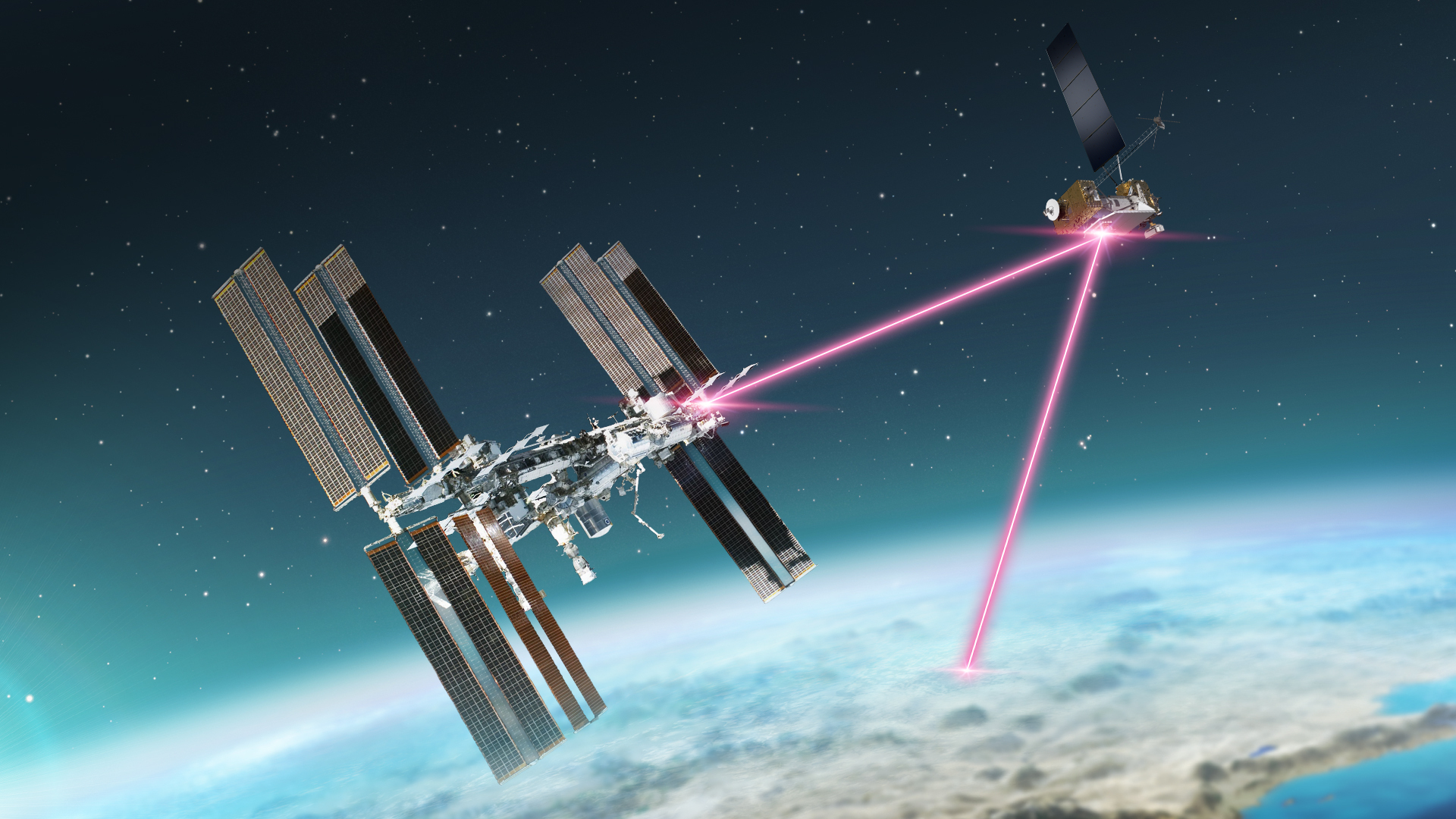
NASA’s latest Artemis II mission preparations are highlighting a major leap in space communications, demonstrating that laser-based, space-to-Earth data transmission can scale far beyond traditional radio systems, potentially transforming how missions relay high-volume data across deep space; the agency’s testing shows that optical communications can deliver dramatically faster speeds and improved efficiency, a development that could reshape everything from crewed lunar missions to future Mars exploration by enabling richer scientific data transfer, enhanced video capability, and more resilient communication architecture as reliance on legacy radio frequency systems becomes increasingly limiting.
Sources
https://techcrunch.com/2026/04/22/nasas-artemis-ii-moon-mission-shows-space-to-earth-laser-comms-can-scale/
https://www.nasa.gov/directorates/stmd/space-communications-navigation-program/laser-communications-relay-demonstration/
https://www.space.com/nasa-laser-communications-deep-space-artemis-missions
Key Takeaways
- Laser-based communications are proving capable of transmitting significantly more data than traditional radio frequency systems, making them critical for future deep space missions.
- Artemis II is serving as a proving ground for scalable optical communications infrastructure that could support lunar and Mars exploration.
- Transitioning to laser systems could enable higher-quality video, faster scientific data transfer, and improved operational reliability in space missions.
In-Depth
The advancement of laser-based communications represents one of the more consequential, though less publicly discussed, developments in the next phase of American space exploration. While rockets and crewed missions dominate headlines, the ability to move data efficiently across vast distances is what ultimately determines the success and scalability of those missions. NASA’s work tied to Artemis II is quietly addressing that bottleneck, demonstrating that optical communications—long considered promising but technically challenging—are now reaching a level of maturity that makes them viable for real-world deployment.
Traditional radio frequency systems, which have served space missions for decades, are increasingly constrained by bandwidth limitations. As missions grow more complex, with higher-resolution imaging, real-time telemetry, and the potential for continuous video feeds, those legacy systems begin to show their age. Laser communications, by contrast, operate at much higher frequencies, allowing exponentially greater data throughput. That difference is not incremental; it is transformative. It opens the door to capabilities that were previously impractical, including near real-time transmission of high-definition video from deep space and far more detailed scientific datasets.
What makes the Artemis II demonstration particularly important is its focus on scalability. Proving that a technology works in a controlled or limited environment is one thing; showing that it can be integrated into a broader operational framework is another. NASA’s efforts indicate that optical communications are not just experimental but are moving toward becoming a foundational component of future mission architecture. That matters as the United States pushes toward sustained lunar presence and, eventually, human missions to Mars.
There are still hurdles to overcome. Laser communications require precise alignment and can be affected by atmospheric conditions on Earth, which introduces operational complexity. However, the trajectory is clear. The combination of technological refinement and strategic investment suggests that the shift away from radio-dominant systems is not a question of if, but when.
In practical terms, this evolution strengthens mission resilience and enhances scientific return, while reinforcing American leadership in space infrastructure development. It’s a reminder that in space exploration, the systems that support the mission often determine its ultimate success.