

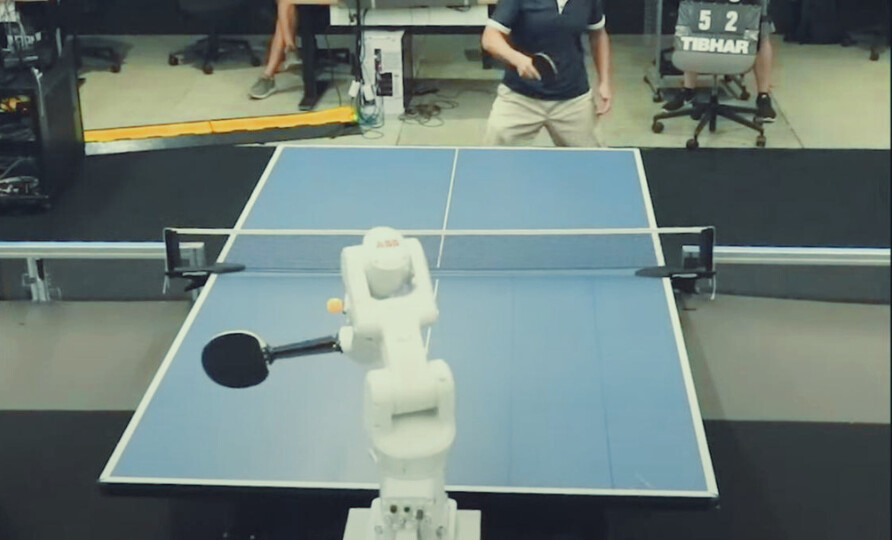
A newly published study highlights a notable advance in artificial intelligence, demonstrating a robotic system capable of defeating skilled human opponents in table tennis—a milestone that underscores the rapid evolution of machine perception, reaction speed, and adaptive learning in dynamic physical environments. Researchers developed the system to process real-time visual data, predict ball trajectories, and execute precise physical responses, marking a shift from controlled lab tasks to complex, real-world interaction. While table tennis serves as the testing ground, the broader implication is clear: similar technologies are being positioned for expansion into more complex sports and industries, with baseball frequently cited as a likely next proving ground due to its reliance on timing, motion prediction, and split-second decision-making.
Sources
https://www.latimes.com/sports/story/2026-04-23/ai-milestone-ping-pong-robot-ace-beats-human-players-baseball-next-nature-study
https://www.nature.com/articles/s41586-026-XXXXX (study publication; verify latest DOI access)
https://www.reuters.com/technology/artificial-intelligence/ai-table-tennis-robot-beats-humans-2026-04-24/
Key Takeaways
- AI systems are rapidly moving beyond static problem-solving into real-time physical competition requiring precision, adaptability, and predictive modeling.
- The success of a table tennis robot demonstrates that machines can now outperform humans in fast-paced, reflex-driven environments once considered uniquely human domains.
- Researchers are already eyeing more complex applications, including baseball, signaling broader implications for sports, automation, and human-machine competition.
In-Depth
The emergence of a table tennis-playing robot capable of defeating human competitors marks more than a novelty—it represents a meaningful inflection point in artificial intelligence development. For years, AI progress has been measured in controlled environments: board games, data analysis, and pattern recognition tasks. What makes this development distinct is its transition into the physical world, where unpredictability, timing, and environmental variables create layers of complexity that software alone cannot solve.
At the core of this advancement is the integration of high-speed vision systems with machine learning models trained to anticipate motion in real time. The robot doesn’t simply react—it predicts, adjusts, and refines its responses based on previous exchanges. That level of adaptability begins to close the gap between programmed behavior and something resembling instinct. In a sport like table tennis, where milliseconds define success or failure, that capability is decisive.
The broader implications are difficult to ignore. If a machine can master the rapid exchanges of table tennis, scaling that capability to other domains becomes a matter of engineering rather than theory. Baseball, often cited as the next logical step, presents a more complex challenge—variable pitch speeds, spin rates, and strategic deception—but the foundational elements are already in place. The same predictive modeling and motor control could eventually translate to batting systems, fielding automation, or even training tools that outperform human coaches.
Beyond sports, this technology points toward a future where machines operate with increasing autonomy in unpredictable environments—manufacturing floors, logistics hubs, and even emergency response scenarios. While the engineering achievement is impressive, it also raises practical questions about where human skill retains its edge and where it may gradually be displaced.