

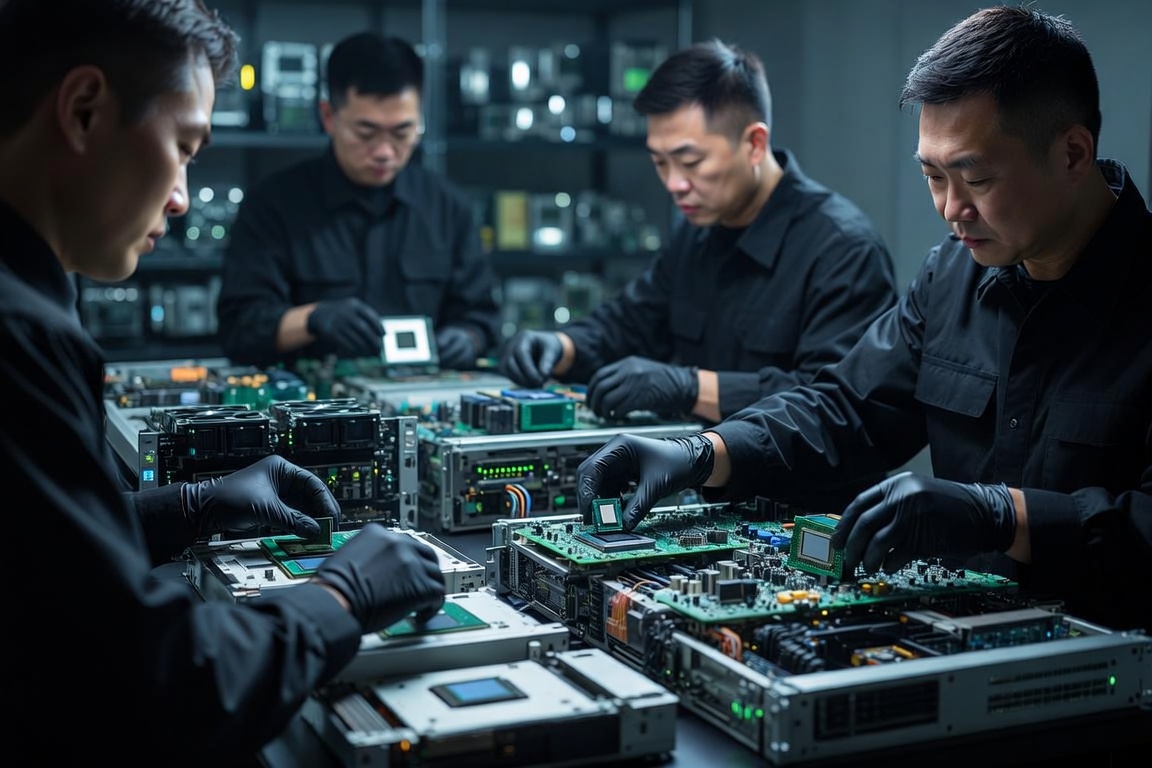
There is a growing and largely underexamined risk emerging in the technology sector—one that doesn’t arrive with the spectacle of a cyberattack or the visibility of a trade war headline. Instead, it is being embedded quietly, piece by piece, into the hardware powering the next generation of artificial intelligence. As U.S. companies race to compete in AI, some are increasingly turning to chips and components developed in Communist China. That decision may offer short-term cost savings or supply chain flexibility, but it introduces long-term vulnerabilities that deserve serious scrutiny.
At the heart of the issue is not simply where a chip is manufactured, but the system of control behind it. China’s technology sector operates under the authority of the Chinese Communist Party (CCP), which maintains sweeping legal powers over private companies. Under Chinese law, firms are required to cooperate with state intelligence services upon request. That means any company producing advanced AI chips—no matter how “private” it appears—exists within a framework where state interests can override corporate independence. When American companies integrate such components into their products, they are not just making a business decision; they are potentially introducing a foreign government’s influence into critical systems.
This concern becomes more serious when considering the nature of AI chips themselves. Unlike traditional hardware, AI processors are designed to handle vast amounts of data, enable machine learning, and support autonomous decision-making. They are not passive components. They sit at the core of systems that interpret, analyze, and act on information. If there is even a remote possibility of hidden backdoors, data leakage pathways, or embedded vulnerabilities, the consequences extend far beyond a typical hardware defect. The risk is systemic.
Some will argue that rigorous testing and verification processes can mitigate these concerns. In theory, that sounds reasonable. In practice, however, verifying the integrity of highly complex semiconductor designs is extraordinarily difficult. Modern chips contain billions of transistors and layers of firmware that are not easily audited. Even the most sophisticated security reviews cannot guarantee the absence of malicious design features—especially when dealing with opaque supply chains and limited transparency from foreign manufacturers.
Beyond security, there is also the issue of strategic dependence. The United States has already seen the consequences of relying heavily on foreign supply chains in sectors like pharmaceuticals and rare earth minerals. AI is poised to become even more central to national power, influencing everything from economic productivity to military capability. Allowing a geopolitical competitor to play a foundational role in that ecosystem raises obvious concerns. If tensions escalate, supply disruptions—or worse, deliberate manipulation—could place American companies in a precarious position.
There is also a subtler, longer-term implication: the erosion of domestic innovation capacity. When companies prioritize lower-cost foreign components over investing in domestic alternatives, they inadvertently weaken the incentive structure that supports American semiconductor development. The U.S. still leads in many aspects of chip design, but manufacturing and advanced packaging have increasingly shifted overseas. Integrating Chinese AI chips into American products accelerates that trend, making it harder to rebuild a resilient, self-sufficient technology base.
To be clear, this is not an argument for isolationism or a blanket rejection of global trade. The modern economy is interconnected, and collaboration across borders has driven significant technological progress. But there is a difference between healthy interdependence and strategic vulnerability. AI infrastructure is not just another consumer product category; it is rapidly becoming critical infrastructure. Decisions about its components should be made with that reality in mind.
What makes this issue particularly challenging is that the risks are not immediately visible. Products will function. Performance benchmarks may even improve. The costs will appear competitive. The downside, if it materializes, will likely do so years later—quietly, and with consequences that are difficult to trace back to a single decision. That lag between cause and effect makes it easy for companies to discount the risk in favor of short-term gains.
A more prudent approach would involve a combination of stricter supply chain scrutiny, targeted investment in domestic semiconductor capabilities, and clear guidelines for what constitutes acceptable sourcing in sensitive technologies. Policymakers have begun moving in this direction, but the private sector ultimately plays a decisive role. Companies that position themselves as leaders in AI innovation should also lead in safeguarding the integrity of the systems they build.
The integration of Chinese AI chips into American products is not, on its face, a dramatic or headline-grabbing development. But it is precisely the kind of incremental shift that can reshape strategic realities over time. In an era where technology and national security are increasingly intertwined, those shifts deserve careful attention. The question is not whether cooperation with global partners should continue—it should—but whether the United States is being sufficiently deliberate about where it draws the line.
what happens after the ma