

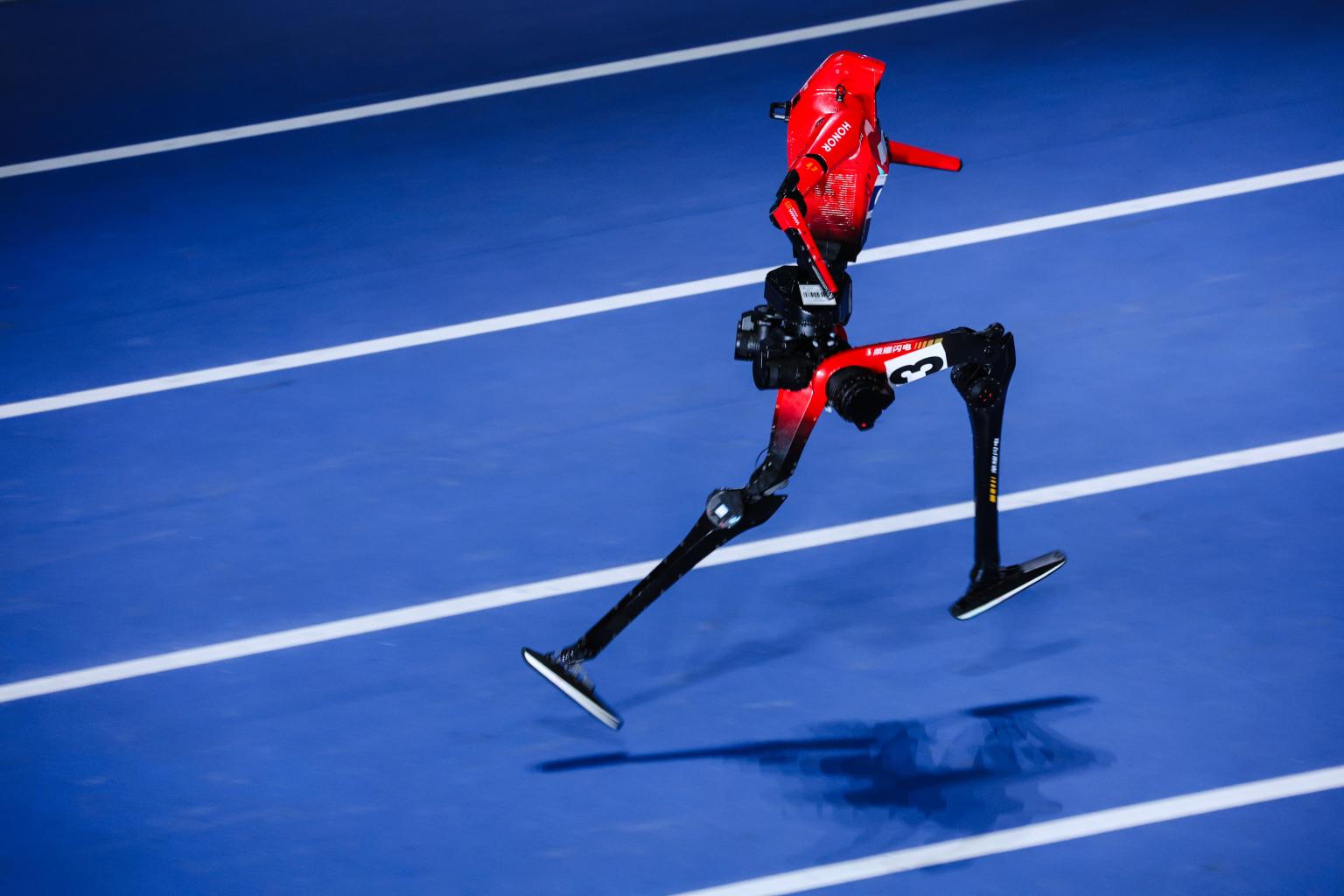
A Chinese-developed humanoid robot reportedly surpassed Usain Bolt’s legendary 100-meter sprint time during a test run ahead of the World Humanoid Robot Games in Beijing, highlighting the accelerating pace of robotics and artificial intelligence. Honor’s “Lightning” robot completed the distance in 9.32 seconds during a trial, while another humanoid later posted a 9.39-second performance in competition, both faster than Bolt’s 9.58-second human world record. Although these machine performances are not recognized as human athletic records and occurred under entirely different competitive conditions, they underscore how rapidly robotics engineering is advancing and how AI-powered machines are increasingly exceeding human physical capabilities in narrowly defined tasks.
Key Takeaways
- Robotics progress is accelerating. Humanoid robots are now capable of outperforming the fastest human sprinters in specialized events, demonstrating remarkable advances in motors, control systems, balance, and artificial intelligence.
- Human and robotic achievements are fundamentally different. While the robots recorded faster times, Bolt’s mark remains the official human world record under international athletics rules, making direct comparisons more technological than athletic.
- China continues investing heavily in humanoid robotics. The World Humanoid Robot Games and related technology showcases illustrate Beijing’s broader strategy to establish global leadership in advanced robotics and AI-driven manufacturing.
In-Depth
The latest results from Beijing demonstrate just how quickly humanoid robotics is evolving. Honor’s Lightning robot reportedly covered 100 meters in 9.32 seconds during a pre-competition test, while Tiangong Ultra later crossed the finish line in 9.39 seconds during the games themselves. Either performance would eclipse Usain Bolt’s celebrated 9.58-second world record if judged solely by elapsed time, even though robotic demonstrations exist outside the framework of human athletics.
The significance extends well beyond sports. Sprinting at these speeds requires precise coordination of sensors, actuators, software, and mechanical design while maintaining stability throughout the run. That level of performance suggests rapid improvements in technologies that could eventually benefit manufacturing, emergency response, logistics, and hazardous-duty operations. At the same time, the robots’ tendency to crash into barriers after crossing the finish line illustrates that speed alone does not equate to complete real-world capability. Control, adaptability, and safe interaction with unpredictable environments remain equally important engineering challenges.
For policymakers and industry leaders, these demonstrations reinforce that the global competition over artificial intelligence and robotics is no longer theoretical. Nations that lead in advanced robotics are likely to enjoy significant economic, industrial, and strategic advantages. The spectacle in Beijing therefore represents more than a sporting novelty—it is another indication that technological leadership will increasingly shape economic strength and geopolitical influence in the years ahead.
Sources
- https://nypost.com/2026/08/22/tech/robot-smashes-usain-bolts-record-during-test-run/
- https://www.reuters.com/sports/chinese-humanoid-robot-lightning-beats-human-100m-world-record-state-media-says-2026-08-22/
- https://apnews.com/article/86cb8e310843151a77057e4cb764b4e2
- https://www.upi.com/Top_News/World-News/2026/08/22/robot-record-bolt/1151787452252/