

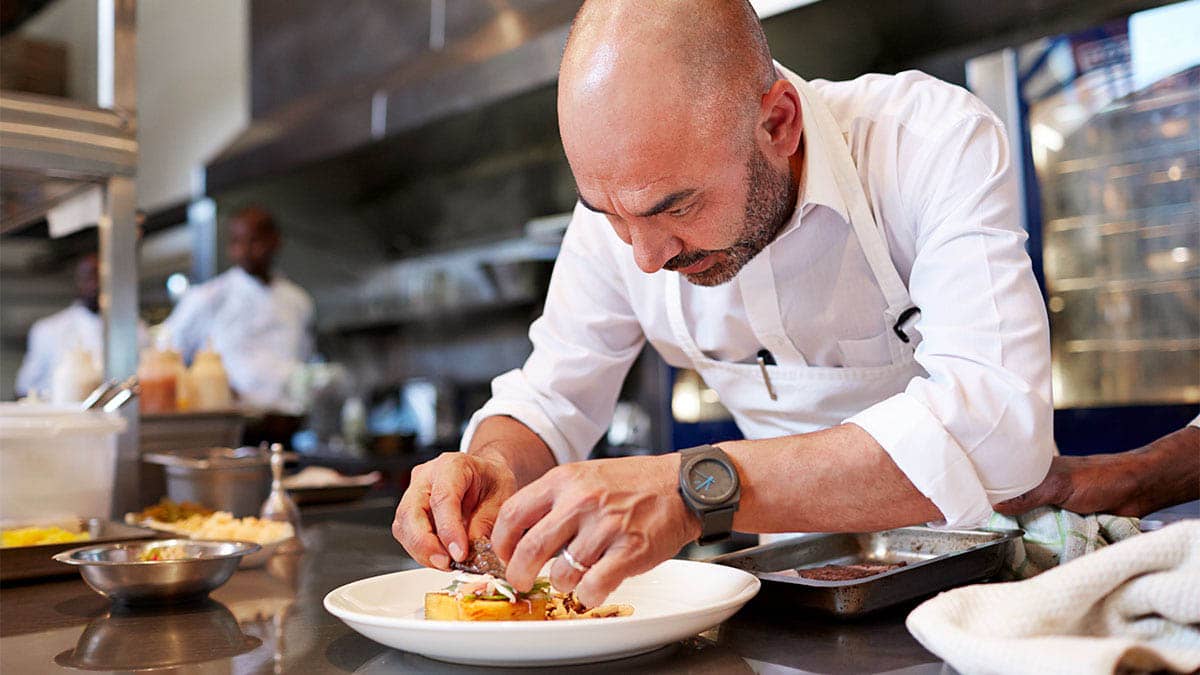
Artificial intelligence is usually discussed in the language of Silicon Valley: algorithms, data centers, automation, large language models, and increasingly sophisticated machines. But one of AI’s most promising frontiers may be far removed from the technology campuses of California. It is in our restaurants, grocery stores, farms, bakeries, food-processing plants, and home kitchens.
The culinary industry is particularly well suited to an AI revolution because food is simultaneously creative, scientific, logistical, and deeply personal. Preparing a good meal may be an art, but getting ingredients into the kitchen at the right price, keeping them fresh, managing labor, controlling portions, maintaining equipment, predicting demand, and delivering a consistent product are exercises in mathematics and logistics.
AI can help with virtually every one of them.
Consider the ordinary restaurant. One of its most persistent problems is predicting demand. An owner has to decide how much beef, chicken, produce, bread, seafood, and dairy to order before knowing exactly how many customers will walk through the door. Order too little and popular dishes disappear from the menu. Order too much and expensive inventory ends up in the garbage.
An AI system can analyze historical sales, reservations, weather, holidays, sporting events, conventions, neighborhood traffic, seasonal patterns, and dozens of other variables to forecast demand more accurately. Instead of a manager relying almost exclusively on experience and intuition, technology can provide another set of eyes.
The implications for food waste alone are enormous.
AI-equipped cameras, scales, and inventory systems can help commercial kitchens identify what they are throwing away, how much is being discarded, and why. A restaurant might discover that it routinely prepares too many potatoes on Tuesdays, serves portions of rice larger than customers typically eat, or orders produce in quantities that exceed weekend demand. Small corrections multiplied across thousands of meals can translate into substantial savings.
Then there is menu development.
Generative AI can analyze ingredient combinations, nutritional information, food chemistry, customer preferences, historical recipes, and culinary traditions to suggest new dishes. A chef could ask a system to develop ten appetizers using ingredients already sitting in the walk-in refrigerator, create gluten-free variations of existing dishes, or devise a high-protein menu without substantially increasing ingredient costs.
That does not make the chef obsolete.
Quite the opposite.
Cooking is filled with judgment that computers cannot easily replicate: the smell of onions reaching precisely the right stage of caramelization, the feel of bread dough, the instinct to add another pinch of salt, or the presentation that transforms ordinary ingredients into something memorable. AI is most valuable when it handles information while leaving human beings responsible for taste.
The same principle applies at home.
Imagine opening a refrigerator and asking an AI kitchen assistant what can be made from six eggs, leftover chicken, half an onion, spinach, Parmesan cheese, and several ingredients in the pantry. Rather than searching through hundreds of recipes requiring a trip to the grocery store, the system could construct several practical options from what is already available.
That capability becomes considerably more powerful when combined with nutrition. Families could create meal plans around calorie targets, allergies, sodium restrictions, protein requirements, budgets, or personal preferences. Parents could ask for inexpensive dinners that children are likely to eat. Older Americans could generate menus requiring minimal preparation. Athletes could create meals around training schedules.
Grocery shopping could change accordingly. Instead of building a shopping list manually, AI could compare a weekly meal plan against what is already in the refrigerator and pantry, calculate what is missing, estimate quantities, and organize the resulting list according to the layout of a preferred supermarket.
Restaurants will see even greater automation.
AI can help schedule employees based on anticipated demand, identify unusual inventory losses, optimize delivery routes, monitor refrigeration temperatures, predict equipment failures, automate bookkeeping, analyze customer feedback, and detect inconsistencies between expected and actual food costs.
A failing commercial refrigerator, for example, can cost a restaurant thousands of dollars in spoiled inventory. Sensors combined with predictive AI could detect subtle changes in compressor performance or temperature patterns and warn an owner before the machine fails.
Food safety may ultimately be one of AI’s most consequential applications. Computer-vision systems can monitor sanitation procedures, while intelligent sensors can track temperatures throughout storage, preparation, transportation, and delivery. AI can analyze those streams of information and flag abnormalities before they become health hazards.
Agriculture extends the possibilities further. AI systems can help farmers determine when crops need water, fertilizer, or treatment, while machine vision can identify weeds, pests, and disease. Better agricultural forecasting can eventually work its way through the entire food supply chain, giving processors, distributors, supermarkets, and restaurants better information about availability and pricing.
Even recipes themselves could become dynamic rather than static.
For generations, a recipe has essentially been a fixed set of instructions. AI can transform it into an interactive conversation. If the cook discovers halfway through dinner that there is no buttermilk, the system can suggest substitutions based on what is available. If a sauce becomes too salty, it can recommend corrective measures. If a roast is cooking faster than expected, connected thermometers and appliances could adjust instructions in real time.
There are legitimate concerns. Restaurants should be cautious about surrendering critical decisions to algorithms they do not understand. Customer information must be protected. Small businesses should remain wary of becoming dependent on expensive proprietary systems. And automation should not become an excuse to eliminate the hospitality that makes dining out enjoyable in the first place.
But rejecting AI because it can be misused would make little sense.
American prosperity has long depended upon finding tools that allow people to produce more while wasting less. The tractor did not destroy agriculture; it transformed agricultural productivity. Refrigeration revolutionized food distribution. The microwave, food processor, commercial dishwasher, computerized point-of-sale system, and countless other technologies changed kitchens without eliminating the fundamental human desire to cook and eat together.
AI should be viewed through much the same lens.
The great opportunity is not the creation of a robotic chef presiding over a sterile automated restaurant. It is giving a family-owned restaurant better control over its costs, helping a farmer increase yields with fewer resources, allowing a supermarket to throw away less food, enabling a chef to experiment more rapidly, and helping an ordinary family turn whatever happens to be in the refrigerator into dinner.
Technology works best when it expands human capability rather than attempting to replace humanity.
And nowhere is that distinction more appropriate than food. A computer may someday calculate the perfect recipe, temperature, portion, price, and preparation time. But it cannot replicate why a grandmother’s recipe matters to a family, why a neighborhood restaurant becomes an institution, or why breaking bread around a table has bound families and communities together for thousands of years.
Artificial intelligence can make the culinary world more efficient, economical, personalized, and inventive. We should take advantage of it.
But the machine should remain the sous-chef.
Human beings should remain in charge of the kitchen.