

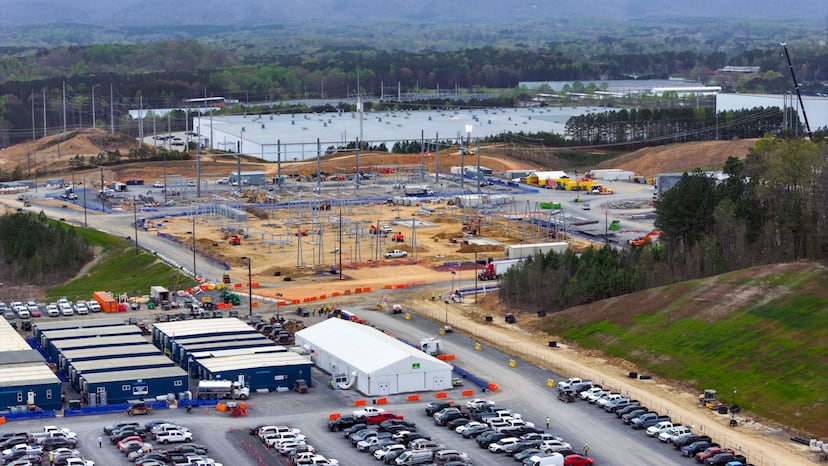
Georgia’s rapid emergence as a national center for artificial-intelligence infrastructure is reshaping the state’s construction economy while exposing a serious shortage of skilled tradespeople. Atlanta surpassed Northern Virginia during the first half of 2026 as North America’s largest market for data-center capacity under construction, with nearly 2.9 gigawatts underway. The expansion is generating substantial demand for electricians, pipefitters, HVAC technicians, equipment operators and other specialized workers, but contractors are struggling to recruit enough qualified people. A national construction workforce survey found that 58% of companies involved in data-center projects reported increased competition for skilled workers, while 49% reported additional wage pressure. Georgia therefore finds itself confronting both sides of the AI infrastructure boom: billions of dollars in private investment and construction opportunities, accompanied by mounting competition for workers, higher labor costs and pressure on other construction projects competing for the same limited workforce.
Key Takeaways
- Atlanta became North America’s leading data-center construction market in the first half of 2026, with approximately 2,882 megawatts under construction—an increase of more than 52% from a year earlier.
- Skilled labor is becoming a major constraint. Among contractors performing data-center work nationally, 58% reported increased competition for skilled workers, 49% reported greater wage pressure and 37% identified worker or subcontractor availability as their biggest data-center construction challenge.
- Georgia’s challenge extends beyond simply recruiting more workers. Data centers require sophisticated electrical, mechanical and power infrastructure, making experienced electricians and other specialized trades particularly valuable and strengthening the case for expanded vocational education, apprenticeships and technical training.
In-Depth
Georgia’s artificial-intelligence boom is producing an economic development challenge that government subsidies alone cannot solve: companies can build facilities only as quickly as qualified workers can construct them.
Atlanta entered the second half of 2026 with roughly 2,882 megawatts of data-center capacity under construction, surpassing Northern Virginia for the first time. The scale demonstrates the extraordinary amount of private capital flowing into AI and cloud infrastructure, but it is also intensifying competition for electricians, HVAC specialists, pipefitters and other skilled trades already in short supply.
Nationally, 87% of surveyed construction firms reported openings for hourly craft positions. Among contractors working on data centers, 58% said those projects were increasing competition for skilled workers and 49% reported additional wage pressure. Worker shortages were also the most frequently cited reason for construction delays.
The problem is particularly important for Georgia because advanced data centers are not ordinary commercial buildings. Their enormous electrical requirements, cooling systems, backup generation and around-the-clock reliability demand workers with specialized skills. Simply adding inexperienced workers cannot immediately close that gap.
The market is responding predictably: wages are rising, contractors are recruiting aggressively and companies are investing more heavily in training. That creates an opportunity for Georgia to strengthen vocational education and apprenticeships while demonstrating that skilled trades can provide lucrative careers without requiring a traditional four-year college degree.
The broader question is whether public policy can keep pace. Georgia has attracted extraordinary data-center investment, partly through substantial tax incentives. Sustaining that expansion will increasingly depend upon whether the state can develop the electricians and other skilled workers necessary to turn proposed projects into functioning infrastructure.
Sources
- https://www.agc.org/news/2026/09/03/construction-workforce-shortages-remain-acute-despite-soft-market-conditions-data-centers-strain
- https://www.cbre.com/insights/books/north-america-data-center-trends-h1-2026
- https://www.reuters.com/business/energy/data-center-rush-worsens-shortages-power-grid-workers–reeii-2026-05-18/