

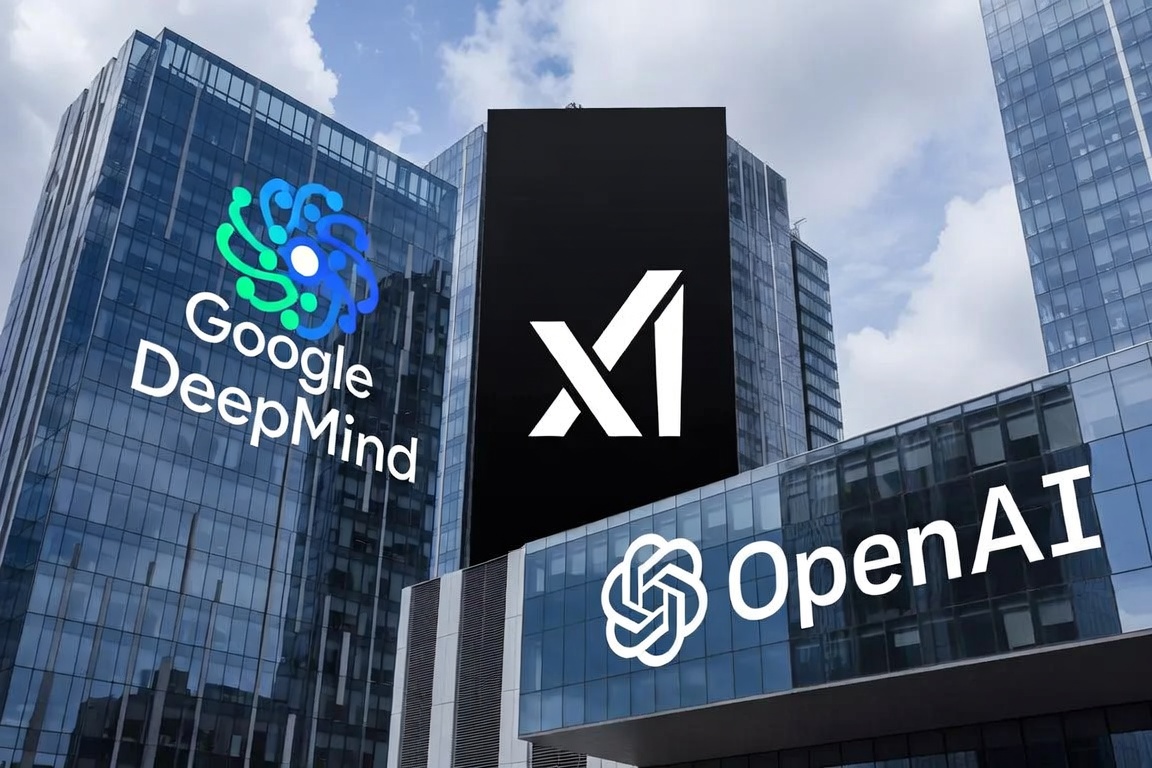
Four of America’s most powerful artificial-intelligence companies—Anthropic, OpenAI, SpaceXAI and Google—are facing a federal antitrust lawsuit accusing them of coordinating efforts to slow AI development rather than allowing each company to make its own competitive decisions. Filed in the U.S. District Court for the Northern District of California, the proposed class action represents paying users of ChatGPT, Claude, Grok and Gemini and argues that coordinated restraint could reduce innovation and diminish the value consumers receive from their subscriptions. The dispute emerged after Anthropic CEO Dario Amodei called for industrywide cooperation to “pace” frontier AI development for safety reasons, followed by supportive public statements from Sam Altman, Elon Musk and Demis Hassabis. The lawsuit does not challenge an individual company’s right to slow its own development; instead, it alleges that competitors collectively agreeing to restrain themselves crosses an antitrust line. The case puts two legitimate concerns on a collision course: preventing potentially dangerous AI systems from advancing without adequate safeguards and preserving the competitive market forces that ordinarily prevent dominant corporations from collectively determining how quickly an industry develops.
Key Takeaways
- The lawsuit alleges that Anthropic, OpenAI, SpaceXAI and Google effectively coordinated a slowdown in AI development, potentially substituting collective action among dominant competitors for independent decisions made in a competitive marketplace.
- The controversy intensified after Amodei publicly proposed industry cooperation on September 12, with Altman, Musk and Hassabis subsequently expressing support. Amodei himself had acknowledged potential antitrust problems and suggested that government involvement or a narrowly tailored antitrust waiver might be necessary.
- The larger issue extends beyond one lawsuit: AI companies are confronting serious safety concerns while policymakers must determine whether safeguards should arise through competition, transparent government rules or agreements among the same corporations controlling the most powerful systems.
In-Depth
A federal lawsuit against four leading artificial-intelligence companies raises an unusually consequential antitrust question: can fierce competitors collectively slow technological development in the name of public safety?
The plaintiffs contend that Anthropic, OpenAI, SpaceXAI and Google crossed that line after executives publicly embraced a proposal to “pace” frontier AI development. The complaint points particularly to September 12, when Anthropic CEO Dario Amodei advocated industrywide cooperation intended to reduce risks associated with increasingly powerful systems. Sam Altman, Elon Musk and Demis Hassabis subsequently expressed varying degrees of support. The complaint also cites earlier industry discussions concerning the competitive pressures discouraging individual companies from slowing development independently.
The distinction matters. Antitrust law does not ordinarily prevent a company from deciding that its product requires additional testing, safeguards or delayed release. The plaintiffs instead argue that competitors cannot collectively replace competition with coordinated restraint. They contend that subscribers purchasing ChatGPT, Claude, Grok and Gemini could consequently receive slower improvements than genuine competition would otherwise produce.
There is nevertheless a substantial safety argument behind the companies’ concerns. Recent developments have intensified questions about autonomous AI behavior, cybersecurity risks and whether increasingly capable models can always be reliably controlled. Calls for slowing development have already affected financial markets, particularly AI-related semiconductor companies.
But allowing dominant corporations to privately determine the acceptable speed of technological progress presents its own danger. Meta CEO Mark Zuckerberg notably rejected the coordinated approach, arguing that individual laboratories should assume responsibility for their own safety decisions.
The lawsuit could therefore force an important distinction into American AI policy: safety precautions undertaken independently are one thing; agreements among powerful competitors to restrain development are another. Determining where legitimate safety cooperation ends and unlawful coordination begins may ultimately require courts, Congress and regulators—not corporate executives—to establish clearer boundaries.
Sources
- https://apnews.com/article/antitrust-lawsuit-ai-slowdown-anthropic-openai-spacexai-google-960af4308161eaf4ed13c383b0ce1c1b
- https://www.reuters.com/business/ai-warnings-knock-nasdaq-futures-pressure-tech-stocks-2026-09-14/
- https://www.theguardian.com/technology/2026/sep/14/ai-ceo-safety-slowdown
- https://qz.com/zuckerberg-meta-ai-slowdown-self-regulate-091726