

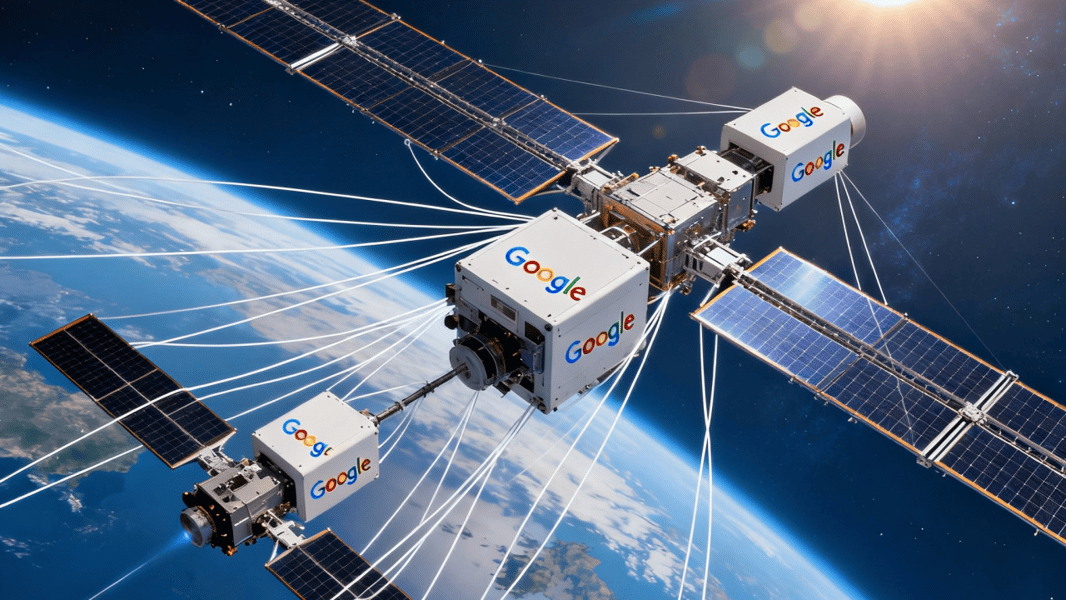
Google is preparing to take a significant step toward moving artificial-intelligence computing beyond Earth, with Project Suncatcher set to send a prototype satellite carrying four of the company’s Tensor Processing Units into low-Earth orbit on October 1. The refrigerator-sized spacecraft, developed with Planet, is intended to determine whether conventional AI accelerators can withstand launch forces, radiation, temperature extremes and the difficult thermal environment of space. Google ultimately envisions constellations of solar-powered computing satellites linked by high-speed lasers, potentially tapping near-continuous sunlight while reducing AI infrastructure’s dependence on terrestrial electricity, water and land. The concept remains experimental: the first satellite will generate only about one kilowatt of power, its processors can operate for roughly 15-minute periods before cooling becomes necessary, and substantial technical and economic obstacles remain before orbital computing could compete with conventional data centers.
Key Takeaways
- Google’s October 1 experiment will place four TPUs aboard a prototype satellite in low-Earth orbit, testing whether commercially derived AI hardware can survive radiation, vibration, extreme temperatures and other conditions encountered in space.
- Project Suncatcher’s longer-term concept calls for clusters of solar-powered satellites connected through extremely high-speed laser communications, exploiting orbital solar generation that Google estimates can be up to eight times more productive than terrestrial solar installations.
- The biggest barriers remain practical rather than theoretical: removing heat in a vacuum, achieving data-center-class communications between moving satellites, protecting electronics from radiation and reducing launch and satellite-production costs enough to make orbital computing economically competitive.
In-Depth
Google’s Project Suncatcher represents a striking response to one of artificial intelligence’s most stubborn constraints: computing power increasingly requires enormous quantities of electricity, land and supporting infrastructure. Instead of assuming every future AI data center must remain on Earth, Google is testing whether part of that infrastructure can eventually move into orbit.
The October 1 mission is deliberately modest. A refrigerator-sized satellite developed with Planet will carry four Google TPUs and roughly one kilowatt of solar-generating capacity. The experiment will examine how ordinary AI hardware responds to launch vibration, radiation and extreme thermal conditions. Cooling may prove particularly difficult because space offers no atmosphere through which conventional cooling systems can dissipate heat. The prototype therefore uses heat pipes and radiators, but its processors are expected to operate for only about 15 minutes before cooling down.
The larger ambition is far more consequential. Google envisions tightly coordinated constellations containing many TPUs, powered by near-continuous sunlight and connected through high-bandwidth laser links. Properly positioned orbital solar panels could produce substantially more energy than comparable terrestrial installations.
That could eventually reduce pressure to construct increasingly massive power-hungry data centers in American communities. But technological ambition should not be confused with commercial readiness. Launch costs, radiation, cooling, satellite manufacturing, orbital congestion and extraordinarily demanding communications requirements remain formidable obstacles. Project Suncatcher is therefore less an imminent replacement for terrestrial data centers than an important experiment testing whether the next great expansion of computing infrastructure might extend beyond Earth.
Sources
- https://www.nytimes.com/2026/09/24/technology/google-suncatcher-ai-data-center-space.html
- https://www.reuters.com/business/media-telecom/google-plans-first-test-ai-chips-space-under-project-suncatcher-2026-09-24/
- https://arstechnica.com/google/2026/09/googles-first-suncatcher-orbital-data-center-test-launches-october-1/
- https://blog.google/innovation-and-ai/models-and-research/google-research/google-project-suncatcher-facts/
- https://research.google/blog/exploring-a-space-based-scalable-ai-infrastructure-system-design/