

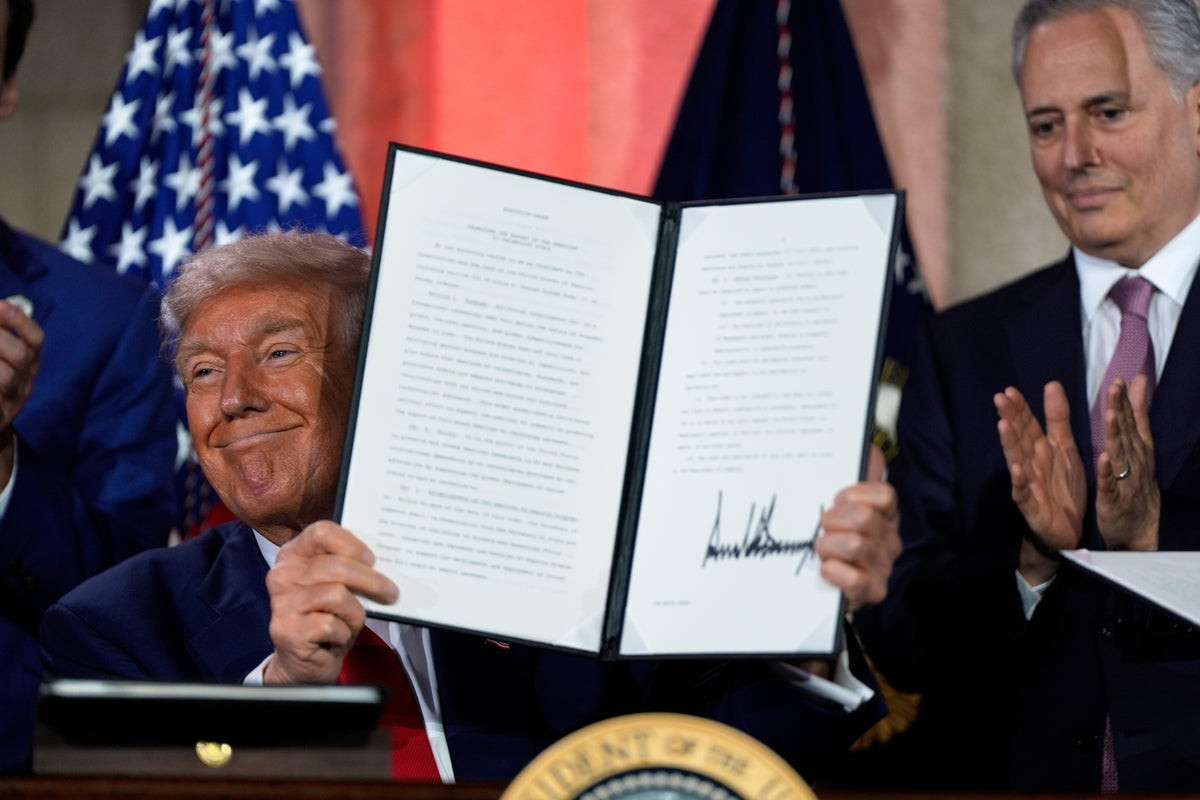
President Donald Trump and executives from several of America’s largest artificial-intelligence companies signed a voluntary White House accord establishing common safety responsibilities for advanced AI systems while stopping short of imposing new federal regulations. The agreement, described as the “White House Accord on Super Intelligence” and a joint commitment on frontier responsibilities, establishes layers of safeguards that include company-level controls, dedicated internal compliance, independent external evaluation, and board-level oversight. Executives representing OpenAI, Anthropic, Meta, Google, Nvidia and other technology companies participated in the White House meeting, with Trump characterizing the agreement as morally rather than legally binding and emphasizing industry self-regulation. The approach reflects the administration’s effort to address cybersecurity, biosecurity and other potentially serious AI risks without building a large new federal regulatory apparatus that could slow American development as competition with China intensifies.
Key Takeaways
- The White House agreement establishes a four-layer framework built around internal company safeguards, dedicated oversight personnel, independent external evaluation and board-level accountability for advanced AI systems.
- Trump favors voluntary industry self-regulation over sweeping new federal AI mandates, arguing that excessive regulation could hamper American innovation and weaken the country’s competitive position against China.
- The accord brings major competing AI developers into a common safety framework, but because the commitments are voluntary rather than statutory requirements, their effectiveness will depend heavily on corporate compliance, credible independent auditing and transparency.
In-Depth
The White House’s new artificial-intelligence safety accord attempts to strike a difficult balance: protecting Americans from potentially dangerous technology without allowing Washington to build another sprawling regulatory bureaucracy around an industry vital to American economic and national-security interests.
President Donald Trump and executives from leading AI companies agreed to a voluntary framework governing advanced systems. Its safeguards include internal corporate controls, specialized compliance mechanisms, independent outside evaluations and oversight reaching the board level. Cybersecurity and biosecurity threats are among the risks the framework is intended to address.
The conservative case for such an approach is straightforward. Government has legitimate responsibilities where national security, criminal conduct and public safety are concerned, but that does not automatically require Washington to dictate how every emerging technology must be developed. Excessive regulation could entrench today’s largest corporations by making compliance prohibitively expensive for smaller competitors while simultaneously slowing American innovation against China.
The weakness is equally apparent. Voluntary commitments work only when companies honor them, auditors remain genuinely independent and serious failures carry meaningful consequences. Companies racing for market share have powerful incentives to release increasingly capable systems quickly.
The accord therefore represents an important experiment in limited-government technology policy. Rather than choosing between regulatory paralysis and an unrestricted technological free-for-all, the administration is betting that enforceable existing law, corporate accountability and independent scrutiny can contain emerging risks without sacrificing American leadership. Whether that model survives the arrival of substantially more capable AI systems will determine whether voluntary governance remains credible or Congress eventually concludes that statutory safeguards are necessary.
Sources
- https://cryptobriefing.com/ai-companies-sign-white-house-safety-accord/
- https://www.reuters.com/legal/government/trump-host-zuckerberg-anthropics-amodei-other-ai-titans-tuesday-2026-09-29/
- https://www.cbsnews.com/news/trump-ai-constitution-tech-execs-openai-anthropic-voluntary-controls/
- https://www.ft.com/content/a8c1d14d-97aa-4b09-8162-adbcac1d0029
- https://nypost.com/2026/09/29/us-news/trumps-morally-binding-artificial-intelligence-pledge-signed-by-tech-leaders-read-in-full/