

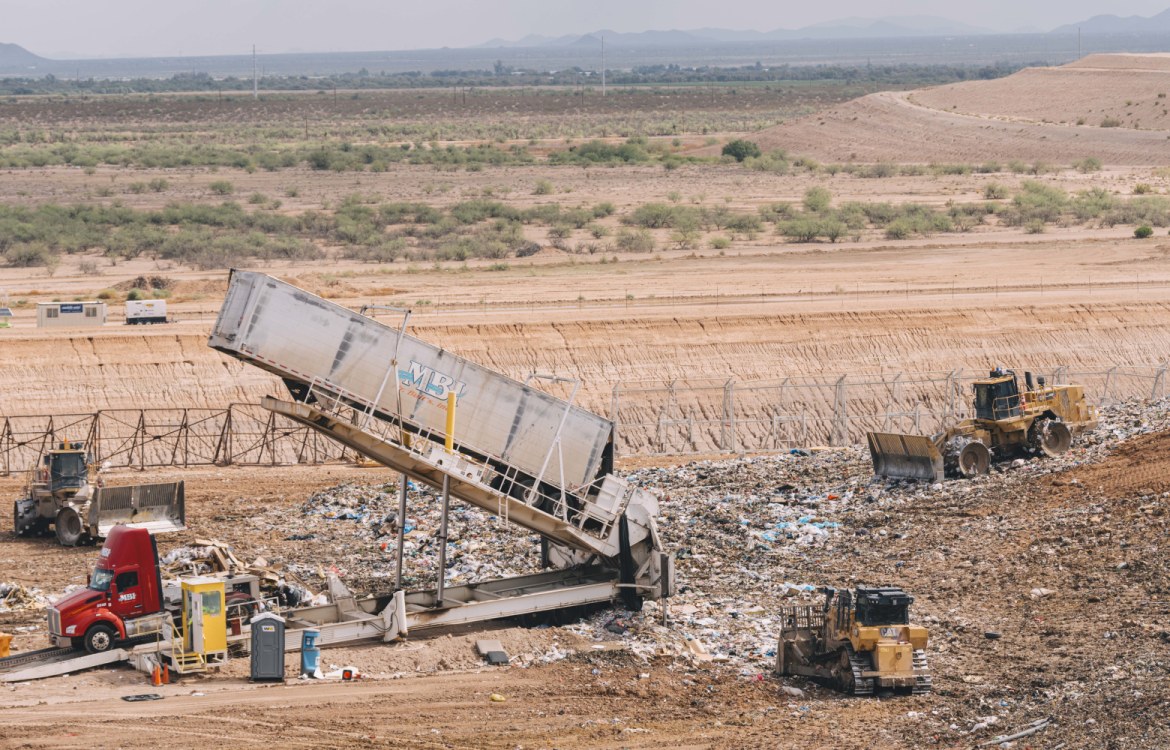
Autonomous technology is moving beyond highways and warehouses into one of America’s dirtiest and most physically demanding workplaces: the landfill. At the 590-acre Marana Regional Landfill near Tucson, Arizona, WM and Caterpillar are testing remote-controlled and increasingly autonomous heavy equipment, including a 40-ton bulldozer that an operator controls from a climate-controlled trailer using joysticks, pedals, cameras and a dedicated wireless network. The site processes roughly 1,800 tons of trash daily, providing the repetitive and controlled environment well suited to automation. WM plans to advance the experiment with an autonomous Caterpillar landfill compactor, potentially allowing machines to perform routine operations without someone sitting in the cab. The technology could reduce employee exposure to heat, dust, unstable terrain and other hazards while addressing a persistent shortage of skilled equipment operators. Federal projections estimate roughly 42,500 openings for construction-equipment operators annually through 2035, suggesting that automation may increasingly supplement a workforce that employers are struggling to maintain rather than simply replace existing employees.
Key Takeaways
- WM and Caterpillar are using an Arizona landfill as a proving ground for remote-controlled and autonomous heavy machinery, beginning with a remotely operated bulldozer and progressing toward an autonomous landfill compactor.
- Removing operators from heavy equipment can reduce exposure to extreme temperatures, dust, rough terrain, collisions and the physical punishment associated with operating massive machines for long periods.
- Automation arrives amid substantial workforce demand: federal projections anticipate approximately 42,500 construction-equipment-operator openings annually through 2035, creating an economic incentive for technologies that allow skilled employees to operate equipment more efficiently.
In-Depth
The autonomous-vehicle revolution may ultimately prove most valuable not on crowded city streets but in controlled industrial environments where machines perform repetitive, dangerous work. WM’s Marana Regional Landfill in Arizona offers a practical demonstration.
Working with Caterpillar, WM has equipped a bulldozer with remote-control technology allowing an operator to manipulate the machine from a climate-controlled command area. Cameras provide a 360-degree view while wireless infrastructure connects the operator with equipment working among enormous quantities of refuse. The arrangement removes the worker from heat, dust, vibration and hazardous terrain without eliminating the operator’s expertise.
The next step is more consequential. WM and Caterpillar plan to test an autonomous compactor capable of performing repetitive landfill operations with less direct human control. Landfills are particularly attractive environments for autonomy because work patterns are relatively predictable and vehicles operate within defined boundaries.
The development illustrates why automation should not automatically be viewed as a worker-versus-machine proposition. Federal projections show tens of thousands of equipment-operator openings annually through 2035. Technology that allows experienced workers to supervise machinery remotely—or eventually oversee multiple machines—could help businesses address labor shortages while moving employees away from hazardous environments.
There are legitimate questions about workforce displacement as autonomy improves. But technological progress has repeatedly changed the nature of work rather than simply eliminating it. The more immediate challenge is ensuring American workers acquire the technical skills required to operate, supervise and maintain the increasingly sophisticated machinery entering industries that once depended almost entirely on manual operation.
Sources
- https://www.wsj.com/tech/ai/dirty-work-goes-driverless-at-the-dump-c2e9516e
- https://mediaroom.wm.com/2026-08-03-WMs-Landfill-of-the-Future-Advances-Towards-Autonomous-Equipment-Testing
- https://www.equipmentworld.com/equipment-controls/autonomous/article/15832520/wm-tests-caterpillar-autonomous-landfill-equipment
- https://www.bls.gov/ooh/construction-and-extraction/construction-equipment-operators.htm
- https://www.cat.com/en_US/products/new/technology/command/command/102740.html