

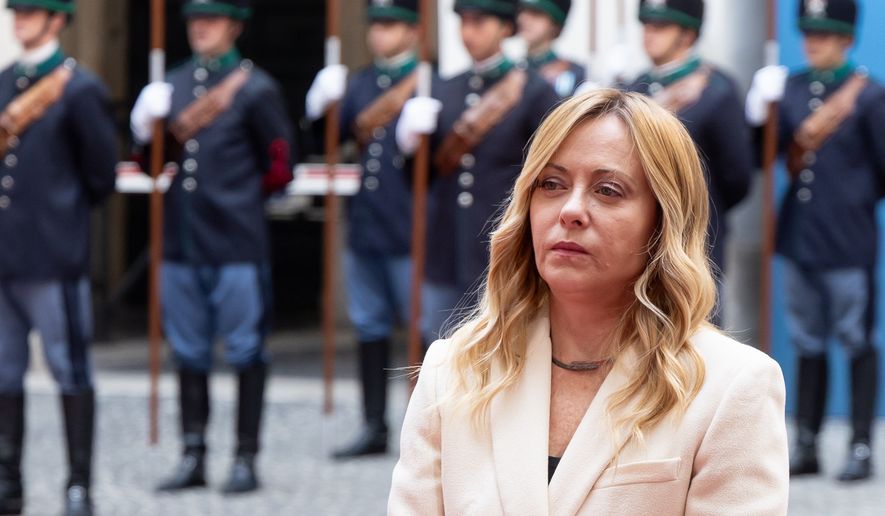
Italian Prime Minister Giorgia Meloni has applied to register her voice as a trademark with the European Union Intellectual Property Office, seeking another legal weapon against increasingly convincing artificial-intelligence deepfakes and unauthorized voice cloning. Her application includes a four-second recording in which she repeats “Io sono Giorgia Meloni,” or “I am Giorgia Meloni,” drawing on the phrase that became closely associated with her after a 2019 political rally and later her 2021 autobiography. The filing remains under examination and follows similar efforts by entertainers seeking greater control over their distinctive voices and likenesses as generative AI makes digital impersonation increasingly inexpensive and realistic. Meloni has particular reason for concern: manipulated images and other AI-generated material depicting her have circulated online, including fraudulent and sexually explicit content. Although trademark protection cannot technologically prevent someone from cloning a voice, it could provide an additional legal basis for challenging unauthorized commercial or political uses and seeking removal of deceptive material.
Key Takeaways
- Meloni filed a four-second recording of her voice with the European Union Intellectual Property Office, seeking trademark protection as AI makes realistic voice cloning and impersonation increasingly accessible.
- The application reflects a broader movement among celebrities and other recognizable public figures to use existing intellectual-property law to protect voices and likenesses against unauthorized AI-generated replicas.
- Trademarking a voice cannot prevent deepfakes from being created, but successful registration could strengthen legal claims against certain unauthorized uses and potentially make it easier to challenge or remove deceptive AI-generated content.
In-Depth
Giorgia Meloni’s attempt to trademark her voice illustrates how artificial intelligence is forcing governments and individuals to reconsider something once taken for granted: ownership of personal identity.
The Italian prime minister submitted a four-second recording to the European Union Intellectual Property Office in which she repeats “Io sono Giorgia Meloni.” Her application seeks recognition of the distinctive voice as a sound trademark, potentially providing another legal mechanism for confronting unauthorized AI replicas.
Meloni’s concern is hardly theoretical. Manipulated images depicting her have circulated online, and she previously pursued legal action involving pornographic deepfakes using her likeness. Generative AI now makes similar manipulation possible with voices, allowing convincing recordings to be produced of politicians apparently saying words they never spoke.
That creates obvious political dangers. A fabricated recording released immediately before an election, diplomatic crisis or military confrontation could circulate among millions of people before authorities establish that it is fraudulent. Existing defamation, fraud and intellectual-property laws were largely designed before realistic synthetic identities became available to ordinary computer users.
Trademark protection offers one potential response without immediately constructing another enormous regulatory regime. It establishes recognizable property rights that individuals can assert when their identities are commercially exploited or deliberately misrepresented.
But intellectual-property protection alone cannot solve the problem. Deepfakes cross borders instantly, anonymous creators can be difficult to identify, and political manipulation may not fit neatly within conventional trademark law. Meloni’s filing nevertheless establishes an important principle for the AI era: technological innovation should not erase an individual’s right to control the commercial exploitation of his or her own identity.
Sources
- https://www.washingtontimes.com/news/2026/oct/5/italys-giorgia-meloni-follows-pop-stars-seeking-trademark-voice/
- https://www.reuters.com/technology/italy-pm-meloni-seeks-eu-trademark-her-voice-amid-ai-deepfake-risks-2026-10-05/
- https://apnews.com/article/a3e1e3de8c42f6b81ef9b7a4d9333a23
- https://www.ansa.it/english/news/politics/2026/10/05/meloni-applies-to-copyright-her-voice-to-combat-ai-clones_566f5d6a-9395-4912-a6ef-1c8a559fdf87.html
- https://www.independent.co.uk/news/european-union-intellectual-property-office-italy-rome-taylor-swift-b3061620.html