

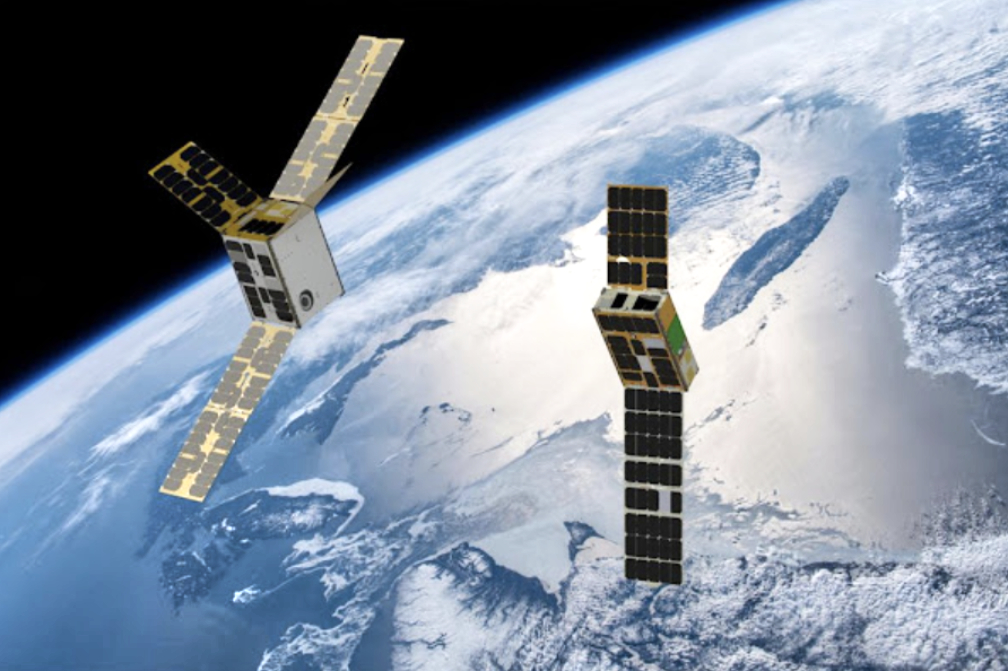
British satellite company Open Cosmos is preparing an ambitious low-Earth-orbit communications network intended to provide Europe and allied governments with a secure alternative to foreign-controlled systems such as Elon Musk‘s Starlink and Chinese satellite networks. The company’s ConnectedCosmos project calls for more than 96 satellites in orbit by the end of 2028 and a foundational constellation of 192 satellites providing global coverage by 2030, with room for significant expansion. The satellites will operate at roughly 1,050 kilometers, or about 650 miles, above Earth and use optical inter-satellite links to move information through space while reducing dependence on vulnerable terrestrial infrastructure and subsea cables. Open Cosmos has secured valuable Ka-band spectrum rights through Liechtenstein and recently raised €300 million to expand manufacturing and its satellite intelligence and communications businesses. Unlike Starlink’s predominantly mass-market broadband model, ConnectedCosmos is primarily aimed at governments, institutions and commercial customers requiring sovereign communications, emergency connectivity, infrastructure monitoring and secure transmission of sensitive data.
Key Takeaways
- Open Cosmos plans more than 96 ConnectedCosmos satellites by the end of 2028 and a core network of 192 satellites by 2030, creating a European-controlled global communications system designed primarily for government, institutional and commercial users.
- The network is being designed around security and strategic independence, using inter-satellite optical links to move data without relying as heavily on ground stations, international subsea cables or communications infrastructure potentially controlled or disrupted by foreign powers.
- Open Cosmos has raised €300 million to accelerate satellite manufacturing and deployment, possesses Ka-band spectrum rights capable of supporting a substantially larger constellation, and says its European factories can collectively manufacture satellites at a rate sufficient to support rapid expansion.
In-Depth
Europe’s effort to reduce its dependence on foreign space infrastructure is beginning to produce serious private-sector challengers. Open Cosmos plans to build ConnectedCosmos around 192 low-Earth-orbit satellites by 2030, establishing a communications network aimed principally at governments, institutions and businesses rather than competing directly for every household broadband customer.
That distinction matters. Starlink demonstrated the extraordinary strategic value of satellite communications, particularly when terrestrial networks are unavailable, damaged or politically vulnerable. But European governments increasingly recognize that depending upon infrastructure controlled outside their jurisdictions can itself become a strategic weakness.
ConnectedCosmos is designed around sovereignty and resilience. Optical links will allow satellites to route information between one another in space, reducing reliance on vulnerable subsea cables and terrestrial ground stations. The system is also intended to integrate communications with Open Cosmos’ Earth-observation capabilities, allowing information gathered from orbit to reach governments and other customers rapidly.
The company intends to have more than 96 satellites operating by the end of 2028 and achieve global coverage with 192 by 2030. Its recently completed €300 million financing round provides substantial capital for manufacturing and deployment.
The difficult part will be execution. Building satellites is only one component of a constellation; securing sufficient launches remains a major constraint, and SpaceX itself controls enormous launch capacity.
Still, the strategic logic is compelling. Western governments cannot demand technological sovereignty while remaining permanently dependent upon a handful of foreign or privately controlled networks. Competition in satellite communications strengthens resilience, encourages innovation and gives governments alternatives when communications become matters of national security rather than simple commercial convenience.
Sources
- https://www.thetimes.com/business/technology/article/open-cosmos-launch-satellite-internet-network-rival-starlink-00xxhj8h2
- https://www.satellitetoday.com/connectivity/2026/10/05/open-cosmos-targets-192-satellites-for-connectedcosmos-leo-constellation/
- https://www.spaceintelreport.com/open-cosmos-50-satellites-are-completed-for-our-broadband-constellation-1st-6-launch-this-year-96-by-end-2028/
- https://www.telecompaper.com/news/open-cosmos-targets-full-coverage-in-government-grade-leo-service-by-2030–1584640
- https://www.globenewswire.com/news-release/2026/09/14/3361170/0/en/open-cosmos-raises-300-million-to-accelerate-real-time-intelligence-and-connectivity-from-space.html